Analysis: Youth Task Force Presents Daunting Challenges but Energizing Solutions

By Kathryn B. Creedy

15-minute read

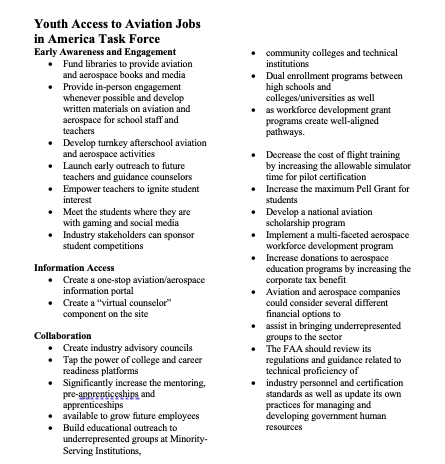
Recommendations include:

  • Massive increase in funding for education and aviation/aerospace career promotion and education
  • Recommendations on a variety of funding mechanisms including user fees
  • K-12 content creation for libraries, parents, teachers, guidance counselors
  • Development of aviation-related games and social media
  • Launching aviation/aerospace promotion programs as early as possible
  • Single website for all aviation/aerospace related resources and information
  • Dual enrollment programs for simultaneous high school and college
  • Stackable credentialling
  • Mentoring and career coaching from school through career
  • Education reform to address affordability
  • Professional development to teach the teachers about aviation/aerospace careers
  • National and regional advisory committees to develop and oversee efforts
  • Congressional action to raising funding to nationwide effort
  • FAA regulatory reform of aviation-related training programs
  • Industry cultural reform

The Youth Access to Aviation Jobs in America Task Force (YIATF) set out the herculean tasks needed to turn the great recommendations from its just released report into reality. Reading the YIATF report is as daunting as it is hopeful, but no one said this “moon shot” would be easy.

Yes we can. Women in aviation & aerospace are latter day Rosie the Riverters.

But to get recommendations done will mean industry reform as well since it is one of the biggest obstacles. Industry has called for workforce development programs for years usually pointing at someone else to do the heavy lifting. It, however, must understand we cannot rely on “someone else,” but must gather our forces to what needs to be done ourselves. With its many recommendations, industry must now take up the gauntlet because we know we can do it. All we need is organization.

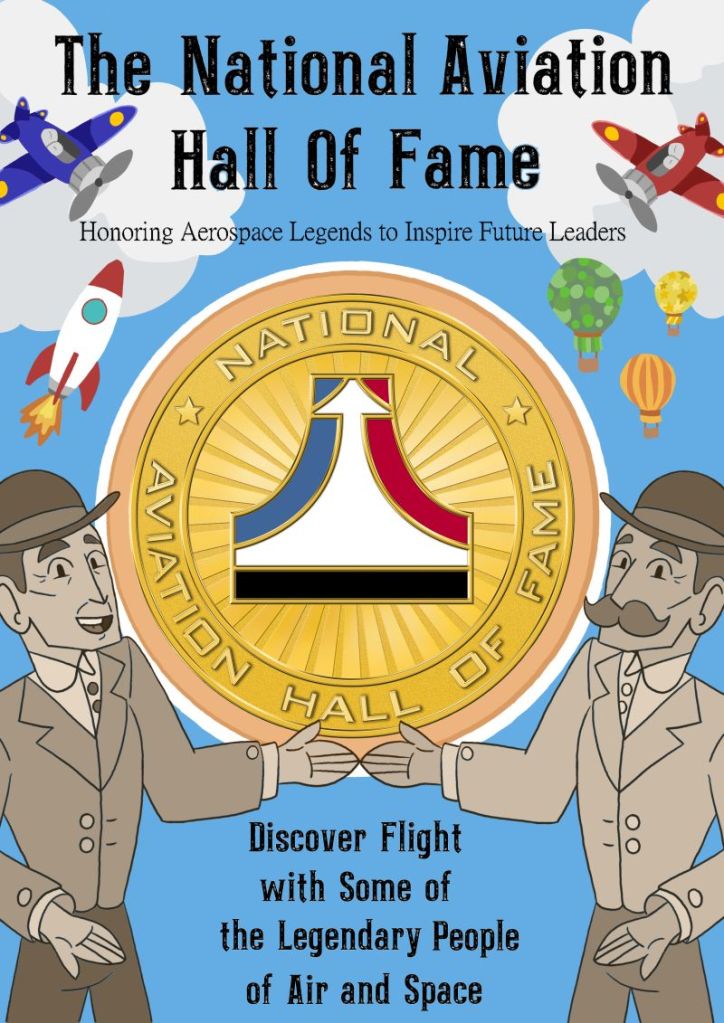
Private interests from all parts of the industry haven’t waited to create great programs to introduce youngsters to aviation and aerospace, each one recognizing the crisis and asking themselves “what can I do.” The results are incredible and include the National Aviation’s Hall of Fame Learning with Orville and Wilbur done in partnership with PBS and ThinkTV. Industry must have its own political will to do the same.

Task Force Chair Sharon DiVivo acknowledged the difficulties ahead.

“We are not going to solve the workforce shortage by continuing to attract the same people to aviation and aerospace,” she told Future Aviation/Aerospace Workforce (FAAW) News. “The answer to solving this problem is attracting and retaining underrepresented populations. This Task Force has provided a roadmap of action that can change the workforce trajectory for our industry now and over the next 20 years. Some of the suggestions we make are doable now such as creating regional and a national advisory council that allow us to collaborate and define activities and pathways to training, higher education and a career. We know that some of the suggestions we made around financially supporting individuals and organizations, a significant barrier to entry, will take industry leadership and Congressional will to change the outcome for the employees of the future.”

The Plan

Recommendations are at once simple and complex. In a nutshell, the Task Force cited a need for content creation for parents, teachers, guidance counselors, libraries and a one-stop, comprehensive industry internet platform for aviation careers and pathways which connects the dots to education and funding. It also called for the creation of aviation-related gaming and social media and a youth advisory committee well-versed in social media influencers and gamers advising on game developers who could fund and develop aviation-and-aerospace, skill-building games. Indeed, we should take a lesson from the military which has long had this recruitment strategy.

“Creating a virtual world that is helpful in all aspects of aviation and aerospace,” the report said, “and connecting industry, schools/training/higher education, organizations, social media influencers, gamers and employment platforms provides families and educators with the information needed to learn more, and intentionally become members of the aviation and aerospace workforce.”

As important, would be a committee on how to achieve a steady stream of education funding which is now so time-consuming and costly. We rely on student loans, Pell Grants and the cumbersome application process for scholarships and federal aid.

At the very least we should be creating a single scholarship application or, better yet, a digital program matching deserving students with scholarships upon school application.

The Task Force recommended expanding dual enrollment programs so students earn college credits while still in high school, popular with students and parents for defraying rising college costs.

It promoted certifications as a strategy to do the same thing. Gaining aviation-related certifications puts high school graduates into a job where they can leverage corporate higher education benefits to gain a college education. Coupled with this, companies must create corporate pathways for rank-and-file employees to pursue degrees as well as mentoring and coaching programs to ensure success.

To that end, the Task Force recommended working with other industry credentialing agencies to develop high-quality, skill certification programs to achieve stackable credentialing programs starting in high school. They would count toward science and math requirements and lead to credit toward the airframe, powerplant or general certificates for aviation maintenance technicians, uncrewed aerial systems (UAS), flight dispatch and other industry recognized credentials.

The Task Force recommended creating mentoring and coaching programs for students and those already in their careers; important for increasing the diversity of the executive suite. Many organizations such as the Aviation Collective already have such programs but connecting students and employees to them on the Task Force’s digital platform makes them more effective.

Building on Current Programs

As FAAW News reported, few realize educators, states, industry associations, manufacturers, aviation museums, corporations, aviation/aerospace technology corridors and individuals have already developed sophisticated curricula, training and workforce development programs that have exposed millions to manufacturing and aviation/aerospace careers. Just the other day the Girl Scouts, which has long had aviation-related badges, announced a new Aerospace Adventure program in Oklahoma, one of our most aviation education minded states. However, serious reform is needed to accommodate new education delivery methods and emerging technology as the Task Force discusses.

Aviation/Aerospace career programs have never been more accessible given the hundreds of programs listed in FAAW News’s Resources for the Promotion of Aviation/Aerospace Careers as well as its Using the Calendar to Promote Aviation/Aerospace Careers, both free online. In addition, The National Air Traffic Controllers Association (NATCA), and others, such as Aviatrix Book Review, have created comprehensive lists of aviation/aerospace related books and activities from pre-school to adults. But this work is a tiny tip of the iceberg compared to the Task Force’s energizing vision.

Infrastructure

Creating the infrastructure to make its vision happen presents a more towering challenge. The Task Force depends on Congressional and Federal Aviation Administration action. That’s a problem since they are known for either dysfunctionality or, in the case of the FAA, its own workforce shortages, the loss of experienced regulators and its stunned reaction to the 737-MAX debacle and the pandemic. This has frozen much of its work in place even as industry regulatory needs increase, according to growing industry complaints.

However, should the industry act on its own to form a coalition, it can accomplish what individual organizations have not been able to do – end what the task force calls a “20-year stretch of unprecedented need for qualified employees and a pipeline of young people who either do not know what we have to offer or perceive that the costs of pursuing a career are simply out of reach.”

Indeed, it recommended a broad-based coalition of industry, government, nonprofits and educators. Industry has long resisted such a coalition in favor of promoting their own needs so it will be another challenge to get them to act as one on a crisis everyone shares. However, the fact those interests gathered in the Task Force to develop the ideas necessary to finally solve our workforce problem, is reason for hope.   

Source: Laurel & Michael Evans via Unsplash

A National Advisory Council was recommended by the Task Force under the auspices of FAA’s Aviation and Space Education Program (AVSED) program and supported by regional councils in FAA’s nine regions. The councils would encompass regional stakeholders including airports, airlines, repair stations, business aviation and museums. It would also bring non-profit organizations such as scouting and youth clubs to the table along with education/training providers that includes high schools, colleges and universities, especially minority-serving institutions. Meanwhile, the National Advisory Council would monitor regional efforts, provide information about best practices, design metrics of success and a model for continuous improvement.

Considering this was a FAA committee that makes sense especially since its infrastructure is in place. However, the question remains whether the agency has the energy, staff and innovation necessary for the challenge, whether it will elevate and fund aviation promotion and education from its backwater and whether a government bureaucracy is the best solution at a time when regulatory needs are so great including the regulatory reform called for by the Task Force. We certainly know it does not have the budget and Congress loves unfunded mandates.

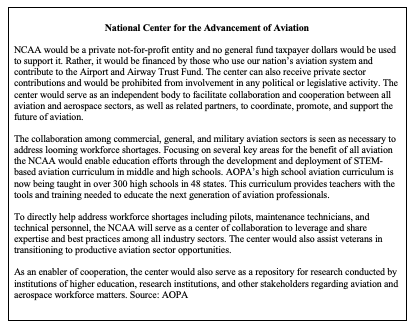
A good place to start is the nearly 200 organizations across the industry that urged Congressional creation of the National Center for the Advancement of Aviation (NCAA) – as long as they can check their parochial interests in the baggage compartment.

The risk if we can’t? “Choosing to do nothing will perpetuate the crisis and keep us from reaching new heights with a diverse workforce that will drive innovation and transformation,” DeVivo, who is also president of Vaughn College of Aeronautics & Technology, concluded.

Funding

The task force referenced NCAA. H.R. 3482 – the legislation creating the entity – was passed 369 to 56 by the House on Thursday reflecting its popularity but companion legislation – Senate S.1752 – languishes in the ever-growing morass of bills and the ever-shrinking opportunities for bicameral agreement.

But it provides significant hope the industry, which has worked hard to reduce fees and blocked any efforts to raise the passenger facility charge, supported this legislation given its reliance on more user fees or diverting money from the Airport and Airway Trust Fund. Perhaps that is why the Task Force embraced user fees.

It recommended several options for Congressional consideration including establishing a separate fund or redirecting funds within the Airport and Airway Trust Fund using 0.75% specifically to pay for scholarships for aviation and aerospace education and flight training or a $0.10 fee on all commercial US-sold airline tickets that would be used to support building the talent pipeline with scholarships.

The Task Force targeted landing fees, suggesting they be increased to fund scholarships for education and training programs and recommended increasing the Workforce Development Grants from the current $10 million to $50 or $100 million, $50 million of which would create a National Aviation Scholarship Fund.

It also suggested developing corporate incentives using DOT and DOD contracting processes making those that address workforce solutions more competitive. While this would require Congressional action and revising contracts, it calls for 0.25% of all DOD and DOT aviation and aerospace contracts to address aerospace education programs.

The funding available using this approach would be $512.5 million per year based on contracts awarded in 2019, the Task Force estimated. It also proposes increasing to 35% the current 25% tax incentive for donating to nonprofits, noting annual corporate donations to nonprofits reached $20.7 billion including $2.9 billion for overall education.

Having users and industry pay for what needs to be done, begs the question of why we should launder money through Washington since we know it is difficult to claw it out of Congressional hands once it is there.

Aviation and aerospace companies are already investing millions in attracting workforce. Nonprofits are too. The question is whether we can establish how much is already being spent and how much business goes unfulfilled for lack of workforce – in the MRO industry, alone, it is estimated at $1.4 billion. Then we need to calculate the cost of Task Force programs and see if we can raise more.  

Aviation industry associations should poll members to determine this information and identify personnel that can make up the recommended regional advisory committees.

Student Debt

The Task Force called for us to rethink educational affordability, a critical need throughout society. That will mean higher education must address its cost. Since the baby boomers, facilities have exploded into resort-style campuses. Meanwhile, faculty salaries are still shockingly small compared to the value they provide, according to surveys by the University Aviation Association. Critics are right concluding forgiving student debt – as important as that is – does not address this challenge facing students and their families.

But beyond that, the Task Force found loans are now perceived negatively. Headlines over the past 20 years rightfully depict loans as a life-long burden preventing workers from pursuing such fundamental milestones as having a family and buying a house. Other headlines describe the mismanagement of forgiveness programs for public service jobs as well as how student loans have worked against economic success enjoyed by previous generations.

Consequently, said the Task Force, students, especially those from low socioeconomic backgrounds, view the debt-level required and, reluctant to take it on, simply choose a different field.

The double-edged funding solution must first convince those who discover aviation that it is not only doable but affordable and second, develop the funding needed to realize the Task Force recommendations in the first place. For instance, it cited the health care industry provision of monthly cash education benefits to repay student loans.

“Funding is the number one obstacle,” said the report. “Existing funding is not enough to cover all the costs for a student. There is a significant gap between what is funded and what is needed…With additional funding they could close the gap and help more students make it into aviation careers.”

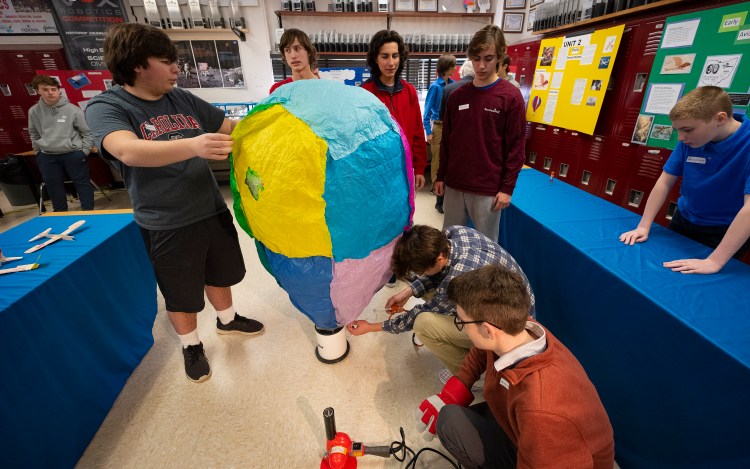
A lot of hot air. Hereford High’s AOPA You Can Fly Program. Credit: AOPA

The Task Force recommended providing expense stipends to enable students to focus on education and training. This would be coupled with other pathway/financial incentives such as scholarships, internships and apprenticeships.

“By lowering the overall debt load for the neediest students, we can provide a lifetime career path with incredible opportunities, as well as another way to drive diversity in the workforce, thus creating more awareness in underrepresented groups,” the report continued. “This could result in a ‘snowball effect’ with a long-term solution for solving the personnel shortage and the lack of diversity in our industry and entails both providing individual financial support to pursue training and education, as well as creating a sustainable funding model for organizations.

That snowball effect is important. DeVivo testified before Congress years ago by focusing on the underprivileged and underrepresented, we transform the trajectory of entire families. Similarly, with the rise of career and technical education (CTE) we can transform local economies. For instance, the creation of new aviation maintenance and flight schools such as newly established programs in West Virginia as well as state emphasis on CTE, coupled with re-shoring initiatives such as that Utah is creating, provides an opportunity to bring local rust belt and fossil fuel economies into the 21st Century.

Educating the Educators

The Task Force offers a ton of great ideas building on the hundreds of programs already working to promote aviation and aerospace careers to youngsters. It also resists reinventing the wheel yet again. Indeed, the report links to those who have already invented the wheel for guidance in how to create similar programs in aviation.

It also links to the effective online and in-class curriculum and teacher continuing education programs such as the AOPA, FedEx, Boeing STEM Symposium set for November and Choose Aerospace Teacher Aviation Maintenance Curriculum National Air and Space Museum’s Teacher Innovator Institute, Teachers Air Camp and Civil Air Patrol’s Teacher Orientation Program Flights. AOPA’s High School program includes teacher flight training.

Its survey of teachers and guidance counselors showed 65% had basic-to-no knowledge of the various aviation careers. And 72% of respondents had basic-to-no knowledge of available aviation and aerospace career resources. That is on top of the 95% of students with no family connection to aviation/aerospace. Thus, the reason for creating digital content in a one-stop shop as well as the creation of by-region aviation/aerospace professional speakers bureau for classrooms. Other recommendations from educators include career days, job fairs and visits from local colleges and vocational schools.”

Task Force surveys report 80% of teachers would attend, especially if Continuing Education Unit (CEU) credits were available. In addition to developing CEU programs, the task force recommended creating connections between K-12 teachers and aviation colleges and universities, state and local aviation and education agencies, aviation museums, airports, aerospace manufacturing facilities and flight training schools.

High School is Too Late

A key conclusion, the 21-member Task Force found was, as suspected, waiting until high school is too late, recommending education start by age 10, and again reinforcing the message at late high school when students are turning interests into career ambitions.

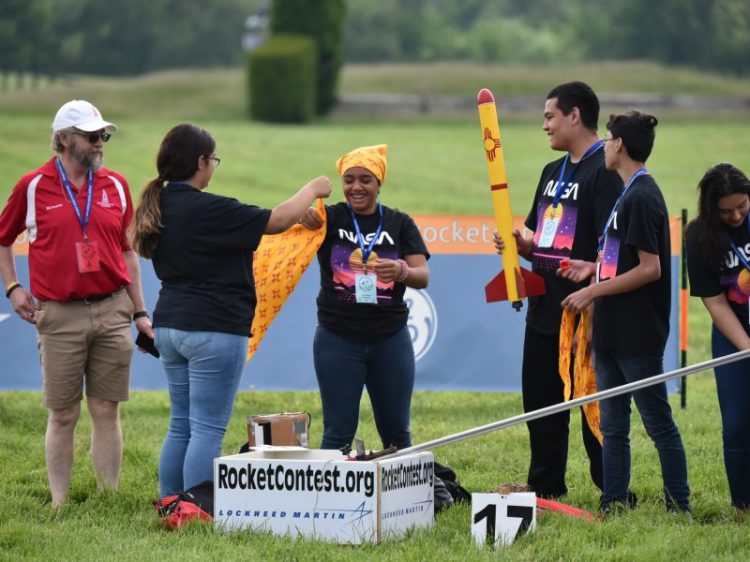
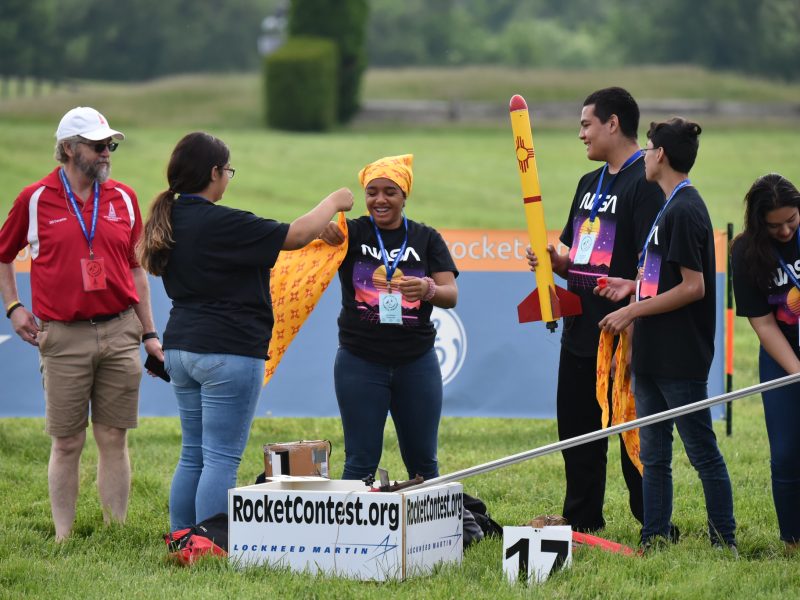
The Task Force suggested the industry sponsor aviation/aerospace related gaming competitions to build on current aviation/aerospace competitions such as American Rocketry Challenge, Aerospace Maintenance Competition, NASAO’s Youth Aviation Art Contest and The Dee Howard Foundation Aviation & Aerospace Art Contest as well as General Aircraft Manufacturers Association’s (GAMA) Aviation Design Challenge, Vertical Flight Society’s Annual Student Design Competition and the National Intercollegiate Flying Association (NIFA) pilot skill events. In addition, it cited the models from business aviation and MRO communities creating special student tracks during their annual conferences. Here again, however, we need funding to would pay travel costs to attend.

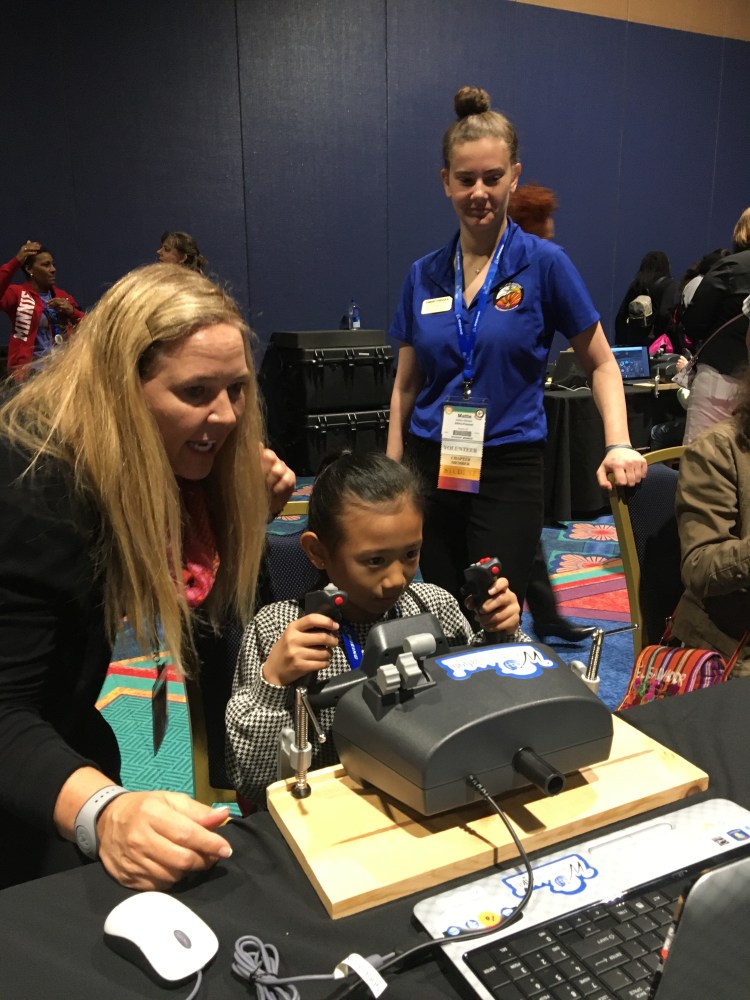
It is never to early to introduce kids to aviation and Women in Aviation makes that a reality at its Girls in Aviation Day during its annual conference. Credit: Kathryn B. Creedy

Also recommended was creation of aviation/aerospace-related afterschool programs modeled on 4H and National Future Farmers of America (FFA). The report noted more than 10 million children are enrolled in after-school programs annually with another 25 million on waiting lists.

“After-school programs are not only effective at reducing the numbers of at-risk youth, but are key programs in workforce development pipelines,” said the Task Force. “There is already federal funding for what is known as 21st Century Community Learning Centers [along with] state funding.” The Task Force would also like to see expansion of the FAA Aviation Career Education (ACE) Academy through industry partnerships targeting K-12 students and providing a range of aviation career exploration and STEM experiences.

In addition, the Task Force recommended the creation of “virtual counselors” to guide aspiring aviation professionals through their education and careers citing the work of the Institute for Electrical and Electronic Engineers (IEEE) offering pre-university resources for volunteers and teachers around the globe. It also cited Choose Aerospace Alliance for Aviation Across America and Utah Rotor Pathways, the latter of which gathers high schools and universities to provide helicopter pilot and maintenance training in high school.

The airline industry recently began focusing on Historically Black College and Universities as well as Hispanic-Serving colleges and has increased focus on affiliate groups such as Organization of Black Aerospace Professionals, Gay Pilots Association, Latino Pilots Association, Women in Aviation-International (WAI) among others.

The task force recommended expanding that outreach to partnering with National Society of Black Engineers (NSBE), Society of Hispanic Professional Engineers (SHPE), Society of Women Engineers (SWE) and leveraging their local chapters along with those at EAA, AOPA and Civil Air Patrol. The Task Force also recommended working with the hundreds of aviation/space museums around the country to develop programing for parents, students and educators.

Regulatory Reform

The report would be incomplete without a discussion of regulatory reform, especially since government training regulations haven’t changed in 50 years with the singular exception of aviation maintenance.

It recommended review of government regulations, to ensure certification standards are performance-based, something aviation safety experts and airline training professionals have advocated for years. It recommended adapting regulations to allow for skill development and adaptability to new resources and technologies.

But for pilots this, too, is controversial given Air Line Pilots Association steadfast refusal to consider any changes in commercial airline pilot requirements despite the fact regulations actually encourages changes. But this is a lesson for the union – if you can’t be helpful then get out of the way.

Revealingly, like many aviation safety organizations, the Task Force recommended more flight simulation and virtual reality to improve training and ensure more proficiency and competency, a move opposed by unions but favored by aviation safety and training professionals. ALPA has long opposed switching to something widely accepted in the rest of the world – the multicrew pilots license – citing its reliance on simulation. ALPA’s opposition is shocking given the fact that simulators were first created to save pilots lives lost to dangerous inflight maneuvers and the wide-spread recognition that simulators are a key safety tool.  

Other recommendations included the creation of Job Corp and Jobs of the Future Programs for aviation/aerospace.

Task Force Targets Culture

“If we want to retain individuals from underrepresented backgrounds, the industry must not only be committed to outreach and hiring, but also to creating equitable environments so that these same individuals feel psychologically safe and valued as members of the team. This is not a problem that can be solved overnight, and companies need courageous conversations, examinations of policies with a new educated lens, and an ongoing training and education program that allow everyone to learn, make mistakes and move forward. Most importantly, we all need to be accountable and responsible for making change happen by setting measurable goals, publishing our data, sharing our learnings and never stopping the work.”

Future Aviation/Aerospace News, in its Women in Aviation, Aerospace & Defense, cited several studies showing women lag in taking on substantial C-Suite rolls and account for only account for 15% of the 600 positions surveyed by Flightglobal.  

The Women in Aviation Advisory Board (WIAAB) concluded culture is a major problem. It also begs the question as to what, if anything, industry is doing about it beyond rhetoric. For instance, Southwest Airlines is noted for the number of women executives but women from the ops department talk about toxic masculinity. We can recruit women and minorities all we want but if they slam up against the same problems current employees face with discrimination, harassment and toxic workplaces we won’t retain them.

Credit: Mark Stenglein Upsplash

To that end, the Task Force cited a more expansive definition of diversity, a metric to be adopted by anyone wishing to make the rhetoric the industry espouses today meaningful. It quoted Secretary of Defense Lloyd Austin who said at a White House Diversity Roundtable in February 2022 said: “I equate diversity with being invited to the dance. Inclusion is actually being asked to dance.”

But the Task Force also cited Dr. Menah Pratt-Clarke, vice president for strategic affairs and diversity and diversity professor of education at Virginia Tech who went further saying: “…belonging is being able to dance to the music that is representative of your background heritage. What those who are on the outside of the dance decision-making team really want is equity. They want to be part of the planning committee, co-selecting the music, co-selecting decorations, not having to wait to be asked to dance… It’s about changing the system and the way in which the dance decision-making process operates. It’s about restructuring practices, procedures, policies, and politics, to create a system that is more wonderful for everyone.”

My conclusion is the same as it was for the landmark WIAAB report. It would be a tragedy for every stakeholder if these initiatives are not realized. YIATF makes clear much of what is needed is already happening and it’s a matter of communicating these resources to parents, educators and kids. Yes, there is much work ahead on content creation, regulatory reform and infrastructure development, but we must ask ourselves whether we can put aside parochial interests and forge the leadership necessary to take the great ideas within the two task force reports and make them happen. The answer must be yes.

Analysis: Republic Pilot Training Proposal Deserves Thorough Hearing

By Kathryn B. Creedy

Editor’s Note: In an effort to independently determine the requirements of the of the Pilot Certification and Qualification Requirements for Air Carrier Operations and the Airline Safety & FAA Extension Act (Public Law No: 111-216 (08/01/2010) and whether the negative reactions to Republic’s proposal are justified, I reviewed the following:

Findings:

One final question: Does the law or regulation prevent the development of alternate pathways? No, in fact, they encourage it precisely because pilot training should be continuously improved based on new data and technology.

The opposition, by rejecting the Republic petition out of hand, is also rejecting all the aviation rulemaking and safety research and expertise that developed the rule.

Upsplash

Petition Shouldn’t Even Be Controversial

When unions opposed the Republic petition to the FAA to develop an alternative pathway for gaining a Restricted-ATP (R-ATP), it was clear they hadn’t read the petition.

In fact, thorough research reveals, perhaps, for the first time in history, we have a pathway that improves pilot quality, and, for that reason, the petition deserves thorough consideration by both FAA and legislators.

Common sense tells us a company would not invest $30 million to diminish safety or to produce poorer pilots. Common sense also tells us we should never be satisfied with yesterday’s training if adopting widely accepted techniques creates higher quality pilots. We know from ARC reports past training did not produce the quality of pilot we want, and regulations changed but should not stop there.

It’s been nearly a decade since those regulations and we should be demanding a review, given how technology has changed. We also know the loss of skills, discipline and professionalism while building hours seriously undermines safety, according to analysis by Flight Safety Foundation and the Pilot Source Studies. To its credit, the industry significantly increased training to counteract this deterioration but all these factors deserve independent consideration because it could become a template for higher-quality pilots.

Following the Law

To date conversations and solutions surrounding pilot qualifications have been limited to an arbitrary set of hours, the pilot shortage and training costs which is excruciatingly simplistic and counterproductive. Indeed, opposition has misled regulators, legislators and the public while forestalling genuine improvements pilot quality.

The petition was viewed through the lens of airline training experts and international safety authorities who have defined the widely accepted pathway to produce a high-quality pilot. Balancing that is safety experts who have no agenda aside from developing safer pilots including the National Transportation Safety Board, Flight Safety Foundation and training professionals extolling evidence/competency-based training for the Royal Aeronautical Society (RAeS).

The opposition charged Republic is trying to “circumvent the clear intent of the law.” That simply is not true. Their position rejects the already accepted logic of providing credits for university aviation programs and the military as well as the widely accepted belief that any changes to pilot training should be based on data.

This is no end-run as opposition suggests.

Republic’s petition capitalizes on the regulatory invitation for proposals to develop alternative pathways specifically designed to improve pilot training and develop safer, more qualified pilots.

In its rule, FAA noted “the importance of an aviation curriculum permitting a reduction of hours” as long as it incorporates “aviation coursework above and beyond what is required for pilot certification.” Indeed, Republic’s program is defined by what FAA and industry have already considered and accepted.

Republic’s petition also takes FAA at its word that developing a program going above and beyond pilot certification requirements is worthy of consideration.

The question then becomes is there a way to make better pilots. For the US military the answer is yes, it can train better pilots before giving them hundreds of millions of dollars in high-performance jets to fly. This is important because supervised training methodology of the US Air Force is granted 750 hours credit and is the genesis of Republic’s R-ATP petition when it was revealed by then Air Force Secretary Heather Wilson five years ago.

The First Officer Qualifications Aviation Rulemaking Committee Report researched the best pilot training and its recommendations outline the specific training requiring mastery before certificating a commercial airline, transport category pilot. It went so far as to identify the training that can be accomplished in a simulator/flight training device cautioning that its recommendations for non-aircraft training were in the interest of safety. This is important because ALPA has, astonishingly, rejected sim time in the past. Those recommendations became part of the rule and is incorporated in Republic’s 46-month training and, based on its petition, seems more stringent than what the military has done.

Regulators have already answered the question as to whether a closed-loop, highly structured, advanced training curriculum provides the same level of proficiency as traditional training.

The next question is whether a civilian, airline-specific, mission-driven version should be awarded credit similar the already approved military R-ATP pathway at 750 hours. Republic’s data indicates a higher level of proficiency than those trained in the military or outside of LIFT but that is for the FAA and other safety experts to validate.

But, and this is extremely important, any acceptance of credit hours must come with continuous, data-based analysis to ensure continued competency of a pilot once they join the line as Republic does.

Silly Argument

It is disingenuous of opposition to forward what I think is a silly argument – its insistence that since the law was imposed there have been no accidents – as the opposition does. That is also overly simplistic and ignores the complexity of the interlocking mechanisms that make up the aviation safety ecosystem. It suggests it was only increased hours that did the trick, not other causal factors such as industry-wide safety improvements including safety management systems and more reliable equipment and technology, according to Legal Adviser and JDA Journal Editor Sandy Murdock, who added any statistician will tell you correlation does not equal causation.

But, hey, I’m happy to use that argument to suggest this is a different industry since Colgan and old stereotypes no longer apply. It’s a great argument for suggesting the opposition’s view of the industry is outdated.

Opposition’s response to any pilot quality discussions to hours. For that reason, it is important to revisit this tedious, distracting subject.

I’ve often wondered why ALPA was so stingy on its requirements. Why 1500 hours? The union says experience makes better pilots, but the Colgan accident proved that wrong.

Murdock noted the captain had 3,379 hours of total flying time, including 3,051 hours in turbine airplanes, 1,030 hours as a pilot-in-command (PIC). The first officer had 2,244 hours of total flying time, including 774 hours in turbine airplanes. So, if ALPA wanted a better pilot based on the Colgan accident, why didn’t it choose 3500 hours or even 2500 hours?

The FAA’s and National Transportation Safety Board’s opposition to an arbitrary hourly requirement prompted my suspicion of the legislation and its actual intent which I detailed in a five-part Forbes series.

My suspicion grew because, despite the characterization that 1500-hours is desperately needed for safety, no other safety regulator rushed to copy the FAA. This is ironic since foreign carrier and regional pilots fly into US airspace without a question about their safety or anything to prove they are less safe such as accidents.

Suspicions prompted attendance at the World Airline Training Summit for years to find out what is needed in pilot training and competency. I happily returning to its halls this year where I realized that, while there is a lot of talk about improving training, progress is slow. We always seem to be on the cusp of adopting evidence/competency-based (EBT/CBT) training but never get there despite the fact it’s accepted around the world.  News flash, it’s not the hours, it is the quality of the training and the quality of the airline-oriented experience in time building.

Do Your Homework

The fact is pilots supporting the 1500 hours have not done their homework and know they are on shaky ground when it comes to debating. Indeed, they don’t debate at all.

Many mainline pilots and airline trainers tell me the key to increasing pilot quality is selection which today is little more than a credit card. In addition to stringent selection and testing, experts suggest constant data-based monitoring of the pilot throughout training and into operations is important to establish competency. Republic has both.

During 40 years covering the aviation industry, the entire industry turned to data analysis to successfully increase safety and is why experts are turning to data to judge the competency of trainees.

In rejecting this data paradigm, opposition wants us to rely on hours, saying any proposal to do otherwise is tampering with the 2010 law and consequent regulation requiring 1500 hours.

Research reveals the Republic Airways Restricted Air Transport Pilot (R-ATP) Program is very much in line with the ARCs’ recommendations, regulations and the general trend of aviation training professionals to move toward more data-driven evidence of not only pilot proficiency but competency. It also reveals there is near universal agreement on what it takes to make a safe, quality airline pilot. Republic’s petition details the many steps a candidate must accomplish during their R-ATP training which mirrors what is required in the pilot certification rule.

No One Suggesting Elimination of 1500-hour rule

It is well known that any discussion of eliminating the 1500-hour rule is a non-starter so the regional industry and Republic gave up on eliminating the 1500-hour rule. The Regional Airline Association stated that emphatically in numerous interviews and Republic Airways reiterated that during a media briefing, saying its proposal was not a reduction in the 1500-hour rule but works within the existing published 1500-hour rule alternatives. It merely wants credit for a highly structured training program for which the military is already receiving credit.

Nor did Republic develop its program in a vacuum. It conferred with both the military and FAA for feedback to improve its program. It also conferred with its pilots and its safety committee along with partners American, Delta and United, for which it flies.

The question is whether the FAA and legislators are serious about recognizing modernized training programs that improve safety, making way for new pathway programs to address the training gridlock we have today. Or, will the opposition continue to stand in the way of pilot training improvements.

Republic was gutsy enough to take the 2010 law and FAA at its word taking five years and $30 million to create LIFT Academy and gather the data necessary to prove its training delivers better pilots.

Changes Needed to Pilot Training

Mindless opposition suggests pilot training should be static and never change. No one believes that. Pilot training has come a long way in the last decade especially with new training technology and immediate data analysis and assessments improving pilot competency. The industry would be irresponsible if it didn’t insist on continuous changes, based on data analysis and safety, not on some gut feeling, politics and emotions.

Data from LIFT indicates a superior result, but it is up to safety experts and the FAA to validate its conclusions.

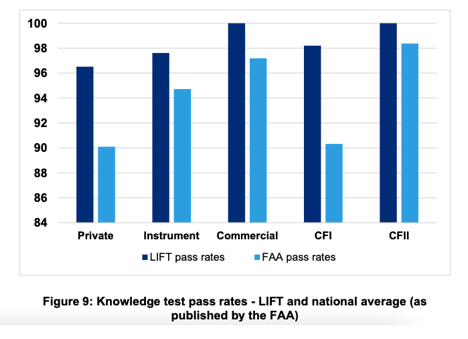
In its petition, it stated historical data suggests LIFT students going through Republic R-ATP meet or exceed the level of safety of the military R-ATP. Historical first time and total pass rates for LIFT students on DPE check rides are above the national average or well above the national average.

Source: Republic Airways Restricted Air Transport Pilot (R-ATP) Program

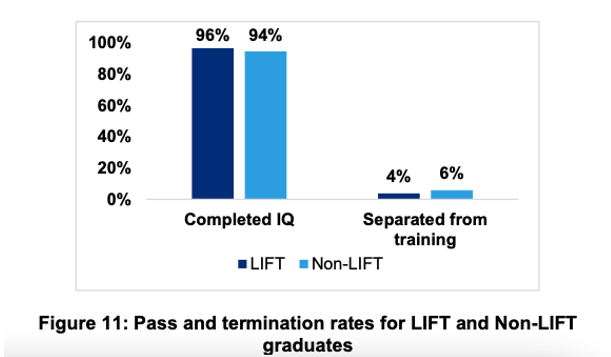
Using AQP line performance data, Republic also compared LIFT graduates with non-LIFT graduates with data showing they out-performed non-LIFT pilots. LIFT Academy graduates consistently exceeded safety standards in line performance, qualification and continuing qualification training.

Improving Training

Training experts want to see a regime based on data proving pilot competency is so good they will do the correct things in scenario-based training every time, not just during the check ride. The quality of a pilot should never be judged on one subjective pass-or-fail test because we’ve seen too many pilots passed along with disastrous results leading to accidents at American Eagle, Colgan, Continental and Atlas.

Indeed, that is why we have the Pilot Records Database, perhaps the most important aviation safety advance to come out of the 2009 Colgan accident. This despite the fact it took nearly three decades since it was first recommended by the NTSB and more than a decade since the 2010 legislation to be turned into an actual rule all while we’ve been arguing over how many hours it takes to make a pilot. It relies on data, but a robust process is, sadly, still in the making.

Training experts just want an objective measure of student performance rather than judging pilot quality solely on the subjectivity of an instructor. We need both. This is so important, according to the WATS speakers, that airlines are tapping aircraft data streams to determine whether what is being taught on the ground and in the simulator is happening in the skies. After determining it is not, they revise training programs using data in the spirit of Safety Management Systems continuous improvement philosophy. All that is going into developing better training programs for higher quality pilots and really makes debates about pilot shortages and time building silly.

“With the perspective of more than 70 years spent focused on aviation safety–related research, education and advocacy, Flight Safety Foundation believes that a pragmatic, data-driven approach to pilot training is essential to the continued improvement of the industry’s safety performance,” said the organization in its 2018 position paper. “The industry needs to embrace, and national civil aviation authorities need to have the flexibility to adopt, competency- or evidence-based training methods that target real-world risk and ensure a progressive and satisfactory performance standard. It cannot be assumed that critical skills and knowledge will be obtained only through hours in the air.”

Shutterstock

In fact, Flight Safety Foundation indicated we are asking the wrong questions when it comes to pilot training. We should be asking whether what we are doing will achieve the levels of safety required to meet the growth demand. As thousands of flights are cancelled; as communities lose air service and as airlines scramble for schedule reliability, the clear answer is no.

FSF also asked whether we are using technology, data and experience to maximize training efficiency. Finally, it asked whether we can maintain a sustainable quantity and quality of pilots from our current approach. That answer is also no.

About Producing Better Pilots

Most conversations about pilots start and stop with whether or not there is a pilot shortage and I’ll admit I’ve been lured down that distracting rabbit hole. To be sure airports and airline revenues and growth are feeling the pinch on not having enough pilots, but I think that reducing the entire conversation to economics does a disservice to the serious topic at hand. Worse, the pressure put on pilots is prompting concerns about fatigue which may be compromising safety.

What matters to me is the efficiency and quality of airline pilot training and the blockade forestalling any meaningful aviation training reform, even if it produces better pilots.

While I’ll let the FAA decided on the value of the Republic petition, it seems an important opportunity to improve pilot training and create a boilerplate for other airline academies including those used by the major carriers.

The FAA should not dodge its responsibility because Republic has played by the rules and isn’t asking for anything that hasn’t been considered and granted before. To shirk its responsibility based on mindless opposition could keep us from improving pilot training.

What I can judge is the investment and work dedicated to this effort in solving a long-term, systemic problem is worthy of consideration. If you oppose Republic’s petition then I suggest you do your homework. I have.

Analysis: WIAAB Cites Culture as Driving Women from Aviation

By Kathryn B. Creedy

In its report, published Tuesday, the government’s Women in Aviation Advisory Board (WIAAB) cited culture as the biggest barrier to attracting and retaining women in the industry. While this may not be news, to have culture identified as the over-riding issue in keeping women at bay, may mean something will actually get done.

Source: Science in HD via Unsplash

However, it is unlikely government will make it happen since laws already exist against the bias, discrimination and sexual harassment cited in the report. As WIAAB reported, it is the leadership and the will to enforce those laws within a company, that will make the difference. For that reason, it is really up to women in aviation and members of WIAAB to act collectively to turn recommendations into action. We saw the impact of the “Me Too” movement on the rich and famous, but it has been largely ineffective for the average woman in the workplace as experienced by women who are forced to sue employers for bias, discrimination and sexual harassment.

The 84-page Breaking Barriers for Women in Aviation Flight Plan for the Future outlines recommendations beyond culture including recruitment, retention, advancement and further data gathering.

“Culture underlies most, if not all, of the recommendations” it said.

The Board’s many recommendations are a compilation of similar suggestions over the last decade. But if it can move the needle by changing culture, the report will have done its job in eliminating gender biases, discrimination and sexual harassment including, shockingly but unsurprisingly, FAA medical exams.

For instance, it called for a permanent advisory council – a Women in Aviation Advisory Committee – to promote long-term accountability and provide sustained focus across current and future administrations and industry. More importantly, it called for the establishment of an industry-wide independent reporting program for incidents of gender bias, discrimination, and sexual harassment. This must be more than a data-gathering exercise however, it must come with action against companies and government agencies who perpetuate the culture we have today.

“In addition to combating bullying, harassment, and discrimination, it is imperative leaders in government and industry take steps to proactively foster an environment of respect and professionalism,” the Board stated.

The importance of its findings and recommendations surrounding biases, discrimination and harassment cannot be understated especially since it puts solid evidence behind what many believe are just anecdotal reports of problems in the workplace. The report confirmed what too many women already know. Women are not supported in what some see as the “toxic masculinity” of the modern workplace. Complaints are met with retaliation when reporting bias or harassment. They are often ignored and forced to watch as perpetrators are rewarded and promoted and this is not unique to women. The conclusion of this growing number of women filing lawsuits against their aviation employers is the industry may talk a good game but it does not have your back.

Credit: Shutterstock

Ominously, more than half of women in the industry have considered leaving citing implicit bias, discrimination, lack of career opportunities and lack of work/life balance.

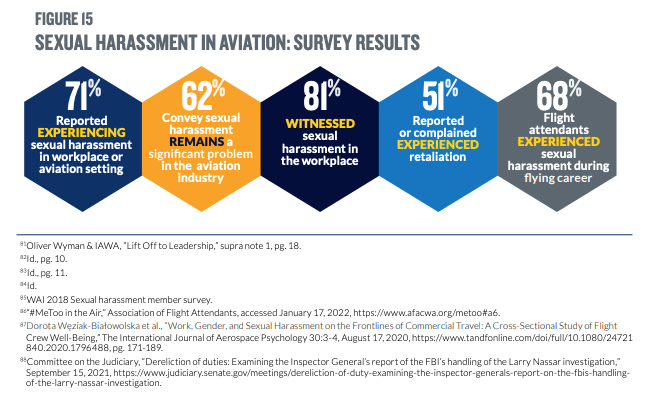
“Research confirms that gender bias, discrimination, and sexual harassment are significant issues in aviation,” the WIABB report said. “In a 2018 survey of Women in Aviation International (WAI) members, 62% of respondents indicated that sexual harassment remains a significant problem in the industry while 71% reported that they experienced sexual harassment in the workplace or another professional aviation setting. Some 81% reported having witnessed sexual harassment.

“Moreover, 51% of the women who had reported, complained about, or indicated they would not submit to the harassment, experienced retaliation,” reported WIAAB. “A survey by the Association of Flight Attendants found that 68% of the responding U.S. flight attendants experienced sexual harassment during their flying careers. Only 7% reported it; with concerns over retaliation and or inaction driving under reporting. A specific concern is under reported sexual abuse during FAA medical examinations. Examples of abuses include unwarranted breast and pelvic examinations, and skin checks requiring the removal of clothing. The impacts of these unacceptable violations of trust can be life-altering, as evidenced by the USA gymnastics team testimony on abuse during medical examinations.”

The Link to Safety

These findings are why two of the Board’s major recommendation, if developed, would go a long way in changing the status quo – the formation of a national reporting system and the recommendation the FAA incorporate bias, harassment, and discrimination awareness education, and allyship training in Safety Management Systems (SMS).

This recognizes the link between safety and an inclusive workplace, an argument well made by Captain Kimberly Perkins in her report on the subject. “We have an opportunity to enhance safety while simultaneously improving the industry’s workforce development strategies. Without addressing this systemic culture issue, the recruitment of any personnel other than the demographic majority will be mired.”

The Board agreed, citing a 2018 article by the Royal Aeronautical Society concluding, “Without an inclusive environment, there can be no guarantee of safety.”

I’m with her! It’s never too early to start a love of aviation.

The Board continued, saying, “Explicit and implicit gender discrimination, exclusive cultural norms, sexual harassment, and gender bias can all directly and negatively impact aviation safety. Bias can impact behaviors and decisions and undermine organizational culture. Conversely, belonging and inclusion build trust, which is fundamental to establishing and enhancing system safety. Psychological safety is ‘the amount of relational trust one feels in [their] environment.’ It includes being able to speak up, to address an error without fear of retribution, and to be one’s authentic self.”

No Surprise

It is no surprise that culture is the over-riding problem, since a study by Women in Aviation International, authored by WIAAB Board Member Dr. Rebecca Lutte, Associate Professor, The University of Nebraska at Omaha Aviation Institute, concluded the perception of the industry’s overwhelming Old Boy Network discouraged women.

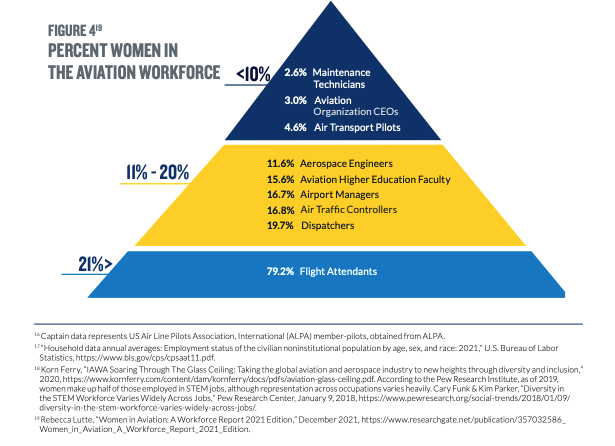
“While participation of women in the workforce has increased dramatically over the past four decades, despite all efforts, the percentage of women in the aviation industry hasn’t appreciably changed,” said the Board. “Fewer than 10% of licensed pilots are women and the percentage of women in maintenance fields is in the single digits.

“In most aviation occupations, women make up less than 20% of the workforce—and for the last 60 years, the introduction of women into the industry has been largely stagnant,” the report continued. “Much of the aviation workforce also lacks ethnic and racial diversity. Women who belong to additional underrepresented groups are part of a very small minority, facing unique barriers and often even greater challenges.”

WIAAB’s conclusions confirm Flightglobal’s recent report showing the problem is equally acute in aviation management. Its annual assessment of the progress of women in executive ranks at airlines found a 1% increase in their numbers in 2021.

“Overall, some 15% of the 600 positions surveyed by the publication covering the C-Suite were taken by women, marking a one-percentage-point increase from the 2020 survey,” Flightglobal reported, commending JetBlue for becoming the first airline with women as the majority of its executives. “Few airlines achieved a 50:50 gender split among their executives in the survey. That milestone was recorded by Air New Zealand, Southwest Airlines, TAP Air Portugal and VietJet,” reported Flightglobal.

FA/AW News curates and updates a list of Women in Aviation, Aerospace & Defense, the only permanent online list, with impressive results showing hundreds of women in leadership positions in aviation/aerospace.

Starting With Leadership

While recognizing culture as the top barrier for women in aviation, WIAAB acknowledged it is hardest to change but starts with leadership.

“Women don’t feel like they belong,” the board said. “Changing culture requires consistent leadership commitment over time in thousands of large and small actions across government and industry. Although women in aviation have broken through barriers and made remarkable contributions, the industry has been largely unsuccessful in meaningfully attracting, retaining, and advancing women.”

Among the leaders to be included in this effort is pilots, according to Captain Perkins, who, in a landmark study cited the attitude of male pilots.

“Sixty four percent of male pilots say pushing for equity on the flight deck is not their responsibility,” said Perkins in a 2020 study, reflecting an astonishing violation of the principles of crew resource management. “Only 16% are actively doing something to make a positive change while 20% want to help but don’t know how. When I share stories of being called a ‘token’ or having someone say, ‘another empty kitchen,’ they are shocked and immediately attempt to discredit the occurrence.”

More than Pay, It’s About Work Rules

The report comes on the heels of a new pay-equity study showing something new. Young women in the big metro areas are pretty much on par with their male counterparts when it comes to pay. However, their careers stumble as soon as they have a family, something not experienced by their partners. This is also part of the culture that must be changed.

The issue has long been reported by women pilots who push for changes to work rules to accommodate the emerging needs of the millennial-generation pilots – work rules that even male pilots want but, to date, unions have yet to address. Women pilots are stunted in their careers and robbed of upward mobility on the flight deck in favor of a more predictable schedule.

FA/AW News recounted these problems in a two-part report on how the industry and unions much adjust in order to attract more women.

Millennials are driving dramatic changes in work/life balance which has been accelerated by the pandemic and, according to the Board, changing culture cannot be achieved unless work-life balance is addressed.

While its recommendations are aimed at women who now carry the main responsibility for caregiving, solving work/life balance issues provides an opportunity to change the family – allowing men to take on more caregiving, something they say they want. It will also take a change of women’s mindset in allowing men to take over rather than defaulting to sacrificing their own careers. Consequently, we must be careful that, in focusing on women, we don’t ignore the wider workforce changes wrought in the last three years.

To its credit, the Board recognized this. “The scope and benefits of some of the recommendations also are not limited to women,” it explained. “These recommendations improve the representation of women in aviation by improving the recruitment, retention, and advancement of all talent.”

The Board recommended “at a minimum”:

  • Examine, update, and create policies and workplace cultures that allow [employees] to balance work and life — particularly caregiving responsibilities
  • Paid parental and paid family leave, scheduling flexibility, access to childcare, and accommodation of nursing mothers
  • Ensuring employees are aware of and understand these benefits and be able to use them without fear of retribution, reprisal, or impact on career progression.
  • Mentoring women and providing essential navigational support along their entire careers which is seen as critical to retention.

Other Recommendations

In addition to culture, the Board’s recommendations fall in four other categories and reprise many of the suggestions made by the industry over the last decade or more.

“For women to have an indisputable sense of belonging, the FAA and industry must increase the visibility of women in aviation careers,” said the Board. “The FAA and industry must also address language and professional appearance standards…two of the most powerful external manifestations of a culture’s values. The FAA must also encourage organizations to implement inclusive aviation uniform and professional appearance standards policies.”

That timely recommendation comes as Alaska becomes the first airline to move to gender neutral uniforms.  First announced at the end of 2019, the airline said this week it is enabling frontline employees to dress in the uniform that best aligns with their gender identity.

How Women Come to Aviation

The insights in this report analyze how girls and women are attracted to aviation careers and what makes a difference in pursuing aviation. For instance, not surprisingly, guidance counselors have little influence while parents do. In addition, mentors are better for retention than recruitment and youth outreach is an important influencer.

Fifty four percent of respondents said exposure to aviation as a child was instrumental in pursuing a career. “The Experimental Aircraft Association found most were introduced to aviation under 10 years of age with 64% under the age of 20. Only 15% reported being exposed to aviation in school,” said the report. “In a survey of professional women, 70% said they never considered an aviation career citing lack of familiarity, interest, misconceptions about needing STEM skills and ignorance of how to start.”

The Board recommended establishing programs fostering early exposure to aviation careers including the development of government/industry Virtual Resource Center. It wants a one-stop-shop for exposing students, parents, teachers and volunteers to aviation career pathways, education and scholarship resources. This is a good idea given time consuming research now involved in exploring aviation careers.

While government support is always welcome – especially when it comes to increased education funding – much of this work is already done by industry and state governments which long ago moved to fill the void in promoting aviation careers as recounted in this FA/AW News article – Industry Educational Resources Reaching Millions, Serious Education Reform Needed.

Indeed, hardly a week goes by that does not include a story on a new aviation program opening at the high school somewhere in America. But the industry has also developed hundreds of resources, much of it FREE, connecting young people to aviation/aerospace. These include the University Aviation Association’s centralized scholarship listings, Women in Aviation’s Girls in Aviation Day, AOPA’s high school aviation curriculum, Embry Riddle Aeronautical University’s free online coursework designed for girls and women, Experimental Aircraft Association’s online courses, the American Rocketry Challenge and state moves to develop career and technical education (CT&E) programming for aviation and aerospace. Last year, the National Aviation Hall of Fame teamed with PBS/Think TV to develop early education aviation programming providing an unprecedented opportunity to reach young children.

And, in a perfect example of connecting the dots between aviation education programs and industry funding, yesterday, FedEx announced a grant to support NAHF’s Discovery of Flight program. Similarly, the JetBlue Foundation also provides funding for such programming.

FA/AW News developed a list of aviation/aerospace education resources designed to connect the dots between industry programs, educators, museums and other STEM and aviation/aerospace oriented programs.

AAR Corp, Embraer, Airbus, Boeing, Raytheon, Northrop Grumman, Southwest Airlines, Collins Aerospace, OneWeb, Boeing, Textron and GE Aviation are among those leading the creation of new community education programs and air camps to strengthen pipelines to their operations. 

While calling for government and industry to develop and implement aviation-focused curricula and career education, it might be better to support the many programs already existing. The fact remains, that much of this work has already been done and only needs increased support. The one thing the industry keeps doing is re-inventing the wheel to attract people to their own organization instead of supporting with partnerships and funding current programming to make them accessible to under-represented communities.

Consequently, the Board recommended increased federal financial aid for aviation careers addressing the biggest need and greatest role government and industry can have in changing the diversity of the industry.

Equally important is the long-suggested public service campaigns promoting aviation careers across all channels including television, radio and, of course, social media. These should emphasize women and other under-represented groups, especially those who have achieved leadership roles.

Still, recommendations do address voids in workforce development:

  • Training for career workforce development professionals
  • Immersive confidence camps so young girls and women learn about opportunities in aviation.
  • FAA/Department of Transportation establishment of recruitment offices and career readiness partnerships with other federal entities
  • Coordination with state governments on nationwide workforce needs
  • Connecting students interested in aviation careers with educational resources.
  • Clearing pathways to funding for schools serving women, minorities, and veterans
  • Development of a Scholarship Program Toolkit, to easily implement scholarship programs.
  • Partnerships between FAA, DOT, and the U.S. Military, to enhance awareness of aviation career opportunities
  • Enhancing Career & Tech Education programs in high schools enabling students to earn an FAA certificate in high school.
  • Mentoring programs for students including a mentoring app designed specifically for the aviation industry will allow young women to easily access and connect with mentors.
  • Resources needed to develop and maintain partnerships for educational programs leading to aviation-related certificates.
  • Updating and industry support of the FAA’s website to include for curriculum resources, internships, scholarships, and pathway programs.

Advancement

The Board concluded the industry will be unable to achieve culture change without the advancement of women into leadership roles. Women must be included in decision making, in leadership roles and be visible.

Recommendations include:

  • Development of professional development programs purposefully designed for women
  • FAA provision of resources and best practices for implementing such programs
  • Development and promotion of affinity groups, communities of support, and employee resource groups that provide critical skills development and facilitate relationships, improve engagement and retention and necessary for career advancement.
  • Opportunities to participate in corporate strategic initiatives on innovation and problem-solving
  • Creating environments for recognition and advancement.
  • Advocate for women by adopting personal sponsorship plans to increase access and visibility for women and other underrepresented groups to stretch assignments and development opportunities.

Finally, the Board recommended continued data collection and one area might be in establishing whether the hundreds of women in leadership positions in the industry have really made a difference in changing the culture. After all, findings it cited on how little the participation of women in the industry have changed, suggest they haven’t.

Other gaps include:

  • Gender statistics in workforce data
  • Pay parity information
  • Data on women in aviation occupations and leadership positions
  • Gender data by race/ethnicity
  • Research into the recruitment, retention, and advancement of women in aviation and the evaluation of recommendations implemented.

Not Up to Government to Change Industry

While government can play a role in many areas related to diversity, equity and inclusion, ultimately it is up to the industry’s self assessment of how it treats women and minorities, something that remains to be done. Still, the value of the WIAAB report lies in the follow through — realizing its recommendations. It provides a roadmap for change if the government and Congress don’t let it join the thousands of government reports now lying fallow.

Source: Mimi Thian via Unsplash

Consequently, it is up to us to collectively take up the baton. We cannot leave it to others to decide our fate. We can attract thousands to aviation but if we don’t change the culture, we will just have more of what we have now.

At stake is nothing less than the health and competitiveness of the industry, as WIAAB concluded.

“The continued strength and success of the U.S. aviation industry must not be taken for granted,” said the Board. “Aviation faces significant workforce challenges that threaten the industry’s sustainability, profitability, and ability to innovate. Identifying and recruiting talent from underrepresented groups is an obvious and necessary strategy to address workforce needs throughout the industry.”

Without widening the pipeline and changing the culture, the job simply cannot be done. Consequently, WIAAB and the Youth Access to American Jobs in Aviation Task Force, expected to report later this year, need to identify what can be done with or without government actions and make them happen.

Industry Falling Short of 6,000 AMTs Annually to Meet Demand

By Kathryn B. Creedy

Source: Science in HD via Unsplash

The challenges of meeting the demand for aviation maintenance technicians just became a lot tougher, according to Aviation Institute of Maintenance Executive Vice President Joel English, who cautioned while there is theoretical capacity to produce enough technicians, there are roadblocks, because only about half graduate or pursue certification.

“The Boeing Technician Outlook this year forecast a need for 132,000 technicians within 20 years in North America alone,” he told members of the Regional Air Cargo Carriers Association (RACCA) during its recent annual meeting. “We’ll need 700,000 worldwide. The good news that is down from the 2019 demand which was 192,000 in North America. Still, that means we need to graduate 6,600 new technicians annually. There are 166 FAA Certificated Part 147 schools being relied on to produce that 6,000 and the average size of these schools is about 100 students, so the numbers look good.”

But, he cautioned, they quickly whittle down because only about 40% (6,209) are graduating annually while fewer than 60% (3,725) of those become certified.

“Over 20 years that’s 74,500, only about half of what we need in North America,” he said. “That’s a big problem. Prior to Covid, 77% of certified technicians were over age 50 but Covid took a theoretical near-future problem and turned it into reality since companies relied on early retirements to reduce the number of furloughs required. The good news is the average age of technicians has declined over the past two years, but the number of available technicians has declined even more. Airlines and MROs don’t have enough technicians to keep up with the business they currently have and could be making millions more if they had enough technicians.”

Pre-Covid, the Aeronautical Repair Station Association (ARSA), reported about $1.4 billion in business is left on the table each year owing to workforce shortages.

ATEC Pipeline Report Shows Declining Certifications, Increased Diversity

English’s speech came on the heels of the Aviation Technical Education Council’s (ATEC) latest Pipeline Report showing the strong momentum for producing more technicians in 2019 was slowed with Covid despite ATEC’s efforts to help members pivot from in-person to online learning.  

Source: Xi Wang via Unsplash

“In 2020, the FAA issued 30% fewer airframe and powerplant (A&P) mechanic certificates than it did the previous year—a devastating drop given the workforce development strides made in 2019 when more individuals achieved FAA mechanic certification than in any of the previous 17 years,” said ATEC Executive Director Crystal Maguire. “While the dip is likely an anomaly related to the COVID-19 pandemic’s ramifications, the long-term effect of the pandemic on the mechanic pipeline remains unclear. The 2021 Pipeline Report increases the urgency to the already-established priority of ensuring the pipeline is leveraging all available resources, including capacity in aviation maintenance technician schools (AMTS).”

ATEC reported the mechanic population is expected to increase 13% over the next 20 years, but ultimately fall 12,000 mechanics short of meeting commercial aviation needs in 2041. This optimistic scenario assumes pre-pandemic certification rates return.

“Despite the overall drop in newly certified A&P mechanics, 2020 did include some positive development. AMTS reported 11% of A&P graduates were female, compared to 2.6% representation in the broader mechanic population,” ATEC reported. “In addition, 40% of graduates represent a racial or ethnic minority. In addition, AMTS enrollments increased 5% in 2020—a drop over 2019’s increase, but still a welcome sign during an historic downturn.”

English reported AIM women students have quintupled as the school now has five times the national average of female tech students.

CT&E, Community Colleges Only Part of the Answer

With the growth of Career & Technical Education (CT&E) and community colleges fielding AMT curricula, an increasing number of resources are becoming available to train technicians. However, for community colleges, English explained, the discipline is only one of any number offered and, unless enrollment is robust, such programs are likely to be cut.

“Community colleges look at the costs of these specialist programs and some close nursing and aviation maintenance programs because they cost $15,000 to educate students while all they need is a desk for English majors,” said English. “You have to have 314 enrollments to make money on it.”

Some colleges, such as the Olive Harvey College on the south side of Chicago have teamed with corporate backers such as AAR Corp which developed programs to meet specific needs. But it also illustrates how important industry is in not only creating these programs but retaining the resource for their pipeline needs.

“One of the best things industry can do is partner with aviation maintenance schools to instill their identity among the students,” said English, pointing to AAR’s Eagle Pathway Program as an example. The program provides on-site mentoring, an externship course, $15,000 in loan repayments if employed, $2,500 tuition and other perks. Similar programs from other companies increases the pipeline for employment. English also noted United has a similar program with Teterboro School of Aeronautics while Piedmont Airlines is now paying tuition as a partial grant secured by working for the company for a certain number of years.

“Companies are putting their money where their mouths are in developing the next generation workforce,” he said. “I recommend companies work with the closest AMT school. You don’t necessarily have to donate money, just provide the brand recognition for students so they’ll become your future employees.”

He also pointed to the Launch Partnership for Veterans using the Part 65 Skill-Bridge Program which includes pre-graduation screening and hiring, a core team to collaboratively create student programs, tuition discounting and student mentoring. Viper Transitions is a similar program designed for Veterans as is Veteran Air Warriors, whose representative, Austin Kirkwood, spoke during RACCA, noting the scholarships take veterans through their private pilot license.

For both junior and senior high school programs, students complete 400 hours of general content preparing them to sit for the exam and then transfer to any AMT school, according to English.

Barriers High for Increasing Educational Capacity

To develop a new program is takes two years for the certification process alone, reported English. “There is also between $50,000 and $500,000 in equipment needs and $500,000 to $2 million in build-out costs,” he said. “All faculty must be certified A&Ps and, to qualify for Title IV Funds accreditation is needed from the state and Veterans Administration and that requires two additional years of instruction.”

Also a board member for ATEC, English cited the work the organization did in reforming Part 147 achieving a Congressional mandate for FAA to reform Part 147 which passed last December and has yet to be implemented. Reform means curriculum will be less restrictive and could ultimately accommodate the inclusion of emerging technologies, especially in propulsion.

“The new regulations focus on outcomes rather than prescribing instructional methods and hours on topics,” he said. “It also means aviation maintenance schools and universities can open satellite campuses at local high schools such as the partnership created when Clemson University adopted the Choose Aerospace Curriculum to encourage high school programs.”   

English called on companies to take a two-pronged approach – community youth programming and support for political leaders who can help expand the pipeline.

“If all of us commit to new programming and youth awareness, we could be on pace to produce more technicians,” he said. “We need to double the number we are producing every year over the next 20 years to get to where we need to be.”

PBS, NAHF Offer Unique Aviation Education Opportunity

By Kathryn B. Creedy

The National Aviation Hall of Fame and PBS partnered to deliver a once-in-a-lifetime opportunity to an aviation/aerospace industry struggling with workforce shortages and creating pipelines for future workforce needs.

Aviation organizations from airlines to manufacturers, MROs, and the aviation/aerospace alphabet-soup groups in Washington need to grab on to this golden opportunity to sponsor, promote, fund and otherwise support this effort because it brings PBS – the most trusted name in education – into aviation education.

But aviation/aerospace companies are not the only ones that can leverage this opportunity. Anyone working in aviation education can help scale this to a national effort and at the same time, introduce yourself as the resident aviation education expert at your local PBS station. That’s what I intend to do here in Central Florida.

While elementary school programming exists, nothing has the potential of the NAHF-PBS/ThinkTV initiative delivered through their PBS-created, in-classroom curriculum; the NAHF and PBS websites; social media; PBS Kids programming; and PBS Learning Media. The program, called Learning with Will and Orv, is designed to support teachers and inspire students both in and outside the classroom and emphasizes development of aviation education at remote, rural and otherwise under-represented or under-resourced schools.

The NAHF-PBS/ThinkTV initiative results from the pivot NAHF President and CEO Amy Spowart took at the beginning of the pandemic. “In 2019 I met with former NASA Administrator Sean O’Keefe and he shared his belief that the gap in STEAM education was in the younger, elementary grades,” Spowart told Future Aviation/Aerospace Workforce News (FA/AW News). The effort was further supported through two webinars moderated by Spowart and National Aeronautic Association (NAA) President Greg Principato. During the two-part event Inspiring the Workforce of Tomorrow, Panelist John Langford, founder and CEO of Electra.aero, encouraged Spowart’s plan further when he observed it is assumed kids will get to aviation/aerospace through STEAM education. But Dr. Langford thinks it should be the other way around, that aviation/aerospace is a perfect way to get young thinkers into STEAM concepts. Spowart realized to build the aviation workforce of tomorrow, we need to make aviation the primary focus.

Inspiring the Workforce of Tomorrow remains available online at www.nationalavition.org and www.naa.aero

Their approach is refreshing since every industry is pushing themselves as STEM/STEAM delivery systems. But aviation/aerospace has already stepped up to ensure kids of all ages are exposed to aviation and aerospace. With PBS we have a way to amplify them.

“The pandemic shut-down truly made it all happen for us,” Spowart explained to FA/AW News. “We used the lull to create an education plan called Discovering Flight: Learning with the National Aviation Hall of Fame. For the curriculum, called Learning with Will and Orv, we joined forces with PBS/ThinkTV. We wanted a multidisciplinary approach. Our friends at PBS/ThinkTV even came up with the idea to include some of the etiquette from a book the Wright’s wrote. Our goal is to make the curriculum free to under-resourced schools and the program so flexible that teachers can do it for a week, month or spread out longer. PBS/ThinkTV have, unsurprisingly, included everything from step-by-step guides to providing activity instruction and worksheets.”

Previous Coverage: Industry Education Resources Reaching Millions

Spowart, who recenty posted a video about the new program, explained it was PBS’s idea to make Will and Orv heroes of the curriculum and build them to become as iconic as Curious George or Arthur in an effort to teach kids about aviation and STEAM principals. To do that, PBS/ThinkTV is creating 53 one-minute vignettes which will make up a one-hour video to be shown on PBS affiliates and available on PBS, the NAHF website and in its Heritage Hall and Education Center.

“We are eager to find partners to share the digital media on their websites, in airports and other museums,” Spowart said, adding through PBS/ThinkTV, teachers will have a dedicated 1-800 number to answer any concept questions they may have.

“To share this outside of Dayton, we hope to have the support of industry and beyond,” she said. “We are looking for partners to help fund this initiative to begin the aviation and aerospace pipeline in elementary grades. We seek to ignite that spark and keep it going throughout their education because we know we may lose them in middle and high school. Just because you introduce aviation to kids once, doesn’t mean it will stick. Our goal is to create on-going relationships and touch points throughout their education. In elementary school kids absorb new information like a sponge, aren’t afraid to fail, and we want to dig into that fearlessness. Aviation is about being fearless. That’s why our partnership with PBS/ThinkTV is so impactful. It works because PBS knows how to meet kids where they are.”

Spowart also explained other ways aviation companies and organizations can help. This is actually where everyone interested to aviation/aerospace education fits in by contacting local PBS affiliates to urge adoption of the Learning with Will and Orv effort. Teachers in the new program can talk about about opportunities for kids to continue their aviation education in middle and high school, such as through the AOPA High School Curriculum as as well as high-value, high-paying aviation/aerospace careers. This would ultimately create a relay-like education ecosystem the industry so sorely needs.

“Scaling this will be the challenge, and this is how the rest of the industry can help,” she said. “We want our Learning with Will and Orv partners to connect with us and help our reach to the most vulnerable schools and beyond in markets that matter most to them. We will work with their local PBS affiliates to support the media content. Once we move it through PBS, kids can watch the content at home, or the library while teachers have it in the classroom.” Or in the dozens of home-grown aviation education programs throughout the nation.”

Help can also come via in-kind opportunities and Spowart shared the initiative includes curriculum binders containing support materials like balsa airplanes, an opportunity for co-branding and exposure in the schools. Entities with experienced aviation employees could help with the quarterly on-going professional development programs for educators. There is also a plan to make field trips to airports, maintenance facilities and air traffic control towers part of Learning with Will and Orv to illustrate that aviation is about much more than being a pilot since the FAA recognizes 53 different jobs related to aviation career fields.”

Teaming with Education Departments and Career & Tech Ed

Spowart plans to meet with the Ohio Department of Education to build a relationship and to learn how Learning with Will and Orv can meet its needs as well as ensure teachers are supported. Reaching out to government officials as well as those developing Career & Technical Education (CT&E) programs is extremely important as the demand for such programming increases. Parents see it is a way to get a college education without incurring the crushing debt it now entails. The idea is to get their kids into certification programs such as aircraft and powerplant or manufacturing programs that lead to jobs while leveraging corporate higher education benefits to gain that college degree.  

The importance of technical education is illustrated in a recent article highlighting the Pittsburgh Institute of Aeronautics. Employment rates for its graduates exceed 80% compared to just 50% for graduates of more traditional colleges. A recent survey by the Georgetown University Center on Education and the Workforce showed PIA had a better 40-year return on investment than the median average ROI for all US postsecondary schools.

Learning with Will and Orv

The NAHF-PBS/ThinkTV Phase One Grades 1-3 programming – available for the 2021/22 school year – will be beta tested in one of the key birthplaces of American aviation – Dayton, OH – where Wilbur and Orville Wright, with their mechanic Charles Taylor, toiled away to invent the airplane and where Katherine Wright ensured her brothers’ success and legacy. Indeed, Learning with Will and Orv – leverages America’s two earliest aviator/inventors as a springboard, with Hall of Fame inductees, to learn about American innovation in aviation and aerospace.

Rollout has been slowed by the rise of Covid’s Delta variant but formal launch and live websites will be coming soon.

NAHF-PBS/ThinkTV are already developing plans to expand the program with PBS in 2022 to include curriculum for grades 4-6. The next phase will include a focus on sustainability in aviation and aerospace.

“The National Aviation Hall of Fame is known for honoring its Enshrinees who contributed so much to aviation,” Spowart told FA/AW News. “But that is only part of our mission. We want to really dig into the other part of our mission which is to inspire. We will take inspiration from our greatest aviation pioneers and incorporate them into our educational programming.”

Learning with Will and Orv is a multidisciplinary curriculum of standards-aligned videos, interactives, lesson plans that partners NAHF’s mission with the educational expertise of PBS/ThinkTV. A kids workbook has already been created. The Wrights are informal guides to lessons within the curriculum as they interact with other famous aviation and space leaders from history to deliver fun, educational experiences for the classroom. It hopes to inspire kids to pursue future achievements in air and space frontiers.

NAHF includes the arts in the program because aviation STEAM-based early education encourages kids to explore aviation no matter their interest. After all, aviation/aerospace related jobs now encompass the arts, community planning and even wrangling animals transported by air from Pandas to thoroughbreds. Ensuring lessons take in the entire STEAM concept, activities include language arts, mathematics, social studies, journal writing, short story assignments and even comic book development.

NAHF-PBS/ThinkTV teamed with Crayons to Classrooms, a free store for teachers from under-funded Pre K-12 schools that serve students living in poverty and underserved classrooms, to develop and distribute 100 binders of the curriculum which will include the workbook.  Complementing this will be creations from Digital Studios and Interactions for PBS Learning Media and a Discovering Flight PBS KIDS engagement page. There will also be an NAHF-PBS/ThinkTV social media campaign, spotlighting Hall of Fame enshrinees with online curricular assets and an interactive website to host content and engage young learners.

Junior Collier Challenge Joins American Rocketry Challenge to Inspire Kids

The success of such programs as the American Rocketry Challenge and the General Aviation Manufacturer’s Association’s Aviation Design Challenge in capturing kids passions and enabling them to pursue aviation careers has paved the way for a new challenge developed through the NAHF/PBS initiative.

From FA/AW News Archives: How Even Poor Schools Can Tap Aviation/Aerospace Education Resources

With the National Aeronautics Association (NAA), the home of one of aviation’s most coveted awards – The Collier Trophy – and the National Air & Space Museum (NASM), the program launched the Junior Collier Award. The Junior Collier Challenge invites students to develop a concept/idea inspired by a Collier-winning technology, challenging not only students but education and community organizations whose focus is on traditionally underserved and under-resourced communities.

Instead of emphasizing fabrication and build out, the challenge will focus on the original thought and design behind the technology to inspire students. Each year a NASM leader, NAA Awardee or NAHF Enshrinee will promote the Junior Collier Challenge which will begin as a regional effort, with the eventual goal of expanding annually to a national audience, in conjunction with the Collier Trophy winner. A Junior Collier trophy will be presented to each winner and the official Junior Collier Trophy, with the names of the winners permanently attached, will be displayed along with the actual Collier Trophy in the NASM. This is a perfect opportunity for companies to work with local schools – which many are already doing – to develop teams.

Other Elementary School Programs

Certainly, NAHF is not the first to target young children, but the power of the NAHF-PBS/ThinkTV effort can only strengthen other programs already in existence by giving them much needed national platform to make local school boards and schools more receptive to such programming. FA/AW News has heard far too many stories of local efforts to include aviation/aerospace in schools only to be shut out by unreceptive school boards. That is why working with state aviation and career & tech ed officials will likely yield better results.

The number of organizations targeting youngsters are legion and in every corner of America, as illustrated by the Future Aviation/Aerospace Workforce News Resources for Education and Workforce Development Programs for Aviation/Aerospace but it is doubtful they know about each other, how they can amplify their efforts or how to access corporate workforce development programs for support.

For instance, we have seen the national effort surrounding the 100th anniversary of Bessie Coleman pilot’s license launched in June by Aerostar Avion Institute to support its pipeline K-12 curriculum.

These programs, such as Space Kids Global, target younger kids and works with the Girl Scouts to inspire and empower girls to go into science, technology, engineering, art, and math (STEAM) education and jobs. It recently worked on a challenge designing a new Girl Scout Space patch and developing an experiment that launched on the recent SpaceX mission.

Flight Schools Association of North America (FSANA) sponsors AeroCamp for which it developed a tool kit for members to help in planning and budgeting. Launched in 2009, FSANA Chair Lisa Campbell estimates more than 5,000 young aviators have attended one of the many AeroCamps around the country where campers are exposed to every facet of aviation and gain a strong foundation for piloting but also learn about everything from air traffic control, airport operations, maintenance, avionics, firefighting to weather reporting and engineering. While most are held at flight schools, Campbell recently met with a community college and aviation companies interested in forming camps.

The FAA has long had curriculum and activities for kids. All this dovetails nicely with the AOPA Foundation High School Aviation Curriculum, which just passed the 300-school mark having reached 8,000 students spanning 44 states, the next step in the lifelong relay to aviation/aerospace careers from Learning with Will and Orv to AOPA High School curriculum to Civil Air Patrol and beyond. AOPA, too, offers teacher professional develop as well as helps them learn to fly. There are also online programs for youngsters such as Experimental Aircraft Association AeroEducate. The industry needs them all but the earlier we attract kids to aviation and the more we mentor them through that education, the more successful we will be.

Those already providing programming need to think bigger and the NAHF-PBS/ThinkTV provides a golden opportunity to leverage this national platform to gain local support for their programs by piggy-backing off the PBS imprimatur to illustrate the importance of aviation/aerospace education in their local communities and to opportunities to be had in aviation careers.  

Indeed, local PBS stations already have funding to create programming featuring their local communities and this could be a prime opportunity to create links to publicize all the wonderful Pre-K-to-College programs already in existence. The more we promote Learning with Will and Orv and link it to efforts providing local hands-on programming for kids, the more likely we are to build the next generation.

Call to Action

I’ve written before how different aviation constituencies – manufacturers, airlines, maintenance, business aviation – are all developing workforce development programs and creating education pipelines. When asked why they don’t get together to amplify the wonderful programs already existing rather than reinventing the wheel they demur saying they focus on the needs of their members.

Fair enough but the workforce crisis affects us all. Isn’t it time for us to destroy silos in favor of a unified effort to start as young as possible to encourage kids into aviation and aerospace? Isn’t that what we are doing when we call on members to support the National Center for the Advancement of Aviation (NCAA) bills now before Congress? If we get NCAA, will we retain our silos?

The NAHF-PBS/ThinkTV and AOPA Foundation efforts are sterling examples of what aviation can accomplish individually but imagine what could happen if we worked together to amplify all of these programs by providing sponsorships, paying for materials needed to support them, donating to organizations creating education programs and yes, planting your logo in the hearts and minds of the next generation. The industry is already doing it so why can’t we do it together? This isn’t about competition, it’s about collaboration and amplification of all these programs.

Check out all the programs already in existence. Resources include contacts for career & technical education, state aviation education officials and corporate workforce education programs designed to attract the next generation. Even small companies can contribute to opportunities in your local area and, right now, there is probably a program already available to support.

Certainly, the NAHF-PBS/ThinkTV initiative will plow new ground and amplify our efforts and, as Spowart said, is a once-in-a-lifetime opportunity not to be missed.

Airline, Aerospace Make Forbes Diversity List

By Kathryn B. Creedy

15 minute read

  • Population declines increases urgency to create new pipelines including immigration
  • American competitiveness at risk
  • Job seekers exclude companies not meeting their diversity goals and will raise diversity issues in interviews
  • A quarter of global companies do not have diversity programs
  • 30 top employers, including the highly regulated, make compelling business case for including those with criminal records
  • Diversity recruiting experts in high demand
  • New pipeline sources needed, affinity groups recommend partnerships
  • Retention of diverse workforce remains a challenge
Source: Hey Lagos Techie via Unsplash

Twenty five aviation and aerospace companies made the list of the Forbes America’s Best Employers for Diversity 2021 and top among them was Delta at 112 but besting the Atlanta-based carrier was Raytheon Technologies at 78.

CompanyRanking
Raytheon Technologies78
Siemens86
Delta Airlines112
JetBlue Airlines126
Alaska Airlines209
Lockheed Martin233
BAE Systems246
Boeing269
GE329
General Dynamics330
Southwest Airlines321
Spirit Airlines322
Motorola Solutions344
CACI Int’l375
DHL376
Expeditors International396
Northrop Grumman402
Huntington Ingalls Industry418
L3 Harris Technologies439
FedEx443
Moog454
Allegiant457
United Airlines474
American Airlines478
UPS488
  

Source: Forbes Best American Employers for Diversity

The publication considered thousands of companies for inclusion on its fourth annual list and reported not only did these companies receive the most recommendations, but also had the most diverse boards and executive ranks as well as the most proactive diversity and inclusion initiatives.

The story validates efforts by companies actively working with schools, an effort outlined in a recent Future Aviation/Aerospace Workforce News analysis of industry programs.

Raytheon topping the list of aerospace companies is no surprise given its strong emphasis on education programs designed to increase those pursuing aviation careers including its recent funding of cybersecurity high school programs. In addition, its subsidiary, Collins Aerospace, is heavily involved in educating the next generation including a mobile STEM lab and generous grants to get computer science curriculum into elementary schools. (See FA/AW News’ Education and Workforce Development Resources for Aviation/Aerospace for details and other corporate programs.)

Population Declines Create New Urgency

Lost in the entire diversity debate is the impact on population declines on fulfilling workforce needs in the future. The Center for Disease Control reports US population fell for the sixth consecutive year in 2020.

“Without raising immigration levels now, the US will no longer be the world’s largest economy,” said a new report from George Mason University. “Expanded immigration will ensure the US workforce can continue to outperform global competitors. [Otherwise], the US will sacrifice its position as the world’s largest economy by 2030. In fact, if current US population trends continue, the US economy will fall behind China’s by 2030 and be only three-quarters of China’s economy by 2050.”

Continue reading “Airline, Aerospace Make Forbes Diversity List”

Building the Workforce Part IV

Global MRO Workforce and Skills Needed For Future

By Kathryn B. Creedy

  • Global MRO employment down 3.5% to 385,000 employees working for more than 4,900 firms in the civil maintenance, repair, and overhaul (MRO) market at the start of 2021
  • Increased government spending on education needed
  • US competitiveness at risk
  • Schools need modern avionics, engines to deliver workforce industry needs
  • Numerous industry workforce development programs making a difference

This article is fourth in a series assessing workforce needs in different industry sectors. Parts One and Two dealt with manufacturing. Part III covered the impact of Covid on the MRO industry.

Credit: Tulsa Tech

By the Numbers

Globally, employment was at 385,000 employees working for more than 4,900 firms in the civil maintenance, repair, and overhaul (MRO) market at the start of 2021, down only 3.5% from the beginning of 2020, according to a recent Oliver Wyman study. In the US, there are more than 4,000 firms with nearly 185,000 employees in the civil MRO market, 5% fewer than at the start of 2020.

“While the impact of the crisis remains severe, recovery does now appear to be underway,” said the company in a newer report. “Two-thirds of respondents expect MRO demand to recover to 2019 levels in 2022 or 2023, in line with Oliver Wyman’s forecast of fleet recovery to pre-pandemic levels in 2022 with MRO following closely. Notably, airline respondents generally expect a slightly earlier recovery than MRO respondents. Regionally, Western European survey respondents were more pessimistic than respondents in North America and other parts of the world on how long recovery will take.”

On of the few projections for the technician workforce available is Boeing’s Pilot and Technician outlook, which last year, predicted a need for 739,000 by 2039.

Key Concerns

NAVEO Consultancy Managing Director Richard Brown worries about the people lost, especially those in who have experienced previous downturns.

Continue reading “Building the Workforce Part IV”

Building the Workforce Part III

Technician Shortage Expected as Early as This Year

By Kathryn B. Creedy

  • Increasing demand leads to hiring recovery
  • MRO workforce cuts minimal compared to other sectors
  • Labor shortages, costs remain a serious concern
  • Key people abandoning the industry
  • Covid is cyclicality reminder making others leave
  • Shift in demand may make recovery harder to predict
  • MRO recruiting efforts succeeding in increasing AMT enrollment
  • Schools will have to produce 2700 new graduates to meet demand
  • Acid test will be 2020 enrollment figures
  • Industry doing poor job of recruiting military, capturing only 10%

This article is third in a series evaluating workforce needs in different industry sectors. Parts One and Two dealt with manufacturing.

Credit: PTC

The technician shortage is expected to re-emerge as early as this year, according to an Oliver Wyman study especially as some unemployed technicians leave the workforce permanently, similar to what has been experienced in the pilot corp covered in the last issue.

The good news, MRO workforces were not as devastated as other disciplines and are estimated to be down just about 3%. The recovery, which Oliver Wyman expects in 2022/23, makes MROs reluctant to lose employees given previous shortfalls.

JSFirm, the industry-leading placement company, reported hiring has already resumed. Its Hiring Trends Survey of hiring professionals, executives, and business owners indicated over 50% are projecting growth in 2021. Additionally, 66% of those surveyed did not cut any jobs in 2020, despite the pandemic. Furthermore, 33% expected to hire in the second quarter 2021 with pilots, maintenance and avionics techs in highest demand.

Continue reading “Building the Workforce Part III”

Analysis: Pilot Shortage 2.0 on Horizon Unless Airlines Act

More than half of retirement eligible pilots are gone

By Kathryn B. Creedy

  • Study warns airlines to start training now to avert new pilot shortage.
  • More than half of pilots nearing retirement took early outs.
  • 30,000 expected to abandon airline pilot career.
  • Booming flight schools provide important pipeline.
  • Career projection unlike anything we’ve seen.
  • Training funding still biggest barrier

For years, airlines, business aviation and even the military struggled with workforce shortages. Covid-19 led to furloughs and, of course, the accelerated retirement of thousands of airline pilots, technicians and manufacturing personnel. While providing a brief respite, retirements only mean a more acute pilot shortage that could start as early as this year. For the first time we have an estimate of how many pilots took early retirement.

Credit: Mike Phillips, WDEL

So it is not surprising to see airlines rejuvenating their pipelines such as United’s recent announcement it would hire 5,000 pilots by 2030, at least half of which would be women and people of color. It expects to enroll 100 students this year.

American, announced it would fly 90% of its 2019 schedule this summer, recall its pilot corp and resume hiring with a goal of 300 this year. It expects to double that next hear while Allied Pilots Association worries the carrier will be short of pilots as it takes time to return to the flight deck, according to Simple Flying. Spirit and JetBlue also said they will resume hiring this year.

A recently released study by Oliver Wyman notes the experience after 9/11 and the Great Recession when new pilot certifications fell 30% to 40% in the five years after the crises. Compounding this will be the departure of what the study estimates as 25,000 to 35,000 current and future pilots abandoning the cyclicality of the aviation industry in favor of more stable careers over the next decade.

But this time, at least for pilots, there is hope for operators in search of new hires. In addition to airline programs, the flight training business is booming which means at last, the pipeline is increasing not just for duffers but for those seeking careers. The question is whether the industry can build capacity fast enough to feed the 34,000 global pilot gap expected by 2025, according to the Oliver Wyman study.

Continue reading “Analysis: Pilot Shortage 2.0 on Horizon Unless Airlines Act”

1st AOPA HS Curriculum Grads, Coordination Needed with Education Programs

By Kathryn B. Creedy

With the first cohort of AOPA You Can Fly High School Aviation STEM Curriculum about to graduate in 2021, it is clear the program is making a difference in everything from school attendance to increasing the diversity of the industry.

Do you drone? Hereford High AOPA STEM program Credit: AOPA

But You Can Fly is only one of many resources available to teachers including the Civil Air Patrol (CAP), Experimental Aircraft Association (EAA), the Federal Aviation Administration (FAA) and an impressive Redbird Flight Simulations program. Combined, these resources offer an impressive array in moving the needle in workforce development programs. They can also be fielded in nearly every community since these organizations leverage their vast membership networks to market their programs either in the classroom or at their airport facilities.

What is needed is not the development of more programs but the coordination of those programs into a cohesive national effort to connect the dots between education, aviation and workforce development programs.

“We say the more the merrier,” said You Can Fly Executive Director Elizabeth Tennyson of all the emerging programs geared to aviation education. “I would love for us to be more coordinated, however. We already encourage people using our program to expand their horizons and explore other programs out there. But I think we need something more formal and, frankly, more effective, in place.”

She sees this as the role for the National Center for the Advancement of Aviation (NCAA) proposed by senators Jim Inhofe (R-OK) and Tammy Duckworth (D-IL). Operated as a private entity and funded from the Airport & Airways Trust Fund, NCAA is intended to support the development of aviation STEM programs. More importantly, its role would be distribution of aviation/aerospace STEM programming as well as connecting the dots between education and workforce development. It would also disseminate economic and safety data as well as research and provide a forum for the cross-disciplinary collaboration needed to develop the interdisciplinary workforce of the future academicians and industry say is needed.

You Can Fly

“AOPA’s You Can Fly program is all about lowering barriers to entry,” Tennyson told Future Aviation/Aerospace Workforce News. “It is not just about the students, it’s also about the teachers. We want to make sure they are confident in teaching the material.” 

You Can Fly Executive Director Elizabeth Tennyson. Credit: AOPA

The AOPA curriculum is in more than 200 schools with 255 teachers overseeing 540 classes in 38 states. Having reached 8,000 students to date, You Can Fly and other programs could not be more meaningful for priming the pipeline for the future aviation/aerospace workforce.
“We reach out to educators through events like our annual High School Symposium, as well as educational conferences and events,” Tennyson explained. “We target conferences that focus on career and technical education and STEM education. We also get a lot of calls from schools, districts, and even state aviation departments who have heard about the program and are interested in bringing it into schools in their area. We regularly meet with these different groups and help them learn more about what we offer, make presentations to decision makers and show them how the curriculum aligns to their own state and local education standards.”

The High School Curriculum is designed so graduates leave high school with either a private pilot or a drone license. Entirely funded by The AOPA Foundation, the program includes professional development programs, designed to help teachers teach the curriculum more effectively, and, last summer, had 300 teachers enrolled in its virtual event.

“We also provide 20 $10,000 scholarships each year to help teachers earn a private pilot license,” said Tennyson. “That gives them first-hand experience. When they have that they light up the classroom and become role models for their students. They come away feeling confident they are making a difference with the kids.”

She explained the value of the program. “Some schools have difficulty getting kids just to show up and this program has made a huge difference,” she said. “Teachers tell us they arrive and the kids are waiting outside the classroom anxious to begin. It can be a real turning point for a youngster to discover they like school. Teachers tell us that it sounds like a party every day as the kids develop competitions and cheer each other on.”

Demographics

The demographics of both schools and students are a testament to the difference You Can Fly can make. Eighty-four percent of schools are public with another 5% charter schools. Some 10% are private and another 1% from the home-schooling arena. Thirty-nine percent are in rural areas and 39% in suburban areas while 23% are in urban areas.
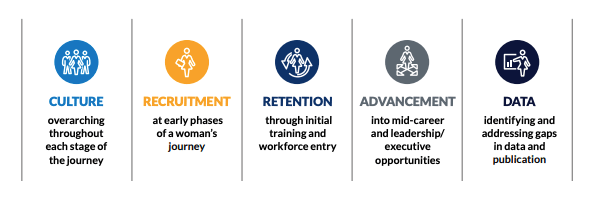
Key to the program is being free with The AOPA Foundation supplying everything needed along with support for teachers and the school to implement the program.

“Small districts are delighted they have access to this programming,” said Tennyson, adding a prime target audience is underserved communities. “They are able to do this without significant resources. That is important because 22% of the schools using this program are considered high-poverty schools. If you add schools that are considered mid-to-high poverty, that equals about 45%.”

Source: Unsplash

As for the kids, 56% have no previous experience with aviation. Saying only 10.6% of pilots and flight engineers were people of color, Tennyson noted nearly 50% of the students in You Can Fly are people of color. Twenty percent are female which may move the needle when it comes to the fact only 5.6% of commercial pilots are women.

This is critical since studies show that girls begin to drop out of STEM-related courses in middle school and children of color in high school. That makes AOPA’s program important as a bridge during these vulnerable years for kids who become involved at a younger age through such programs as CAP’s cadet program which starts at age 12 and EAA’s course work for younger kids.

“Teachers tell us that they capture kids in the 9th grade, and they are hooked and stay with the program,” said Tennyson. “It is opening a door and welcoming them in for the first time. We felt high school was the place to start because that is when students begin taking concrete steps for their future. If you open the door and make it accessible, a lot of students will follow because they realize aviation is fun. We can’t overlook that point when we are recruiting. It doesn’t have to be intimidating, it can be fun.”

Tennyson reported there were a lot of misconceptions about aviation. For instance, people think the only pathway is through the military or that you have to be great a math to be a pilot.

A lot of hot air. Hereford High’s AOPA You Can Fly Program. Credit: AOPA

“That is not true,” she said. “What we are offering here is a way for students to learn those misconceptions are not true. They end up building hot air balloons, wind tunnels and airfoils they then test in the wind tunnels.”

Identifying the Gap

For years, the industry has been worried about workforce shortages and in 2016, the AOPA Foundation examined the resources available to connect the dots between aviation and STEM education.

“When we started developing the program in 2016, we saw a big gap in this type of education,” said Tennyson. “There was nothing available that was comprehensive for high school age students that could be done during their school day and with which they can earn credits over four years. There were also no turnkey programs that were free. What was available, she said, were science classes using aviation-related programming or elective programs which were not for credit.

“We looked at this very carefully and discovered the majority of schools did not have the resources to prepare their students,” Tennyson continued. “They didn’t have the equipment or a qualified instructor or the lab space. So, we looked at what we could do to get aviation in the hands of the most students.”

The program also needed to ensure schools had the flexibility to fit it in whether as a four-year career & technical education program, a single course, an after-school program or as dual enrollment with partnering colleges. It is also paced to the student reflecting the need for curriculum tailored to how different students learn.

Student Pathway

Complete descriptions of each program semester are available on the You Can Fly website. The 9th grade starts with introduction to aviation, a broader brush stroke of history and careers available today including space, the military, piloting, general aviation, drones, advanced air mobility, maintenance and avionics.

“This allows students to see whatever they are interested in, there is a place for them in aviation,” she said, “In sophomore and junior years, they delve into aircraft systems, airport operations, air traffic control, communications, weather – all the things you need to be a pilot and how the system works. That is germane to any aviation career. Juniors get a deep dive into the FAA private pilot knowledge test or Part 107 for unmanned systems and in the senior year we dive into advanced topics which are a lot more career oriented. They also do a capstone project which could be a business plan, an internship or choosing a subject or a mission or designing and building a drone. One student did a business plan to create an FBO at a local airport. We provide a lot of materials and support so that projects are meaningful and to prepare them in a practical way to move ahead to college, certification or the workforce.”

Other Programs

Today, numerous programs exist. Future Aviation/Aerospace Workforce News recently updated its comprehensive list of education resources for aviation/aerospace and corporate workforce development programs in hopes industry and academia would connect the dots and amplify each other’s efforts.

For instance, in January, EAA launched AeroEducate, targeting age five to 18, complementing the AOPA Foundation program for older students. The idea of the free program is to connect the easy-to-use, aviation-themed activities for teachers and EAA chapters and can be used in classrooms or EAA chapter hangars. Similarly, AOPA leverages its chapters to connect the program to local schools.

AeroEducate also complements EAA’s own Young Eagles program that provides introductory flights for kids to attract them to aviation. The AeroEducate web-based resource provides age-appropriate pathways to aviation and aerospace engagement, as well as career paths.

Celebrating its 80th anniversary this year, CAP, the US Air Force auxiliary, has 60,000 volunteer members and 1,000 squadrons nationwide. Its cadet program, for ages 12 and up, goes beyond aerospace education to developing character and physical fitness.

It also has free resources for teachers, said CAP Outreach Coordinator Susan Mallett, who joined Tennyson in speaking recently before the Women in Aviation International (WAI) Conference Aviation Educators Workshop. CAP’s curriculum is free to educators but there is a $35 CAP membership fee.

Source: Unsplash

“Our K-6 is a special program designed to help kids make connections between aerospace and education,” she said. “These are grade-level specific programs to get young students interested in aviation and aerospace. We focus on character and physical fitness because if we don’t have good people of character and integrity we are lost. We have to develop the entire child before they get into middle school and high school where they can make mistakes that can diminish their chances of pursuing aviation careers.”

At no cost to CAP’s education members, it offers sophisticated STEM Kits providing additional materials such as flight simulators or drones that schools cannot otherwise afford.

The curriculum takes in every facet of aviation including drones, VTOL, weather stations, rocketry, remote control and robotics. It also offers teacher orientation flights from pre-flight briefing to actual flying so they can see how  aviation applies to STEM concepts they are teaching.

The program, funded by USAF, has 76,000 students involved in its Aerospace Connections in Aviation (ACE) program every year. It also has an adopt-a-classroom connecting a particular squadron to a local classroom and mentoring kids move through aviation education.

“Sometimes these kids have a pretty negative experience with people in uniform,” Mallett said. “Our program helps to change that because it presents a positive role model of someone in uniform.”

Going Beyond the Sale

When Redbird Flight Simulations hired Joey Colleran nearly five years ago as its education specialist, it knew it could not just sell its low-cost, desk-top simulators and leave it at that. Without teacher orientation and hands-on guidance, it found many simulators were going unused.

“My job was to focus on the K-16 market – the high school market,” Colleran told WAI attendees. “What I quickly learned was a lot of customers had a grant and their solution was to buy our simulators. But they weren’t pilots and didn’t have a lot of knowledge and resources. I began to figure out free resources for them and ended up developing free curriculum to accompany the simulators. That included flight missions and other lessons related to their math and science curriculum.” 

Women in Aviation Girls in Aviation Day. Credit: Kathryn B. Creedy

Colleran added the company also wanted to ensure they were exposing as many as possible to aviation opportunities and created a traveling STEM lab which it plans to relaunch once Covid is in the rear-view mirror. It is familiar to WAI attendees since it is a central part of its Girls in Aviation Day which wraps up its annual conference.

“We take it to schools and different organizations to recruit kids to take free classes taught by our director of STEM education,” she explained. “It helps parents and students become aware of aviation opportunities.”

Like AOPA, it identified a need for professional development for teachers and created an educating-the-educators program online or in person to illustrate how to incorporate aviation into STEM.

Government Resources

The FAA has its own offerings in its Aviation and Space Education (AvSed) program for teachers bolstered by 1,700 volunteer employees and, like EAA, AOPA and CAP, offering local resources nationwide and on the web.

Its Aviation Career Education (ACE) Academy provides unique summer aviation education programs for elementary, middle and high school students and reaches between 1,500 and 2,000 students each summer. The program, which includes lessons in flight planning, history and flight physics, provides students with a wide range of aviation career exploration experiences and also focuses on STEM. Other subjects cover aircraft design and maintenance, flight simulations and introductory flights on some occasions. It also offers field trips to aviation-related sites.

“Our volunteers cover all walks of aviation and space experience and they love to share that in the classroom and help with curriculum in flying or space,” Christina Drouet, manager of the FAA’s Aviation Workforce and Education Division told the WAI audience.

Like Redbird, Collins Aerospace and others, Indiana-based Republic Airways has its own traveling lab to bring aviation to those who would normally not even think about it. The airline, a pioneer in bringing aviation to the underserved, has been struggling for years with the pilot shortage and finally decided to set up Lift, its own flight academy, for ab initio training. More recently, the dearth of aviation maintenance technicians, prompted it begin work on adding that to the curriculum.

Why Aviation & STEM?

Credit: Airbus

“Aviation is really cool,” Tennyson added during the WAI Aviation Education session. “You cannot find a more engaging subject for students. Students who think they don’t like math and science do like airplanes and they make the connection. US News & World Report identified piloting as number 26 in the top 100 careers in the future. In addition, there are all kinds of emerging careers such as commercial space, unmanned systems and drones and we don’t even know the potential for those yet. You will see the reward in your classroom. An engaged student makes your job so much easier.” 

Drouet agreed. “Emerging technologies are a big unknown,” she said. “To show the interest, today, the number of conventional aircraft in the US is about 300,000 but since we began registering drones a few years ago we have two million registered. To me, that is symbolic of how these emerging technologies will keep growing and why we need kids to think about these careers now. It’s exciting and there is so much opportunity.”

Because aviation and aerospace are awesome, Colleran added. “It’s important to have aviation in the curriculum because it’s the future,” she said. “The one important thing for educators to understand is how many free resources there are including the thousands of people in aviation and aerospace who want to help teachers in the classroom. When you bring aerospace in the classroom, you have so many resources at your fingertips.”

Credit: Joby Aviation

Next Steps

Tennyson wants more people involved. “That is why we support the NCAA,” she said. “All the stakeholders need to be at the same table to work together on these issues, identify the gaps that may still exist and fill them in a cohesive way. Ultimately, these are workforce issues as well as education and working together we will be creating the workforce of the future. Awareness is a huge part of it. You can’t create something successful if people are not aware of the opportunities and the needs in the industry.”

Creating an over-arching, industry-wide strategic plan is probably the biggest hurdle industry must overcome besides funding.  You Can Fly is completely funded by The AOPA Foundation but to amplify it and get it into more schools, more funding is needed; likewise for all the other programs.

“Curriculum development is an intense and costly undertaking,” Tennyson explained. “We created a turnkey program of lesson plans, presentations, student activities, teacher notes and unit tests and we have been able to do that through the generosity of our donors. But we also must continuously update and maintain the curriculum and activities as rules and technology changes. We must stay on top of that and adjust and that requires a lot of support for schools. We must contend with high teacher turnover and need more professional development and support during the year. Schools may need help developing the data so there is a lot of hands-on support that goes into every school we work with. To expand, we’d have to provide that same level of support. This is one of our greatest challenges – making sure teachers have the right skills, material and support. For all those reasons, we need something that is formalized. We need support on a broad basis in order to support the great programs out there.”

Cue the Legislators

Having introduced the National Center for the Advancement of Aviation (NCAA), the industry now needs to leverage members to make it a reality just as Aviation Technical Education Council did with transforming Part 147 and Aeronautical Repair Station Association did with the creation of annual $10 million in education grants designed to promote pilot, engineering and aviation maintenance careers.

Then the only remaining hurdle is a formalized approach to alerting parents and students solid programming exists and can be implemented in their local community for free; programming that leads to high-pay, high-value careers. This is no small task but with the advent of the Youth Access to American Jobs in Aviation Task Force and the Women in Aviation Advisory Board it is clear the industry is now working together which makes the task that much easier.