Featured

Analysis: Republic Pilot Training Proposal Deserves Thorough Hearing

By Kathryn B. Creedy

Editor’s Note: In an effort to independently determine the requirements of the of the Pilot Certification and Qualification Requirements for Air Carrier Operations and the Airline Safety & FAA Extension Act (Public Law No: 111-216 (08/01/2010) and whether the negative reactions to Republic’s proposal are justified, I reviewed the following:

Findings:

One final question: Does the law or regulation prevent the development of alternate pathways? No, in fact, they encourage it precisely because pilot training should be continuously improved based on new data and technology.

The opposition, by rejecting the Republic petition out of hand, is also rejecting all the aviation rulemaking and safety research and expertise that developed the rule.

Upsplash

Petition Shouldn’t Even Be Controversial

When unions opposed the Republic petition to the FAA to develop an alternative pathway for gaining a Restricted-ATP (R-ATP), it was clear they hadn’t read the petition.

In fact, thorough research reveals, perhaps, for the first time in history, we have a pathway that improves pilot quality, and, for that reason, the petition deserves thorough consideration by both FAA and legislators.

Common sense tells us a company would not invest $30 million to diminish safety or to produce poorer pilots. Common sense also tells us we should never be satisfied with yesterday’s training if adopting widely accepted techniques creates higher quality pilots. We know from ARC reports past training did not produce the quality of pilot we want, and regulations changed but should not stop there.

It’s been nearly a decade since those regulations and we should be demanding a review, given how technology has changed. We also know the loss of skills, discipline and professionalism while building hours seriously undermines safety, according to analysis by Flight Safety Foundation and the Pilot Source Studies. To its credit, the industry significantly increased training to counteract this deterioration but all these factors deserve independent consideration because it could become a template for higher-quality pilots.

Following the Law

To date conversations and solutions surrounding pilot qualifications have been limited to an arbitrary set of hours, the pilot shortage and training costs which is excruciatingly simplistic and counterproductive. Indeed, opposition has misled regulators, legislators and the public while forestalling genuine improvements pilot quality.

The petition was viewed through the lens of airline training experts and international safety authorities who have defined the widely accepted pathway to produce a high-quality pilot. Balancing that is safety experts who have no agenda aside from developing safer pilots including the National Transportation Safety Board, Flight Safety Foundation and training professionals extolling evidence/competency-based training for the Royal Aeronautical Society (RAeS).

The opposition charged Republic is trying to “circumvent the clear intent of the law.” That simply is not true. Their position rejects the already accepted logic of providing credits for university aviation programs and the military as well as the widely accepted belief that any changes to pilot training should be based on data.

This is no end-run as opposition suggests.

Republic’s petition capitalizes on the regulatory invitation for proposals to develop alternative pathways specifically designed to improve pilot training and develop safer, more qualified pilots.

In its rule, FAA noted “the importance of an aviation curriculum permitting a reduction of hours” as long as it incorporates “aviation coursework above and beyond what is required for pilot certification.” Indeed, Republic’s program is defined by what FAA and industry have already considered and accepted.

Republic’s petition also takes FAA at its word that developing a program going above and beyond pilot certification requirements is worthy of consideration.

The question then becomes is there a way to make better pilots. For the US military the answer is yes, it can train better pilots before giving them hundreds of millions of dollars in high-performance jets to fly. This is important because supervised training methodology of the US Air Force is granted 750 hours credit and is the genesis of Republic’s R-ATP petition when it was revealed by then Air Force Secretary Heather Wilson five years ago.

The First Officer Qualifications Aviation Rulemaking Committee Report researched the best pilot training and its recommendations outline the specific training requiring mastery before certificating a commercial airline, transport category pilot. It went so far as to identify the training that can be accomplished in a simulator/flight training device cautioning that its recommendations for non-aircraft training were in the interest of safety. This is important because ALPA has, astonishingly, rejected sim time in the past. Those recommendations became part of the rule and is incorporated in Republic’s 46-month training and, based on its petition, seems more stringent than what the military has done.

Regulators have already answered the question as to whether a closed-loop, highly structured, advanced training curriculum provides the same level of proficiency as traditional training.

The next question is whether a civilian, airline-specific, mission-driven version should be awarded credit similar the already approved military R-ATP pathway at 750 hours. Republic’s data indicates a higher level of proficiency than those trained in the military or outside of LIFT but that is for the FAA and other safety experts to validate.

But, and this is extremely important, any acceptance of credit hours must come with continuous, data-based analysis to ensure continued competency of a pilot once they join the line as Republic does.

Silly Argument

It is disingenuous of opposition to forward what I think is a silly argument – its insistence that since the law was imposed there have been no accidents – as the opposition does. That is also overly simplistic and ignores the complexity of the interlocking mechanisms that make up the aviation safety ecosystem. It suggests it was only increased hours that did the trick, not other causal factors such as industry-wide safety improvements including safety management systems and more reliable equipment and technology, according to Legal Adviser and JDA Journal Editor Sandy Murdock, who added any statistician will tell you correlation does not equal causation.

But, hey, I’m happy to use that argument to suggest this is a different industry since Colgan and old stereotypes no longer apply. It’s a great argument for suggesting the opposition’s view of the industry is outdated.

Opposition’s response to any pilot quality discussions to hours. For that reason, it is important to revisit this tedious, distracting subject.

I’ve often wondered why ALPA was so stingy on its requirements. Why 1500 hours? The union says experience makes better pilots, but the Colgan accident proved that wrong.

Murdock noted the captain had 3,379 hours of total flying time, including 3,051 hours in turbine airplanes, 1,030 hours as a pilot-in-command (PIC). The first officer had 2,244 hours of total flying time, including 774 hours in turbine airplanes. So, if ALPA wanted a better pilot based on the Colgan accident, why didn’t it choose 3500 hours or even 2500 hours?

The FAA’s and National Transportation Safety Board’s opposition to an arbitrary hourly requirement prompted my suspicion of the legislation and its actual intent which I detailed in a five-part Forbes series.

My suspicion grew because, despite the characterization that 1500-hours is desperately needed for safety, no other safety regulator rushed to copy the FAA. This is ironic since foreign carrier and regional pilots fly into US airspace without a question about their safety or anything to prove they are less safe such as accidents.

Suspicions prompted attendance at the World Airline Training Summit for years to find out what is needed in pilot training and competency. I happily returning to its halls this year where I realized that, while there is a lot of talk about improving training, progress is slow. We always seem to be on the cusp of adopting evidence/competency-based (EBT/CBT) training but never get there despite the fact it’s accepted around the world.  News flash, it’s not the hours, it is the quality of the training and the quality of the airline-oriented experience in time building.

Do Your Homework

The fact is pilots supporting the 1500 hours have not done their homework and know they are on shaky ground when it comes to debating. Indeed, they don’t debate at all.

Many mainline pilots and airline trainers tell me the key to increasing pilot quality is selection which today is little more than a credit card. In addition to stringent selection and testing, experts suggest constant data-based monitoring of the pilot throughout training and into operations is important to establish competency. Republic has both.

During 40 years covering the aviation industry, the entire industry turned to data analysis to successfully increase safety and is why experts are turning to data to judge the competency of trainees.

In rejecting this data paradigm, opposition wants us to rely on hours, saying any proposal to do otherwise is tampering with the 2010 law and consequent regulation requiring 1500 hours.

Research reveals the Republic Airways Restricted Air Transport Pilot (R-ATP) Program is very much in line with the ARCs’ recommendations, regulations and the general trend of aviation training professionals to move toward more data-driven evidence of not only pilot proficiency but competency. It also reveals there is near universal agreement on what it takes to make a safe, quality airline pilot. Republic’s petition details the many steps a candidate must accomplish during their R-ATP training which mirrors what is required in the pilot certification rule.

No One Suggesting Elimination of 1500-hour rule

It is well known that any discussion of eliminating the 1500-hour rule is a non-starter so the regional industry and Republic gave up on eliminating the 1500-hour rule. The Regional Airline Association stated that emphatically in numerous interviews and Republic Airways reiterated that during a media briefing, saying its proposal was not a reduction in the 1500-hour rule but works within the existing published 1500-hour rule alternatives. It merely wants credit for a highly structured training program for which the military is already receiving credit.

Nor did Republic develop its program in a vacuum. It conferred with both the military and FAA for feedback to improve its program. It also conferred with its pilots and its safety committee along with partners American, Delta and United, for which it flies.

The question is whether the FAA and legislators are serious about recognizing modernized training programs that improve safety, making way for new pathway programs to address the training gridlock we have today. Or, will the opposition continue to stand in the way of pilot training improvements.

Republic was gutsy enough to take the 2010 law and FAA at its word taking five years and $30 million to create LIFT Academy and gather the data necessary to prove its training delivers better pilots.

Changes Needed to Pilot Training

Mindless opposition suggests pilot training should be static and never change. No one believes that. Pilot training has come a long way in the last decade especially with new training technology and immediate data analysis and assessments improving pilot competency. The industry would be irresponsible if it didn’t insist on continuous changes, based on data analysis and safety, not on some gut feeling, politics and emotions.

Data from LIFT indicates a superior result, but it is up to safety experts and the FAA to validate its conclusions.

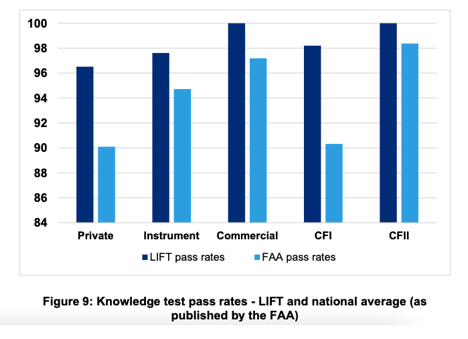
In its petition, it stated historical data suggests LIFT students going through Republic R-ATP meet or exceed the level of safety of the military R-ATP. Historical first time and total pass rates for LIFT students on DPE check rides are above the national average or well above the national average.

Source: Republic Airways Restricted Air Transport Pilot (R-ATP) Program

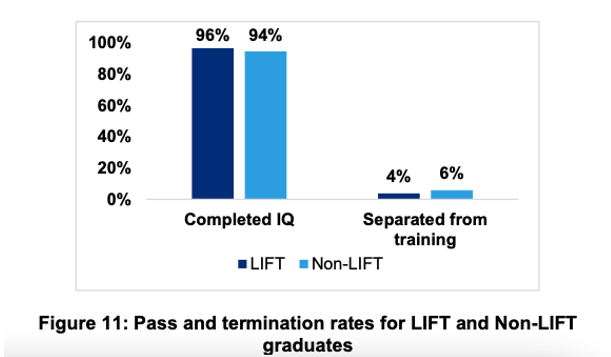
Using AQP line performance data, Republic also compared LIFT graduates with non-LIFT graduates with data showing they out-performed non-LIFT pilots. LIFT Academy graduates consistently exceeded safety standards in line performance, qualification and continuing qualification training.
Improving Training

Training experts want to see a regime based on data proving pilot competency is so good they will do the correct things in scenario-based training every time, not just during the check ride. The quality of a pilot should never be judged on one subjective pass-or-fail test because we’ve seen too many pilots passed along with disastrous results leading to accidents at American Eagle, Colgan, Continental and Atlas.

Indeed, that is why we have the Pilot Records Database, perhaps the most important aviation safety advance to come out of the 2009 Colgan accident. This despite the fact it took nearly three decades since it was first recommended by the NTSB and more than a decade since the 2010 legislation to be turned into an actual rule all while we’ve been arguing over how many hours it takes to make a pilot. It relies on data, but a robust process is, sadly, still in the making.

Training experts just want an objective measure of student performance rather than judging pilot quality solely on the subjectivity of an instructor. We need both. This is so important, according to the WATS speakers, that airlines are tapping aircraft data streams to determine whether what is being taught on the ground and in the simulator is happening in the skies. After determining it is not, they revise training programs using data in the spirit of Safety Management Systems continuous improvement philosophy. All that is going into developing better training programs for higher quality pilots and really makes debates about pilot shortages and time building silly.

“With the perspective of more than 70 years spent focused on aviation safety–related research, education and advocacy, Flight Safety Foundation believes that a pragmatic, data-driven approach to pilot training is essential to the continued improvement of the industry’s safety performance,” said the organization in its 2018 position paper. “The industry needs to embrace, and national civil aviation authorities need to have the flexibility to adopt, competency- or evidence-based training methods that target real-world risk and ensure a progressive and satisfactory performance standard. It cannot be assumed that critical skills and knowledge will be obtained only through hours in the air.”
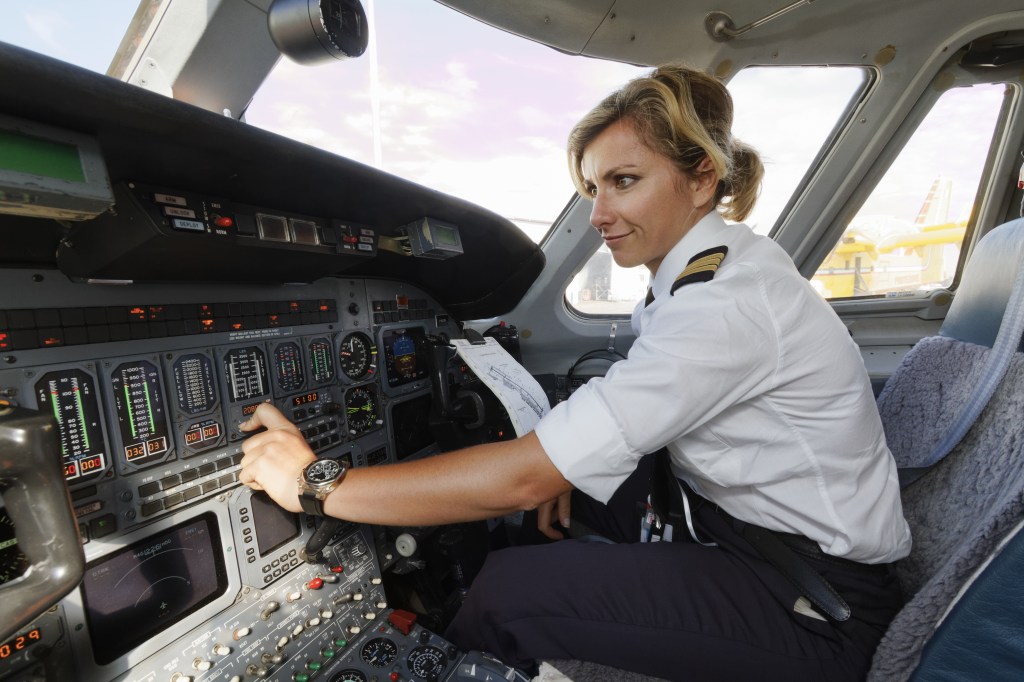
Shutterstock

In fact, Flight Safety Foundation indicated we are asking the wrong questions when it comes to pilot training. We should be asking whether what we are doing will achieve the levels of safety required to meet the growth demand. As thousands of flights are cancelled; as communities lose air service and as airlines scramble for schedule reliability, the clear answer is no.

FSF also asked whether we are using technology, data and experience to maximize training efficiency. Finally, it asked whether we can maintain a sustainable quantity and quality of pilots from our current approach. That answer is also no.

About Producing Better Pilots

Most conversations about pilots start and stop with whether or not there is a pilot shortage and I’ll admit I’ve been lured down that distracting rabbit hole. To be sure airports and airline revenues and growth are feeling the pinch on not having enough pilots, but I think that reducing the entire conversation to economics does a disservice to the serious topic at hand. Worse, the pressure put on pilots is prompting concerns about fatigue which may be compromising safety.

What matters to me is the efficiency and quality of airline pilot training and the blockade forestalling any meaningful aviation training reform, even if it produces better pilots.

While I’ll let the FAA decided on the value of the Republic petition, it seems an important opportunity to improve pilot training and create a boilerplate for other airline academies including those used by the major carriers.

The FAA should not dodge its responsibility because Republic has played by the rules and isn’t asking for anything that hasn’t been considered and granted before. To shirk its responsibility based on mindless opposition could keep us from improving pilot training.

What I can judge is the investment and work dedicated to this effort in solving a long-term, systemic problem is worthy of consideration. If you oppose Republic’s petition then I suggest you do your homework. I have.
FAA’s Jim Brough Honored for Lifetime Achievement in Aviation/Aerospace Education with NCASE Rice Award

By Kathryn B. Creedy — Special to National Coalition for Aviation & Space Education

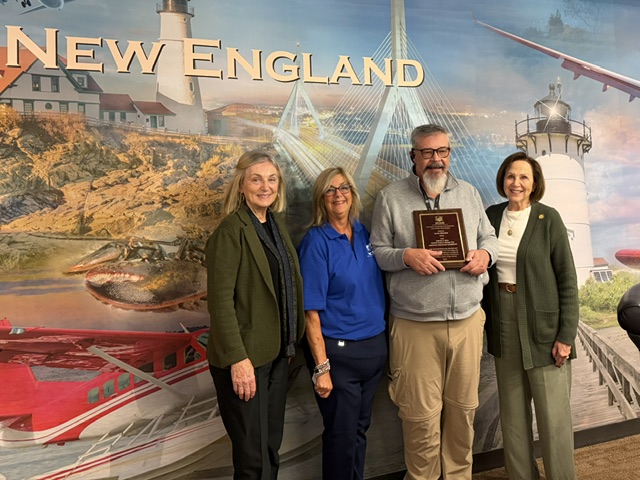
The National Coalition for Aviation & Space Education presented its Judith A. Rice Crown Circle Award for Aerospace Education Leadership to Jim Brough, national aviation and space education program manager at the Federal Aviation Administration.

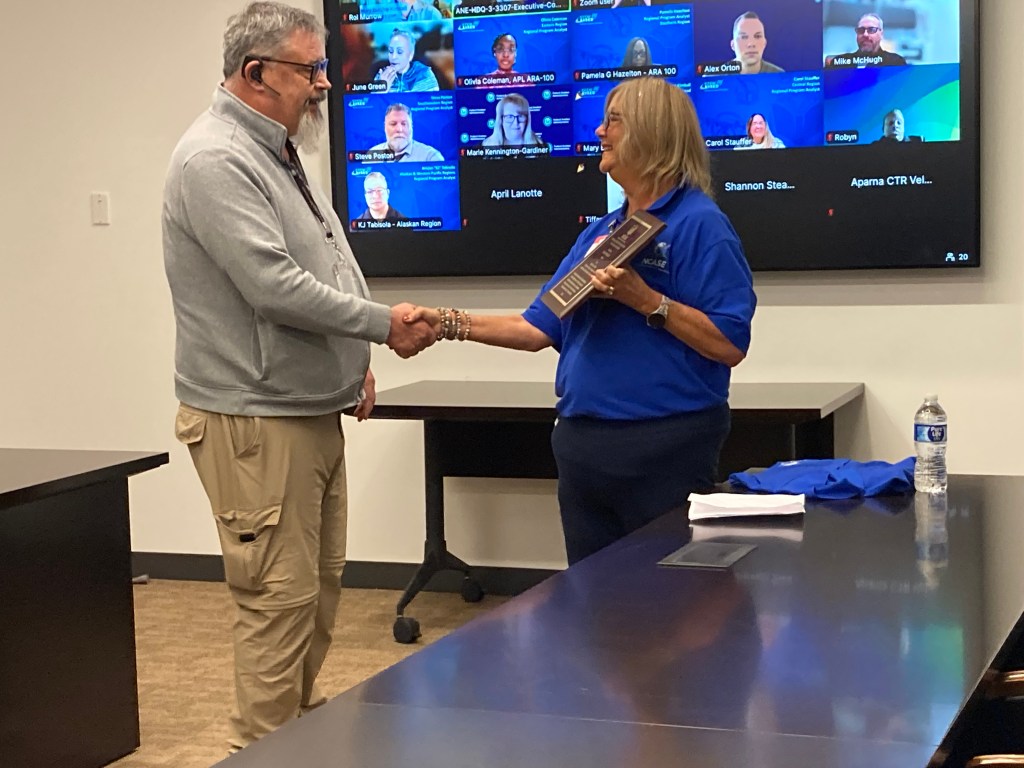
FAA National Aviation and Space Education (AVSED) Program Lead Jim Brough accepts the Judith A. Rice Crown Circle Award for Aerospace Education Leadership from NCASE Vice President Lisa Bacon. Behind them are the many colleagues through the aviation education ecosystem who wanted to celebrate, albeit by video link set up by Jim’s colleague Nitin Rao. Credit: Kathryn Creedy

The award, presented with his family and colleagues in attendance at his Burlington, MA, office, honors Brough’s lifetime achievement in aviation and space education having built on decades of efforts, developing FAA’s STEM AVSED program to what it is today, one of the greatest education assets for educators, parents and students to explore aviation and aerospace careers.

“Presenting this award has been challenged by numerous government shutdowns so it is long overdue, but it is an award from the heart to honor someone who is both respected and loved in aviation education,” said NCASE President Kathryn Creedy. “Whether he is at Kid-venture, Teacher Days at Oshkosh, ACE Academies around the country, competitions with partner organizations, he is always greeted warmly because of what he does every day. We are extremely fortunate to have him in the leadership ranks in efforts to connect kids to our careers. Jim is a role model of how to get the job done.”

Brough is well known in the aviation/aerospace education community as a hub of information and as someone generous with his time for making connections to outstanding aviation/aerospace education programs.

Rice Award Honors a Aviation Education Star

Named for former NCASE President Judith A. Rice, a star in aviation/aerospace education, the Judith A Rice Crown Circle Award for Leadership in Aerospace Education was first presented in 1979. It has been bestowed on the luminaries of aerospace education including NASA Chief Research Pilot Joseph A. Walker, A. Scott Crossfield, The NASA Voyager Team and the Civil Air Patrol Aerospace Education Program.

Rice’s son, Ben, tuned it via video link along with dozens of others. “I know my mother is looking down on us and approving of this award,” he said, acknowledging what many in attendance said.

Judith A. Rice (AKA Captain Judy) is a former president of NCASE, who died in 2024. The NCASE Board re-named this award the Judith A. Rice Crown Circle Award for Aerospace Education Leadership in her memory.

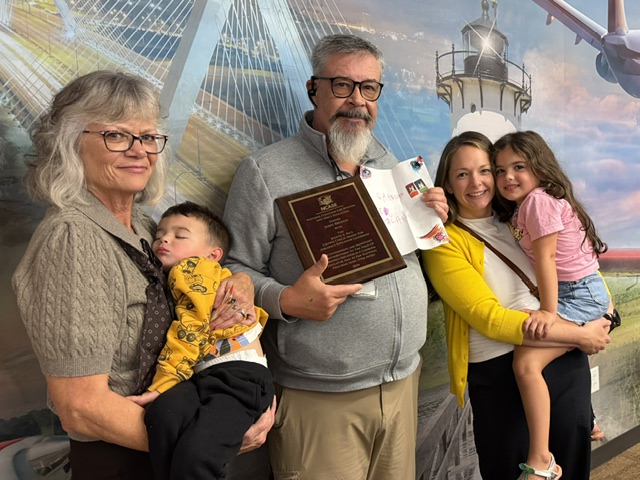
Retired colleagues L-R Amy Corbett and Shelia Bauer flanking Lisa Bacon, NCASE VP, and Jim.

Rice was a dynamic leader beginning as a special education teacher and working for the Civil Air Patrol and the Experimental Aircraft Association as a STEM Aerospace Education leader. She knew no bounds and worked tirelessly with collaborative partners to get educators, students and the public invested in aviation/aerospace education. After a round-the-world flight attempt designed to promote Aviation Education, Rice became a flight instructor at Epic Flight Academy in FL, continuing her pursuit to give anyone who put in the work the right tools to be in aviation.

Brough a Long-Term Aviation Educator

“Honestly, I hadn’t a clue this would happen,” said Brough of the surprise ceremony organized by Brough’s colleagues, family and NCASE Vice President Lisa Bacon. “I thought I was being retired and missed the memo.”

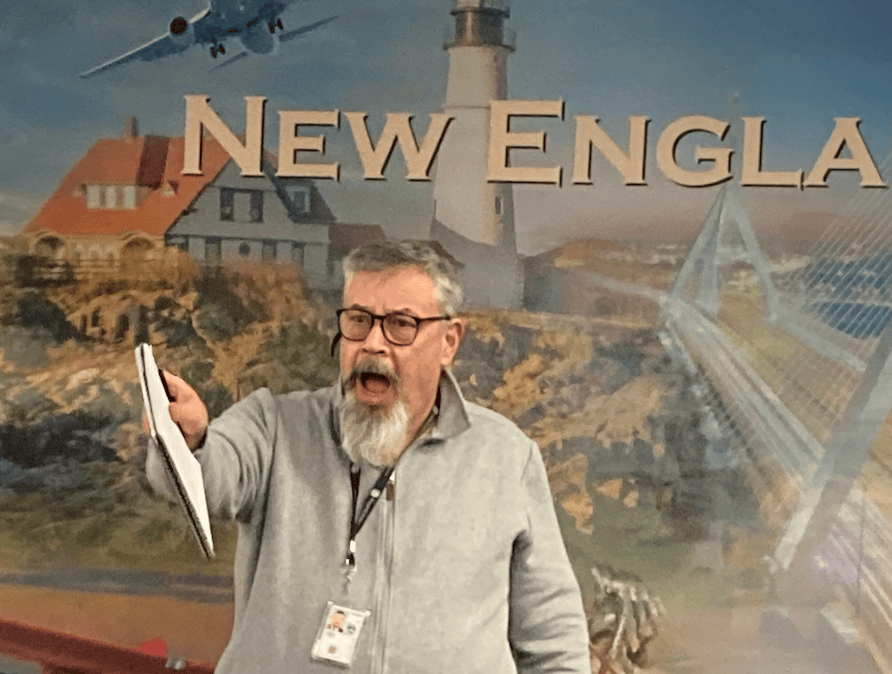
Brough finally recognizing those assembled were not there for the FAA staff meeting he was expecting to attend. Credit: Kathryn Creedy

No way, Jim and his team are too valuable to our workforce development and career pathway efforts.

In the past, his achievements were recognized with the Christa McAuliffe Sabbatical Award and the Excellence in Education, an annual award by the New Hampshire Charitable Foundation that gives an exceptional New Hampshire public school teacher a year-long paid leave of absence and funding to pursue a self-designed project. In 2001, he was inducted into the New Hampshire Teacher’s Hall of Fame after teaching at every level – elementary, middle and high school. He is also an adjunct professor and guest lecturer at local colleges.

In 2008, he brought his experience to the FAA as the National Aviation and Space Education Program Manager. He was responsible for managing all national educational programs and collaborations with partner organizations. He oversaw efforts of over 1,500 program representatives and in 2019, grew the program nationally 254%.

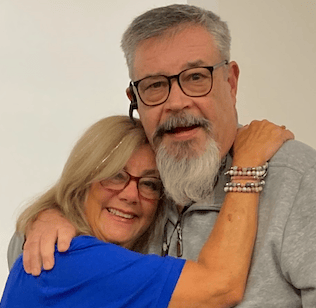
After many years of working together and more years on the NCASE Advisory Board, Lisa signals this award was not only for Jim’s work but because of who he is. Credit: Kathryn Creedy

In 2020, Jim became the National Aviation and Space Education (AVSED) Program Lead for the FAA, a job he continues today. He works closely with industry stakeholders such as National Aeronautics and Space Administration (NASA), National Air & Space Museum, American Institute of Aeronautics and Astronautics (AIAA) and National Association of State Aviation Officials (NASAO).

For NCASE, he is an invaluable member, with NASA’s April Lanotte, of its government advisory board.

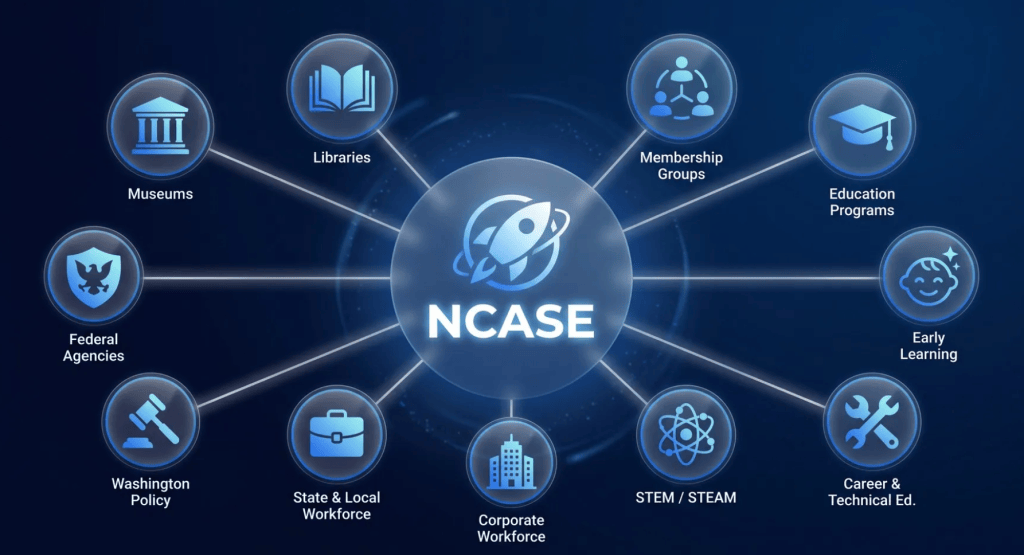
The mission of the National Coalition for Aviation & Space Education (NCASE), a 501(c)(3) nonprofit organization, is to be a funnel to the best of the best in aviation/aerospace education. It equips educators, parents, students and guidance counselors with comprehensive resources on aviation/aerospace education and career pathways. Established in 1993 and revitalized this year, it is dedicated to bringing the recommendations of the four-year-old Youth Access to American Jobs in Aviation Task Force (YIATF) to fruition.

NCASE Launches Membership Campaign

Special to National Coalition for Aviation & Space Education

  • Every CEO is asking the same question: Where is the next generation of mechanics, pilots, and engineers coming from?
  • Every student is asking: How do I start?
  • Every parent is asking: How do I pay for it?

The National Coalition for Aviation & Space Education is launching a new membership campaign to support its mission of answering these questions and to ease the burden of exploring our careers.

This effort, in collaboration with many other aviation/education organizations, will act as a funnel, organizing all the great programming into a searchable website enabling students to identify their local aviation/aerospace education ecosystem and develop an Early-Learning-to-Career Pipeline the industry has needed for 40 years.

The Aviation/Aerospace Education Ecosystem already exists and just need to be organized, connected and promoted to ensure the next-generation workforce discovers our careers.

“With the advent of a new website, crowdsourcing programs not yet listed, promoting aviation and aerospace careers, NCASE is ready to bring the Youth Access to American Jobs in Aviation Task Force recommendations to fruition, four years after it was published,” said NCASE President Kathryn Creedy. “Despite decades of efforts to promote aviation/aerospace careers, we have critical workforce shortages that threaten growth. More importantly, we are leaving trillions in revenues on the table for our aviation, aerospace and defense manufacturers for lack of that workforce. It is time to act and by collaborating with the best of the best in aviation/aerospace education already delivering the workforce, so we can take the frustration out of exploring our careers.”

Three-part Series: Workforce Shortage Stunting Industry Growth, Costing Billions

Membership levels are based on the size of the company, school or the membership organization. We have a special Legacy membership discount of 20% for those who have been a part of NCASE for years.

NCASE founders included Aircraft Owners & Pilots Association, Experimental Aircraft Association, Federal Aviation Administration, National Aeronautics and Space Administration, National Business Aviation Association, National Aeronautics Association, National Air Transportation Association and General Aviation Manufacturers Association. NCASE hopes they will rejoin to help create the Early-Learning-to-Career Pipeline being planned.

Exploring Careers Is Difficult

After discussing career exploration with educators, parents and guidance counselors, NCASE found there was no single resource for exploring our careers despite having dozens of great programs that extend into local communities. Education programs support the need for a one-stop-shop website. The seed money from the membership drive will expand the website and increase the visibility of great aviation/aerospace education programming while promoting careers at a national level.

“There are many great resources, but they offer only a snapshot of a segment of the industry,” Creedy reported. “We found career explorers and educators are tossed all over the internet like a pin ball to learn about getting started. We are now delivering what they asked for in honing their expertise in aviation/aerospace career pathways.”

Most education programming exists in silos which need to be eliminated in favor of becoming a valued resource on aviation/aerospace career pathways in our local communities.

Education Resources Need Promotion

By partnering with the National Coalition for Aviation & Space Education educators, parents and guidance counselors have instant access to free educational programs, complete databases for scholarships, aviation schools, high school programs, universities and trade schools. Education partners can submit their programs and events to be listed. Links go directly to free curricula including the AOPA High School STEM Curriculum, Choose Aerospace and the Space Foundation. There are also links to great kid’s publications designed to inspire and build their interest in pursuing our careers.

“We are competing against every industry to develop, attract and retain the workforce at a time when we are in population decline,” said Creedy, “but they are out-competing us including paying for training. We need to up our game on the visibility of our education programs and careers especially since state-level economic and workforce development officials have all identified aviation and aerospace as key economic drivers and funding training programs.”

The Programs Database on the NCASE site already connects to great resources from the Federal Aviation Administration and National Aeronautics and Space Administration as well as the great membership organizations like Women in Aviation, Organization for Black Aerospace Professionals, Latino Professionals in Aerospace and the other member groups already inspiring kids and guiding them on their career pathway.

Adding your program will build it out into the postal-code searchable resource we are planning.

Join NCASE today to help build the Early-Learning-to-Career Pipeline and access the programming that delivers our future workforce.

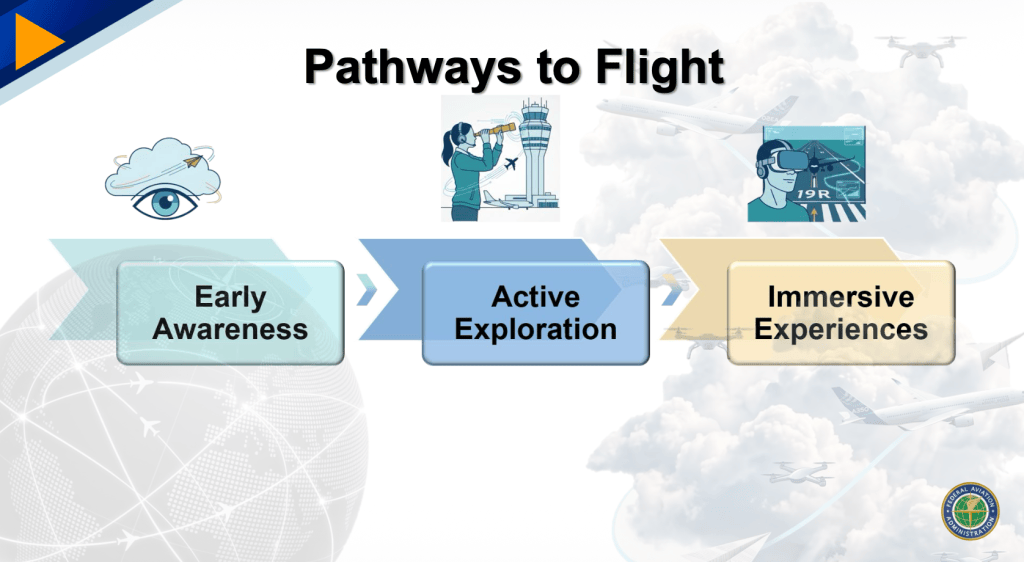
FAA Kicks Off School Year with Pathways to Flight Open Forum

By Kathryn B. Creedy Special to the National Coalition for Aviation & Space Education

With over 100 educators and aviation professionals tuning in nationwide, FAA opened its 2026-27 school season with an open forum to introduce educators to some of the best programming available to connect students to aviation and aerospace careers.

In addition to describing the FAA’s three new educator pathway programs (see related article) – Adopt A School, Aerospace Workforce Educators Program, professional development for educators, and the Airport Design Challenge – the agency introduced NASA, Organization of Black Aerospace Professionals (OBAP), Academy of Model Aeronautics (AMA) and Aviation Start, all five are major contributors to aviation and aerospace education which offer programs for STEM educators, kids, career exploration, model/drone kits and more than $20 million in scholarships.

Educator Programming & Kits

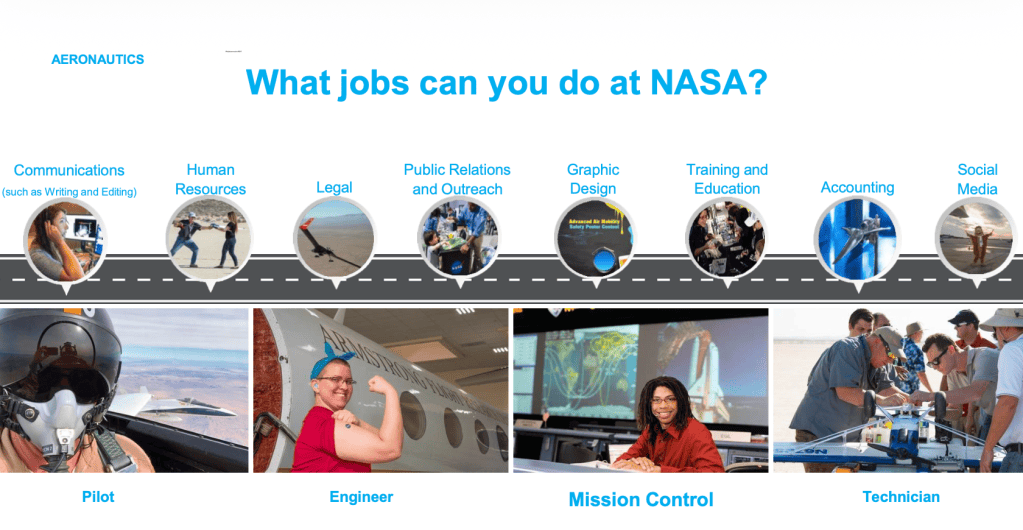
FAA and NASA produce some of the best educator programming connecting students to aviation and aerospace professionals including connections with astronauts on the International Space Station, according to Workforce Development and STEM Integration Lead for NASA Aeronautics Research Mission Directorate April Lanotte.

Providing futuristic career opportunities like returning to the moon, inspiring educators and kids alike, Lanotte stressed the first “A” in NASA – Aeronautics – explaining the mission directorate was focused on the future of aviation, including revolutionizing aerospace engineering methods, automating airspace and safety management capabilities, transforming airframes and propulsion and pioneering high-speed flight. 

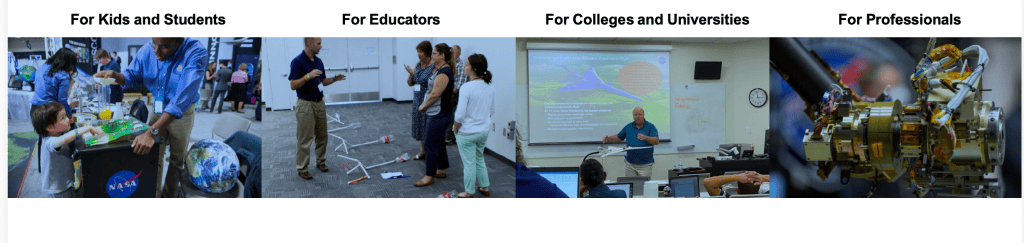
NASA organizes all its programming into a one-stop-shop for educators and students at NASA Learning Resources, a searchable database.

At the university level, NASA’s Aero Opportunities for University Faculty and Students lets them join the NASA research family and collaborate with peers to contribute to the evolving field of aeronautics. To that end it is seeking creative ideas/concepts relevant to NASA Aeronautics from interdisciplinary university faculty and student teams under three programs — The University Leadership Initiatives for faculty, as well as the University Student Research Collaborative and the Gateways to Blue Skies for students.

It’s Space Grant Program encompasses a network of universities, colleges, industry, non-profit organizations, museums, science centers and state and local agencies and funds student awards for those pursuing careers in STEM education, space law and other space-related fields.

Apprenticeships, Internships & Scholarships

Lanotte also discussed NASA’s internship programs which run during the fall, spring and summer seasons and includes educators working on a degree. Meanwhile the Apprenticeship Program matches experienced NASA personnel with those just coming into the industry to pass on their knowledge to the next generation.

NASA, OBAP, Aviation Start and the Academy of Model Aeronautics, discussed the millions in scholarship money available to help families fund student pathways regardless of whether they are pursuing professional certification, college or career training. OBAP also offers a video on its website on how to prepare and apply for its scholarships.

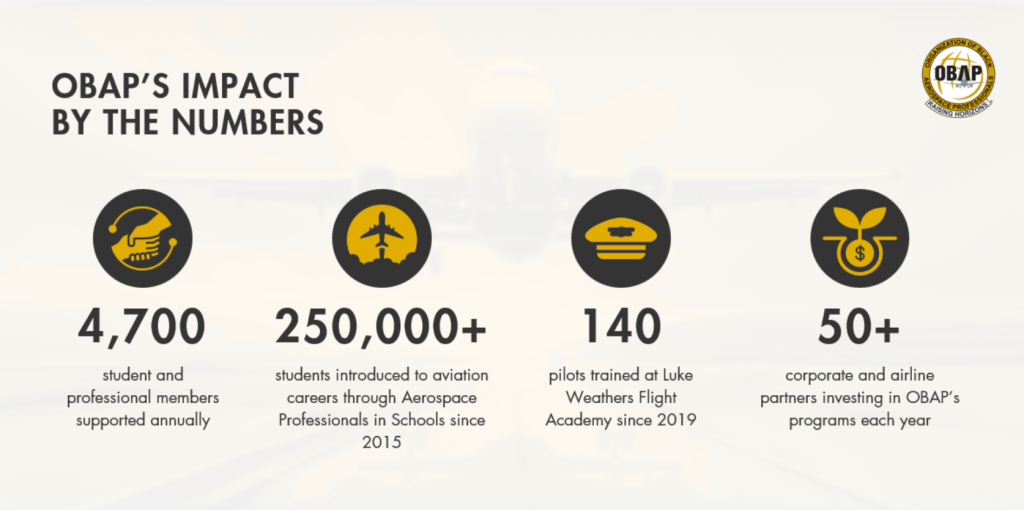
OBAP Scholarships are designed to overcome the financial barriers of pursuing aviation and aerospace careers. Funds can be used for flight and aviation maintenance training as well as advanced technical certifications, college or other aerospace career training. To date, OBAP has awarded over $8 million in scholarships to 600 recipients.

“There are over $20 million in scholarships from over 1,700 organizations,” said Aviation Start CEO Jamail Larkins, who reported more than 2,000 students use its database every month. “Aviation Start is the mentor most students don’t have. Through the Career Zone we connect students to professionals to avoid mistakes and to make the most out of their journey. It is designed to point every student to the right organization whether they want to fly for the military or business aviation or pursue a career in government.”

NASA launched a You Tube STEM Career Series in which each episode features a member of NASA’s workforce, their unique job and personal career journey. Students can dive deeper into a topic related to each episode with a NASA STEM hands-on activity provided in each video’s YouTube description.

Another great education asset not mentioned during the open forum is Scholarship Hacks – Insider tips for Winning College Money by Erika J. Barger. Many scholarships also cover trade schools and certifications such as avionics, flight dispatch and other professions which do not need a college degree.

Events, Kids Programming, Career Exploration

Also on You Tube is STEMonstrations designed as three-to-five-minute videos using the International Space Station’s (ISS) microgravity to demonstrate popular STEM topics. It also enables astronauts working on the ISS to connect to students throuhgh In-Flight STEM Downlinks .

NASA also has a STEM Challenge – the Annual Dream with Us Design Challenge – now open for applications for students aged 13-18 in which teams find innovative ways to respond to natural disasters using aviation. It offers supplemental STEM activities for K–12 and challenge support for educators so all ages can participate.

Resources include STEM in Español, Literacy and STEM, an Educator Facebook Page and Newsletter and Flight Log Experience building a flight log of upcoming X-plane flights.

There are also several publications catering to kids’ interested in aviation and aerospace including NASA’s ISS Magazine Upward. Let’s Go Aerospace! is being sponsored by local companies in schools around the country.

For event planners, NASA Engages provides connections between NASA workforce and STEM learners.

OBAP Youth Outreach and STEAM education

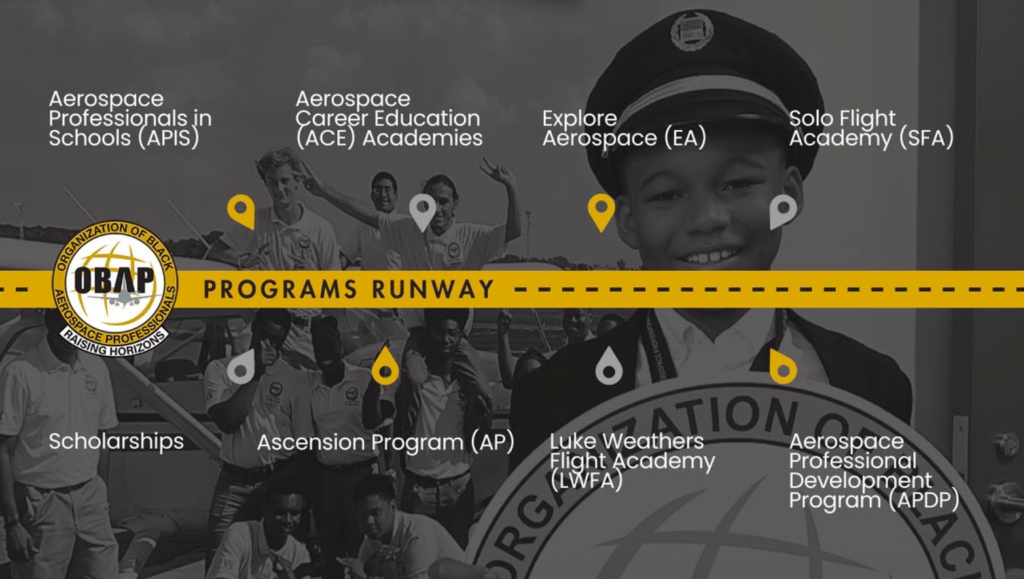
Using flight academies and its Aerospace Professionals in Schools (APIS), the Organization of Black Aerospace Professionals has powerful programs to explore aviation careers, learn to fly and other programs, Antonio Williams explained.

APIS brings pilots, engineers, maintenance technicians and other aerospace professionals into schools and communities to introduce K-12 students to aviation and aerospace careers. One of the most successful programs in aviation education, it has reached nearly 30,000 youngsters in schools and communities with in-person and virtual visits.

In partnership with FAA, it fields ACE Academies to give middle and high school students an immersive introduction to aerospace. The week-long academy, designed for kids 13-18 and often includes a Discovery Flight, teaches aerodynamics, airport operations and exposes kids to air traffic control, airport and other aerospace careers.

Designed for grades 6-12, OBAP’s Explore Aerospace program is a 12-week course providing a deeper understanding of how things work through interactive courses led by industry professionals who demonstrate space and rocket science, drones and uncrewed aircraft systems, as well as aviation maintenance.

Its Solo Flight Academy is an intensive two-week course for aspiring aviators aged 15-18 an introduction to flight training. Students combine 40 hours of ground instruction with up to 10 hours of flight training alongside FAA certified instructors. Held at the Luke Weathers Flight Academy in Olive Branch, MS, students who meet FAA, safety and instructor requirements, the experience may culminate in their first solo flight.

Operating year round, the Lt. Col Luke Weathers Jr Flight Academy offers flight training toward private pilot certification, instrument rating, commercial pilot certification, certified flight instructor certification and advanced rating and time building.

Model Aviation Education Resources

Academy of Model Aeronautics, the nation’s largest community-based organization for model aviation enthusiasts, offers several programs and the opportunity to join AMA Clubs located across the nation. It’s Model Aviation Student Club provides for grants and other benefits including a free membership for the educator who organizes it. It also offers model aircraft kits to teach basic aerodynamics and other STEM work and now offers a Know Before You Fly Discovery Drone Kit and education resources designed to teach you basic safety techniques as well as the limits allowed by Federal Aviation Regulations.

It’s UAS 4 STEM Drone Engineering Challenge helps students learn about drone careers while building, programming and flying an advanced drone.

AMA and OBAP are part of a nine-organization Aero Alliance who leverage their collective aviation and aerospace resources to inform and prepare the future aerospace workforce.

Aviation Start

One of the largest programs in the nation, Aviation Start not only has its annual Dream Launch Tour events inspiring kids, it has a comprehensive scholarship database with an AI agent to help match you to scholarships. Equally important is the mentorship provided to avoid the common mistakes in pursuing and aviation/aerospace career and the shepherd students throughout their journey into their career.

During its 20+ years, it held 1200 live events, reached 68,000+ students and grown to 30,000+ users.

Focus on FAA Education Programs

Special to National Coalition for Aviation & Space Education

Help Wanted – FAA Needs K-12 Educators

Calling all K-12 educators to join the force preparing the next generation aviation/aerospace workforce as the Federal Aviation Administration’s STEM AVSED launches 2026-27 programs.

“By introducing students to aviation, engineering, drones, airport design, and aerospace careers, you can help students discover possibilities they may never have considered,” said STEM AVSED’s Mary Butcher-Kimball, who provided the information for these articles. “Our mission is to support educators with engaging programs, hands-on learning experiences, and connections to aviation professionals that bring aerospace education and career exploration into classrooms and communities across the country.”

The agency developed four educator pathways into a near-turn-key effort to provide teachers what they need to get the job done. (See articles below for full information.)

FAA Education

Resources for Educators

K–12 Curriculum Resources

Aviation and Space Careers

GRADES 3-5: FAA Aerospace Workforce Educator Pilot Program

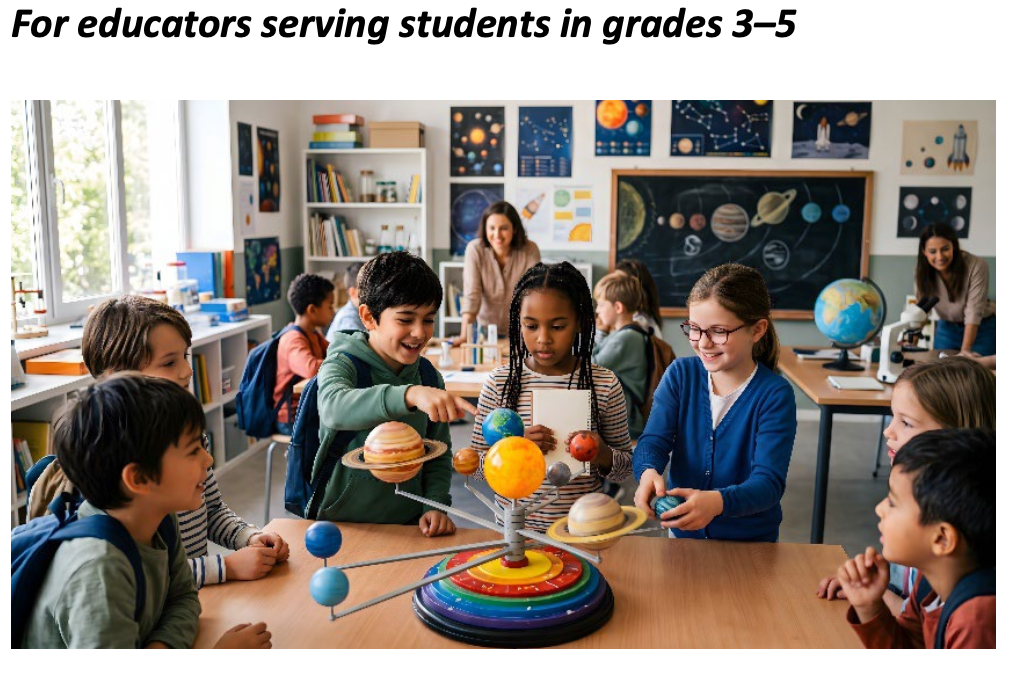
A new pilot program – The Aerospace Workforce Educator Pilot Program – provides a small group of educators with ready-to-use aerospace lessons, FAA engagement opportunities, and resources to help introduce students to aerospace careers.

Ten educators will participate in the inaugural pilot program. Participating educators will receive:

• Six complete aerospace-themed lesson plans

• PowerPoint presentations, classroom materials and student activity worksheets

• Interactive review games

• Support from FAA staff throughout the school year

• Opportunities to connect classroom learning with aerospace workforce and career pathways

The agency will then use educator feedback to shape future educator engagement and aerospace workforce education efforts.

FMI:  Email 9-apl-faaeducation@faa.gov for additional details and information about joining the 2026–2027 pilot.

GRADES 3-5: Adopt A School

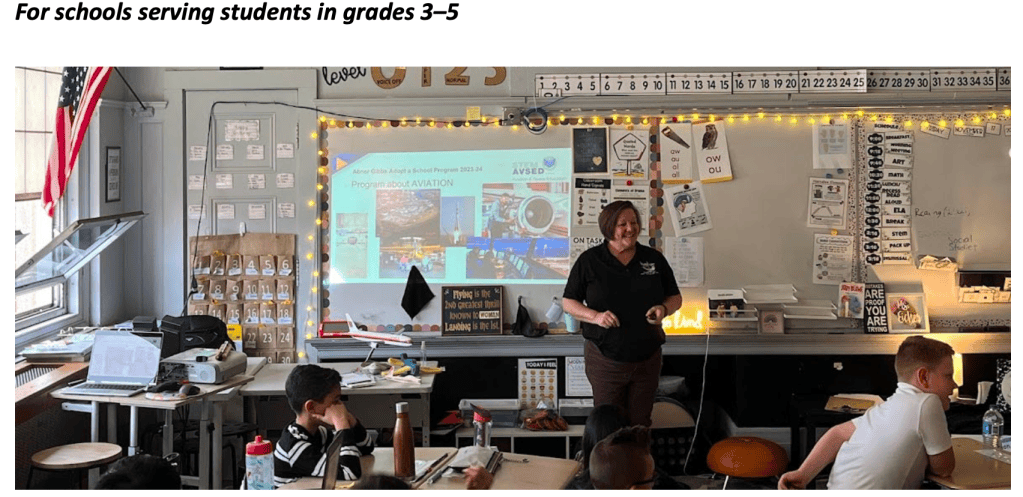
FAA personnel are fanning out across the United States to help schools connect kids to aviation and aerospace professionals and their careers.

During the 2026–2027 school year, participating FAA personnel will partner with selected schools in their local communities to bring authentic aerospace learning and career exploration directly into the classroom through Adopt A School.

Complementing science, STEM, technology, and career-readiness instruction, activities may include classroom visits, conversations with FAA professionals, career exploration, and support for aerospace-focused learning. Activities are designed to help students learn about the wide variety of people and professions that keep the nation’s aviation system moving.

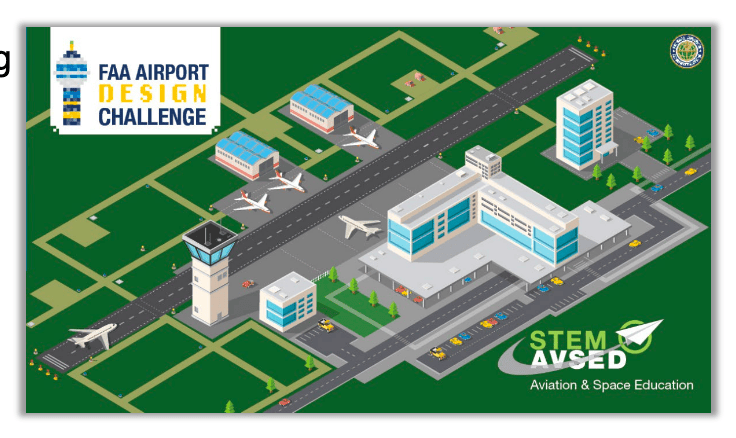
GRADES K-12: Airport Design Challenge

With more than 20 aviation/aerospace student challenges available to schools, the FAA is promoting its Airport Design Challenge designed to help students understand an often overlooked sector of aviation and aerospace – airports. Many communities have an airport – some even have spaceports – but there is little recognition of their value as either an education or economic asset. This challenge is designed to change that.

The Airport Design Challenge (ADC) invites K–12 students to explore aviation, engineering, and airport planning by designing their own airports using Minecraft™. Working individually or collaboratively, students learn about airports, airport operations, engineering, and emerging technologies while applying STEM concepts through creative, hands-on activities.

ADC is available year-round, making it easy to incorporate into:

• STEM, engineering, technology, or geography classes

• After-school programs and clubs

• Career exploration activities

• Team projects

• Independent learning

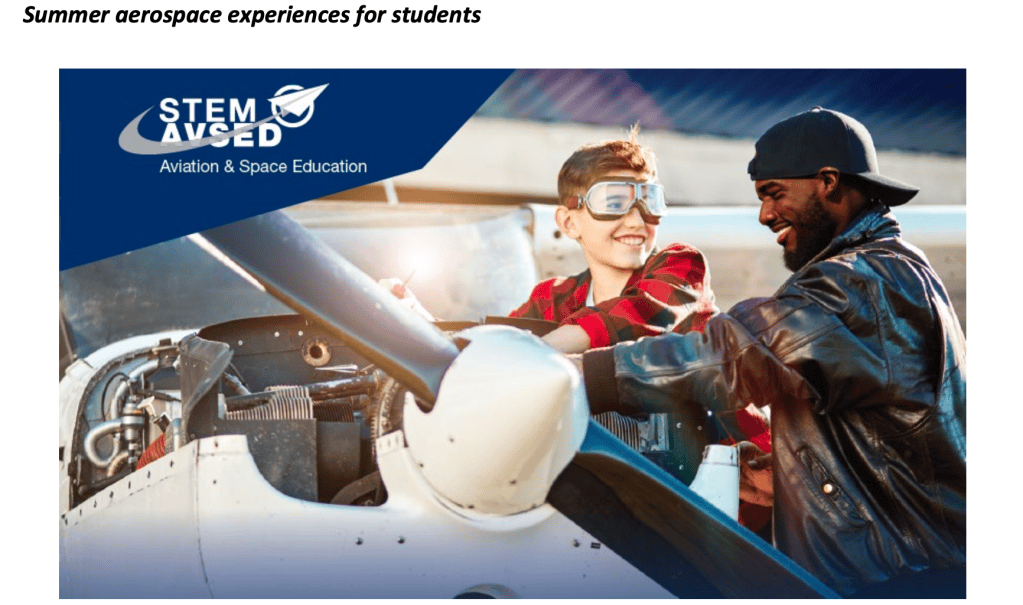
Ages 13-18: ACE Academies – Summer aerospace experiences for students

During the summer of 2026, the FAA co-sponsored 104 Aviation and Career Education (ACE) Academies, many in cooperation with the Organization of Black Aerospace Professionals, giving students an opportunity to explore aviation and aerospace careers through hands-on activities, mentorship, and real-world experiences.

Co-sponsoring enables FAA to provide resources and guidance to organizations interested in bringing an ACE Academy to their community. The agency’s goal for 2027 is to add 10 new ACE Academies throughout the nation and it is offering significant guidance on how to launch one in your community.

Working with aviation and community partners, ACE Academies connect students with professionals such as pilots, engineers, aircraft technicians, and air traffic controllers. Depending on the academy, experiences may include visits to aviation facilities, hands-on demonstrations, career exploration activities, and orientation flights.

See ACE Academies in Action

Find an ACE Academy

FMI: Email 9-apl-faaeducation@faa.gov to learn more about getting started.

Photos courtesy of FAA.

Lessons from the Front Lines on Being Latina in Aviation

By Kathryn B. Creedy

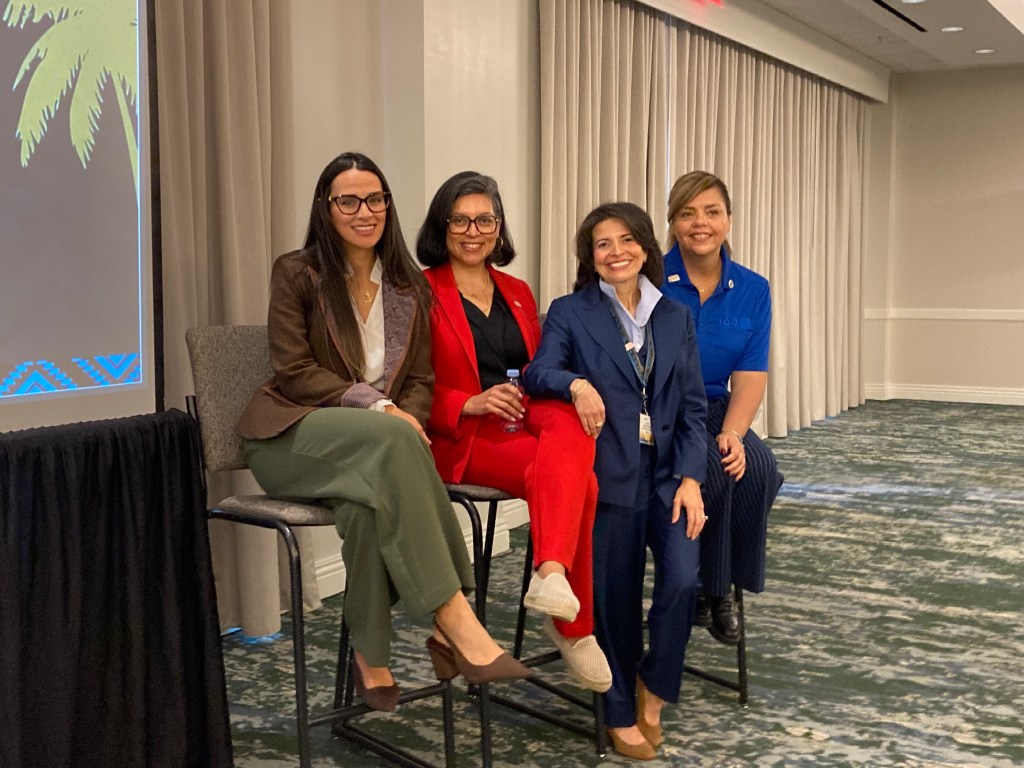
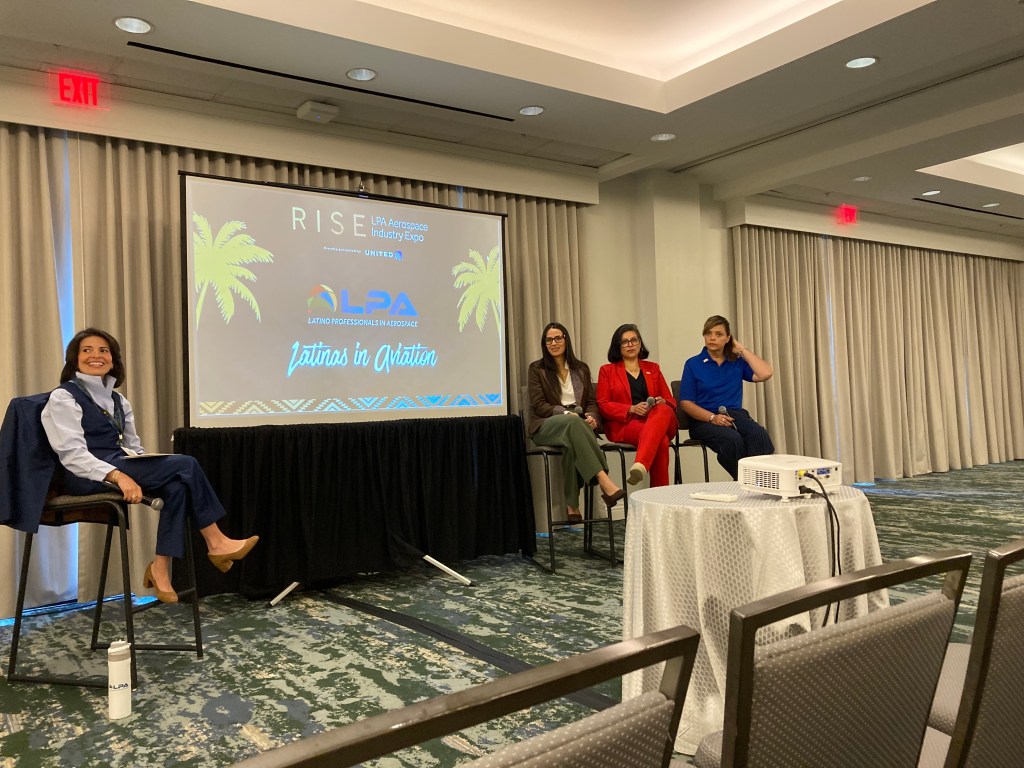
For decades minorities worked to hide who they were, but that is changing as illustrated by the recent Latino Professionals in Aerospace (LPA) conference when former United Airlines Oscar Munoz told attendees to embrace their heritage.

Juanita Valez, Anel Ruiz, Claudia Zapata-Cardone and Laura Allen describe their transition from hiding their heritage to seeing it as a super power. Credit-Kathryn B. Creedy

During the conference, women indicated they hid behind their Anglo names or straightened their hair to “pass” trying to fit into the White World.

Claudia Zapata-Cardone, LPA president, explained she made sure she didn’t have an accent and hid when she was eating her Arepa for breakfast. It was years before anyone knew she even spoke Spanish.

“African-Americans have it worse,” she noted, “I owe my career to the black women of the Organization for Black Aerospace Professionals (OBAP). They taught me about microaggressions which I didn’t even know about.”

Latina Super Powers

Panelist Laura Allen told the packed audience they should also embrace their language skills because “knowledge is power and when you have a second language you have a valuable skill,” she said. “While I want the rules to change to be more inclusive, my experience made me stronger.”

Juanita Valez builds her confidence by knowing the value of the Latino community.

“You have an economic impact and businesses need that,” she said. “Businesses need credibility and to understand how it works. They need to know Latinos – our contribution to the economy and what matters in our lives. Learn how we impact the economy because it positions you as a business expert. There’s no excuse not to know our numbers and know our impact on the economy.

“Today, I want people to know I’m Latina,” she concluded. “It’s like a superpower.”

The Economics of the Latino Community

Given the dramatic drop in birth rates for non-Hispanics, Latinos are now a major force is adding to the working population.

“The future is Latino,” said David Hayes-Bautista, distinguised professor of medicine at UCLA, of a 2026 report on the state of Latinos in America

An article on the study reported:

  • The economic contribution of U.S. Latinos in 2024 surpassed Japan’s, generating the equivalent of the world’s fourth largest GDP.  
  • “Our data shows that the U.S. Latino GDP reached $4.4 trillion in 2024,” said Hayes-Bautista, co-author of the report. “It grew so much that it shattered records for economic vibrancy.”
  • In total, between 2018 and 2024, Latinos added 4.6 million to their population while the non-Hispanic white population reduced by 3.3 million.
  • In 2024, U.S. Latinos’ consumption hit $3 trillion, 25% larger than the entire economy of Italy and 32% larger than Canada.
  • Finance and real estate is the top industry sector for the Latino GDP, amounting to $766 billion in economic activity by Latinos.
  • The number of Latinos with a bachelor’s degree or higher more than doubled between 2010 and 2024, increasing by 144.5% while non-Latinos only rose by 44.8%. Latino educational attainment grew 3.2 times faster than non-Latinos.
  • From 2007 to 2023, the number of Latino-owned businesses, including both employer and non-employer businesses, increased nearly seven times faster than non-Latino.
  • Within that same period, Latino-owned businesses which employ one or more workers grew nearly 20 times faster than non-Latino employer businesses.

Latinos are now a force to be reckoned with, yet another superpower.

Opening Doors

Panelists also discussed how they were reaching back to help others.

“Being the only woman, only Latina, only Hispanic, you feel like to don’t belong,” Valez explained. “Being in that room is powerful. But once you walk through that door, own that room, use that space and identify who else is missing in the room and advocate for them as well. You are not just holding the door for them you are widening the door for everyone. The barrier is there. You must acknowledge it, but it can’t stop you from overcoming that barrier.”

“How are you opening doors,” Anel Ruiz, managing director of people impact at United Airlines asked. “I put my name behind theirs to open the door. I want to take your name into that room. When I got a corporate job, I realized they rewarded vanilla. I didn’t even try to fit in because it felt so awful. But I created an identity. You have to build relationships and carve out a place to feel good about both identities.

“There’s a difference between being invited into the room and having influence once you are there so you can be heard and trusted,” Ruiz continued. “The best lesson I ever received was being prepared to sit at the table. You must show up prepared with knowledge of the subject and a point of view. Show up with questions and the ability to change your mind. A lot of influence happens before the meeting by having conversations with others to understand the topic, their point of view and having them understand yours. If we don’t do that, how are we going to move the needle?”

Allen advised seeking feedback.

“Sharing is important in getting to know each other,” she told the packed room. “What did they see in that meeting? What did I? What were the lessons we learned. What impression did I make, and can I improve? When we share that, leadership will treat you different because they know you now. Building those relationships builds your confidence. Sometimes seeking feedback will hurt but that is how you learn and grow.”

Out of the Mouths of Babes

Valez shared she stopped straightening her hair when her curly-topped, five-year-old daughter asked her why her hair didn’t look like her mother’s.

“I realized you can still look professional even if your hair is curly. The question is, as an immigrant, how do I adapt so I can move and open doors? I stopped trying to adapt. Adaptation is great to open doors but once through the door, what you bring into that room, no one else has. Teaching people about yourself helps them know the culture. Don’t dilute who you are.”

How Allies Can Help

During the question period an ally asked how he could do more to support women and minorities.

“It is a moment to be courageous,” said Ruiz. “You will be seen as an awesome human and a better leader as a result. I try to identify people and build strong relationships with them. The more they are exposed to you, the more they see what you are good at.”

The most important thing allies can do is witness for others by calling out awkward comments. Aviation writer Lane Wallace calls it building bridges with colleagues. That way they are more comfortable calling somone out and saying, “Hey, you are hurting the team.”

On the other hand, Former United CEO Oscar Munoz takes people who make such comments aside, asking them if they really mean what they said. More importantly, he wants to know how they came to have that opinion.

Career Advice from the CEO

By Kathryn B. Creedy

Aviation and aerospace have dozens of conferences but those that represent women and minorities are not graced with the attendance of a lot of airline CEOs. But all of them are a priority for GoJet CEO Rick Leach, who not only supports the organization, shows up but runs an evening Karaoke session for which he has become famous. And, I ask you, in what other venue do you get career advice from the CEO?

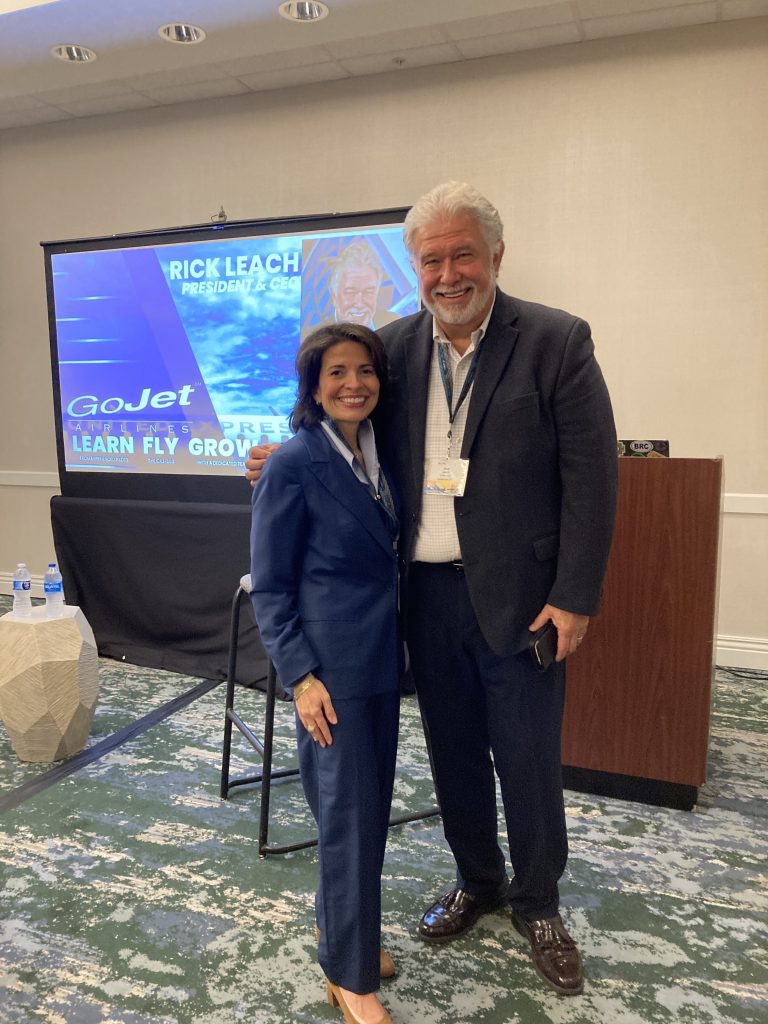
Latino Professionals in Aerospace President Claudia Zapata-Cardone with GoJet CEO Rick Leach who offered career advice to a packed room. Credit: Kathryn B. Creedy

Leach often has a place on the podium to explain why it was so important to start showing up – he needed to raise the visibility of his three airlines to compete for pilots — and why he keeps at it – to keep that visibility for GoJet in the forefront of those who attend these conferences.

Dynamically Powerful Organizations

Leach explained aviation is a relationship business. “But don’t just take,” he said. “You also have to give to create a good relationship. As for organizations like LPA. Show up, get involved and say you have something to offer. I always kept raising my hand to have a voice and to have an impact.”

Making Yourself Stand Out

An important lesson for both airline and candidate is to set yourself apart.

“In the beginning we were not getting what we needed by just sending recruiters,” he reported. “Now, it sets us apart to show up at LPA and OBAP, who have the most dynamically powerful organizations. We want to be an ally. We’ve tripled the size of the company. Perhaps others didn’t have the same need I did in coming to support my team who are great at getting talent. Allyship is so important to us because it brings such strong, like-minded people to our organization. The organizations do all the work so we can be better supporters.”

Leach suggested the other regional CEOs don’t show up because perhaps they didn’t have the same need or felt they were covered by the recruiting team. But as he talked to a packed room at the fourth annual Latino Professionals of Aerospace conference, he said he was there to illustrate the company’s culture. The openness and accessibility of senior management to everyone in the company.

But, he added, it is for the organizations to give CEOs a reason to attend. “You must create an environment so that it makes sense to be here and it may be finding someone to just ask them. They want to know they will have an impact and add value to the proceedings.”

“So, you’ll help us develop a CEO panel for next year’s conference,” LPA President Claudia Zapata-Cardone jumped in.

Always Say Yes

Leach, once a singing seminarian, has a career checkered with accepting assignments he knew nothing about but knew he could figure out. That turned out to be his road to success – leaning in, asking if there were more he could take on to learn theropes.

“You want to put yourself out there,” he told attendees. “I didn’t want to be afraid of trying something. If I hit a barrier, I just found a way around it. You don’t know what you can or can’t accomplish. I said yes to a lot of things and had the blind trust and confidence of the team.”

Then he paused and said, “No one is as smart as all of us.”

Being Bold

He advised listeners not to hesitate in applying for something even if you don’t get it, “it will make you a lot smarter than if you hadn’t tried. You tell the company you want to do more by reaching higher than you actually think you can go,” he said. “In fact, I don’t want someone with all the answers. I want them to have something we can develop in them to make them more successful. How can you improve to get the next job? Leaders love when you tell them you want to do more. You must take the opportunity to let yourself and what you want known. Never shy away from a meeting with the CEO because leaders are looking to develop that person who changes the company and makes it better.”

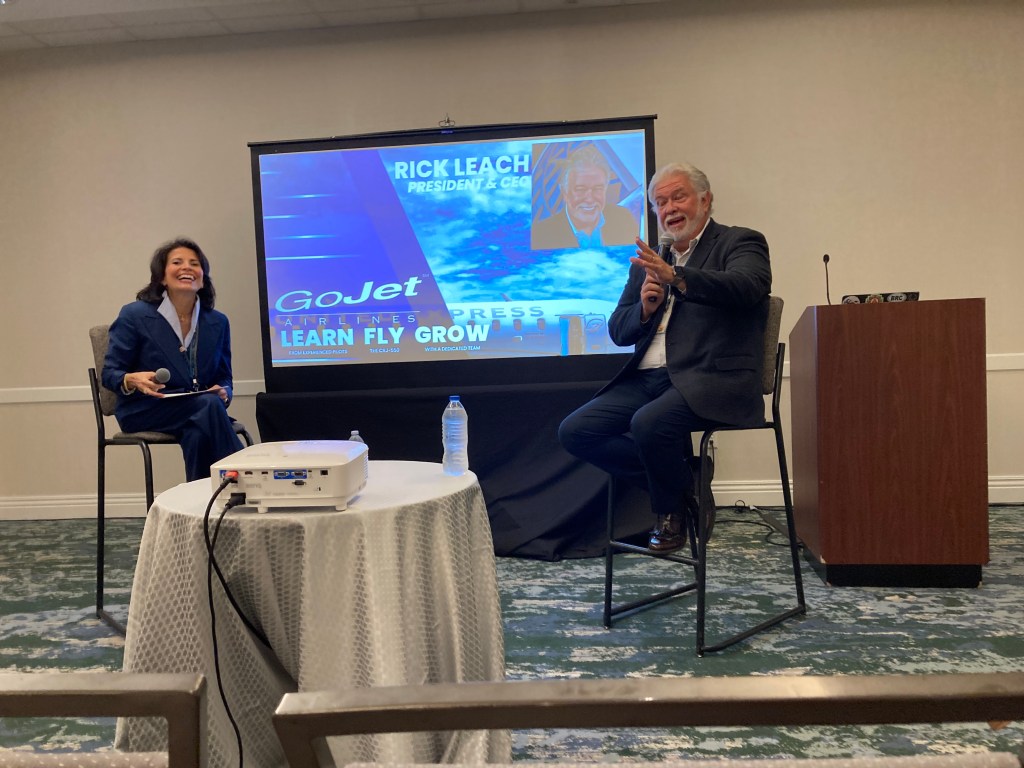
Zapata-Cardone & Leach share a laugh in a lively session during the 4th Annual Latino Professionals in Aerospace conference. Credit: Kathryn B. Creedy

One of his greatest lessons came from the owner of Trans States, who also owned GoJet. CEO Hulas Kanodia had no experience in aviation. “He didn’t know the right or the wrong way to do something, so he developed a new way,” he said. “Leadership is where you learn together to make those ideas a reality. Leadership is to find a way to get the best out of people. Those who molded who I am are those who worked together as a team to accomplish a lot together.”

Great Time to Join the Industry

Zapata-Cardone, who led the conversation turned to culture and Leach echoed former United CEO Oscar Munoz saying it is important to make sure the company fits you.

“The landscape is fertile with opportunities to find the path with LPA and Women in Aviation International,” he said predicting hiring over the next year will be robust. “That’s the value of an organization like this which offers mentorship, engagement and more than $1 million in scholarships a year. It is organizations like this that keep our industry healthy.”

Zapata-Cardone asked him to explain why he thinks aviation is a way of life.

“The more you learn the more you appreciate everything it takes to make it work and the more you understand how it takes us all to do it,” he said. “I’ve been at this for 45 years and I feel as if I still have something to contribute. When you realize you are a part of something that is bigger than you are it becomes a lifestyle. You get to meet amazing people who become friends and you are part of a community that supports you and you are working as a team to get the job done.”

Leach also advised listeners about hiring slowdowns. “You need to find ways to keep yourself relevant to the recruiters,” he said. “That’s the importance of our continuous engagement with all these organizations. When we show up, people notice. When things slow down, we ask ‘where are the ones looking for a home’. The ones who want to be part of a culture, so it becomes an emotional engagement when you get to know people at conferences like this. We wouldn’t get that opportunity without these conferences.”

All Hours Aren’t Created Equal

For candidates, he said it is important to keep up with recruiters. “We know how you look on paper, but we don’t know who you are, so you have to tell us what is going on. How are you challenging yourself to get the best hours you can, not just drilling holes in the sky but actually learning. All hours aren’t created equal.”

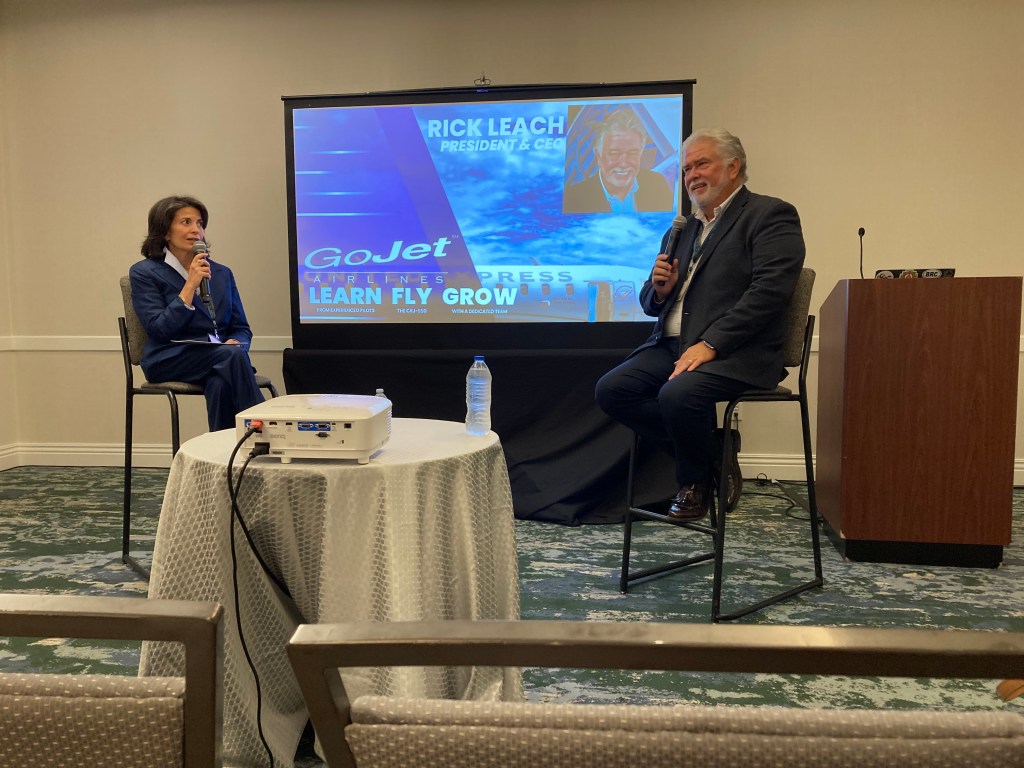
Discussing culture and fit. Credit: Kathryn B. Creedy

That echoes consultants who tell pilots to use these times to add additional skills, like taking a CRM course or an upset recovery training course.

Leach agreed, saying learning new skills is a perfect touchpoint for engagement with recruiters. He also suggested that candidates be themselves and when you make a misstep, turn it into a positive about what went wrong, how you handled it and what you learned from it.

“Find a carrier where you want to build your career. That could be the most important relationship you will have in your entire career,” he said. “Get to know the recruiters keep them updated, keep the engagement going.

“Get a job doing something else at the airline,” he suggested. “That will make you a better aviator. You get to know the operations and the people who make the decisions. We love to see people go up and up and up and consider them first before someone off the street.”

Check out the Fireside Chat Zapata-Cardone had with former United CEO Oscar Munoz

Becoming Familia

By Kathryn B. Creedy

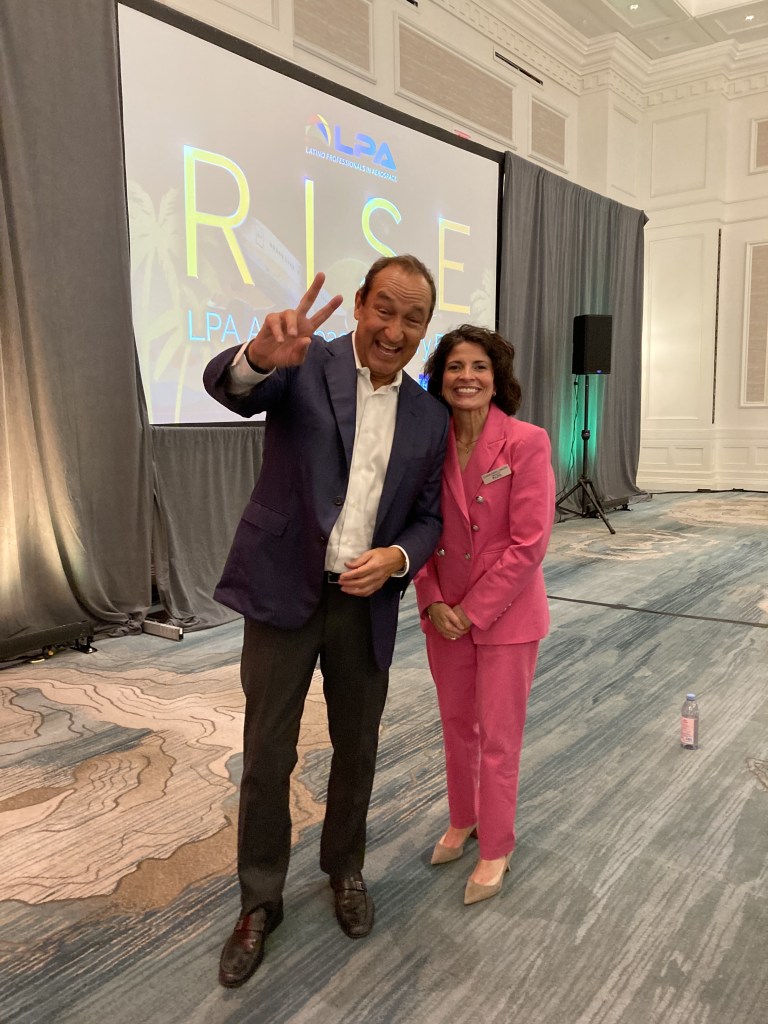
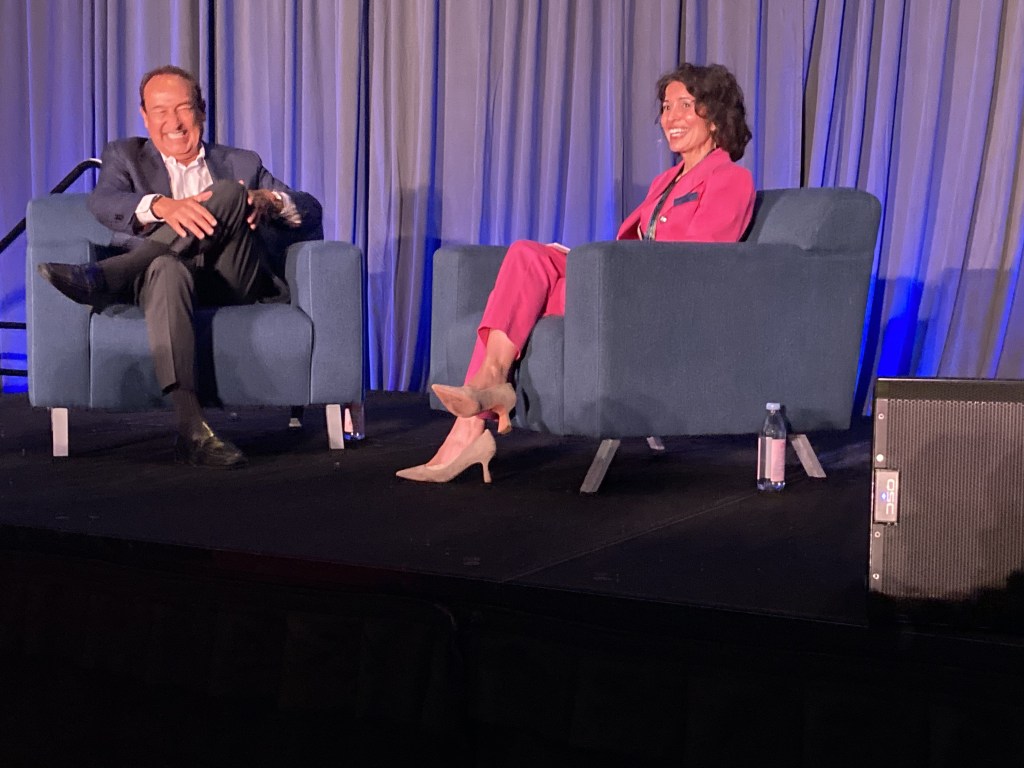
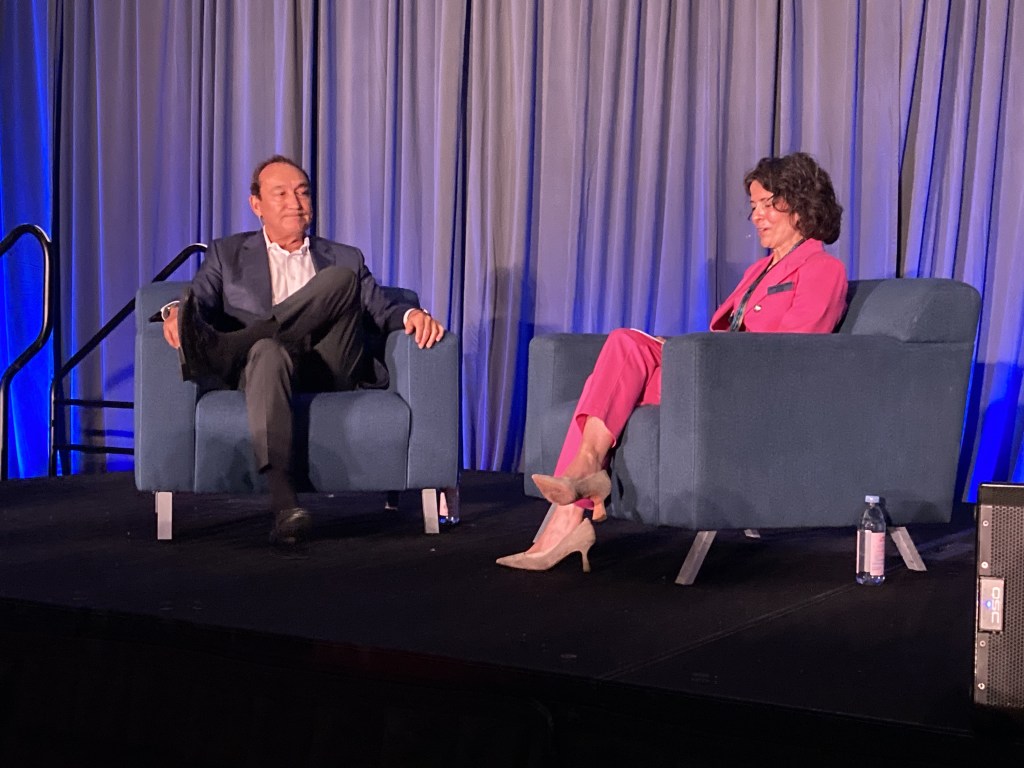
Former United CEO Oscar Munoz & LPA President Claudia Zapata-Cardone during the fourth annual Latino Professionals in Aerospace conference in Orlando. Credit: Kathryn B. Creedy

Orlando, FL, Sept 20, 2026 — As I listened to Former United CEO Oscar Munoz and LPA President Claudia Zapata-Cardone during the fourth Latino Professionals in Aerospace conference, I thought, “this is different.”

I’m used to staid business of the National Business Aviation Association conference or the shock of seeing 5000 women in one place celebrating their roles in aviation at Women in Aviation International.

I was not prepared for the warmth of LPA and felt fortunate to be wrapped in the Latino Familia for two days. Munoz said tears were guaranteed because of Latinos were very emotional and it did not take long when he choked up describing the master class his abuela gave him in humanity or the outpouring of love and support expressed in the thousands of cards he received from United employees telling him to get well and get back after 37 days as CEO when he had his heart attack. He survived to transform United.

“Our culture is emotional that is why coming to this conference is so meaningful,” he said, pointing to the courage and risks LPA founders took in bringing the community together.  “You don’t have to know each other. You just know you’re familia. I felt the emotions expressed in those cards, how caring they were.”

Similarly, Zapata-Cardone choked up when she described her journey to the captaincy of an Airbus A320. Others choked up in their presentations as well followed by the usual apologies. Why do we apologize for being human?

Burden of Perfection

Munoz, who gave his own master class in how to suceed, also described the burden of perfection placed on the shoulders of minorities where you must be twice as good to get half as far, about being called a spicy jalapeño. His main message was to embrace the Latino heritage because no one can take that away from you.

Oscar Munoz and Claudia Zapata-Cardone share a laugh when she told him the reaction of employees to his heart attack. “We killed him,” was the thought followed by the loss of someone very special. But, clearly he survived to advise attendees on how to succeed by being themselves.

“Know thyself – not who you want to impress,” he explained. “Know what you are good at and don’t spend a lot of time trying to be what you are not. I cannot tell you how empowering it was when I let go of that shit and actually let people see the real me. It makes you a better human and that is a good place to be.”

Stop Telling Yourself No

Zapata-Cardone agreed explaining how often she self-selected herself out of opportunities, making every excuse not to lean in until someone told her she short-changed herself. “You told yourself no before you gave us the chance to tell you no,” he said, insinuating she should have thought of the possibility of hearing a yes. Nicole Malikowski had the same story earlier this year as a keynoter at the WAI conference.

When asked how he handled no, Munoz told the audience you learn a lot from failure. “It is more important to question yourself to understand yourself than to worry about failure,” he said. “It is also more important to question whether a job fits you, not whether you fit the job. Knowing yourself is important. But I listen and understand their point of view. That’s what I was doing at United.”

There is no better definition of leadership which he called an act of extended story telling. Leadership is not about knowing all the answers but in surrounding yourself with the people who can solve the problems.

“If you don’t know yourself, you cannot lead,” he said. “You must find out what works for you, what matters to you and be that leader. Look for the leadership styles you want to emulate and find out what works for you. Tennyson wrote you are part of all the people we have met along the way. Embrace that.”

When he became CEO of United with no aviation experience, he knew himself well enough to know that he could fix it. “I trusted myself,” he said, adding at his first earning call he realized he had no clue how. But he launched a listening tour to find out from employees what they thought was broken and how it to fix it. “I’m humble enough to always listen. I met one flight attendant who said, ‘I’m so sick of the constant apologizing for our failures.’ After that, I went back to how I was raised. I actually care about people and I want to know who they are and what drives them because if I know who you are, we’ll become friends.”

His road to success was built on caring and integrity.

“Trust travels only at the speed of your honesty and your transparency,” he said.

Aggressions — Micro or Macro

He is not shy about asking people who tell off-color jokes whether they actually mean what they say and how they came to think that way. It has led to some interesting conversations, but it has also revealed the challenges we have in changing minds. The bottom line, however, is putting them on notice that is not acceptable behavior.

“While we cannot control others, at the end of the day if you can walk out of the office knowing you did your best, that carries the day – not with everyone but with enough,” he concluded.

Florida Aerospace Training Center Contributes to the 21st C Industrial Revolution

By Kathryn B. Creedy

In the 1960s movie The Graduate, Dustin Hoffman was told the most lucrative career was plastic. In the 1980s, it was computers. Today, in the 2020s, it is trade skills because many expect these careers to be bullet-proof against Artificial Intelligence (AI).

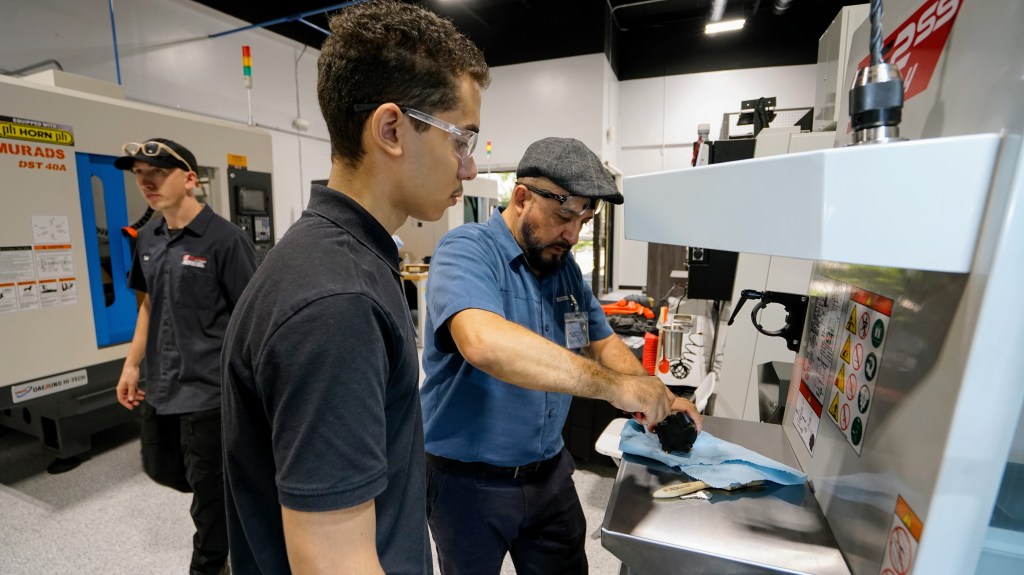
The Aerospace & Defense Training Center opened earlier this year to provide short-term, hands-on training meeting local employers’ specific needs. Credit: ADTC

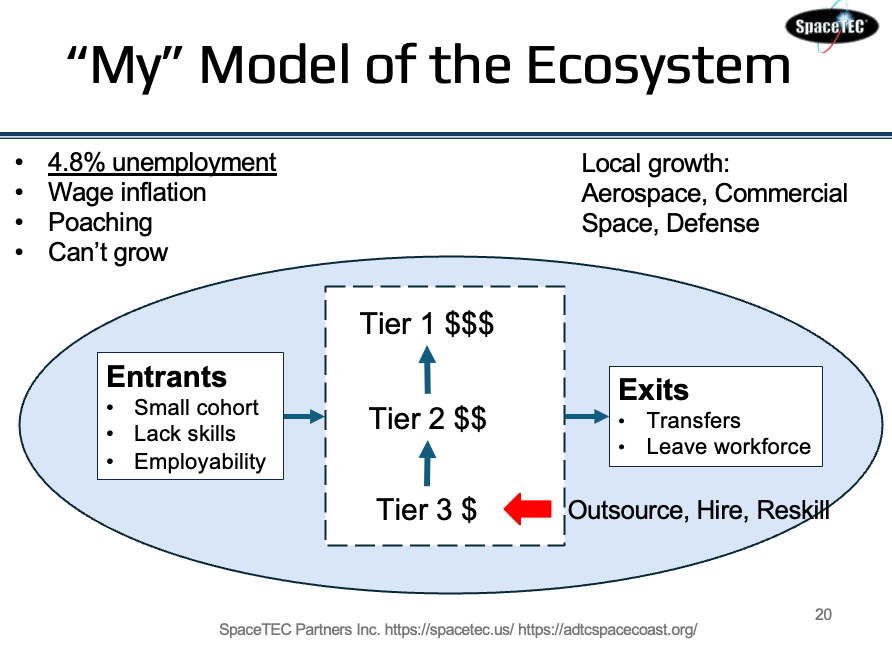
In Florida, a new training center developed a new training model for the aerospace community — one focused on short-term training to meet a specific employer’s needs that ensures the machines keep running. And it addresses one area that is little discussed in workforce development — small- and medium-sized companies who invest in training only to watch that investment walk out the door in answer to a solicitation from a larger company. The key is retention rather than recruitment.

Focus on Trade Skills

The overwhelming shift to trade skills in the past decades is a reaction to college costs and the Great Recession but it also provides a lifeline for the unskilled, the unemployed, the underemployed and those threatened with job loss owing to AI. We first saw it with teens in high school more than a decade ago as a hedge against college costs and it is now attracting displaced workers and those seeking second careers.

That shift has paid off as employers, too, have shifted from degree credentials to skills hiring. To illustrate the demand, the entire graduating class of Eau Gallie High School’s Aerospace/Aviation Assembly Program was already employed before graduation, snapped up by commercial space companies. In addition, the Brevard School District’s Career & Tech Ed programs added aerospace, drone and manufacturing curricula around the county. Just down I-95, in Vero Beach, Piper Aircraft worked with the state’s workforce development program – CareerSource – to develop a training program for its manufacturing of general aviation aircraft and trainers.

All this innovation also illustrates a great strategy to mitigate college costs as these teens enter the workforce and leverage employer education benefits for higher education or certificate training. In the future, employees will be in a continuous education mode as technology changes and pursuing stackable credentials will keep them relevant, according to this article in Future Aviation/Aerospace Workforce News.

Today, that shift is focusing on aviation, aerospace and defense and states across America have identified aviation and aerospace as key economic drivers so what is happening in Florida is happening in every aerospace, aviation and tech arena around the country. As a result, they are not only funding trades training – including aviation maintenance and manufacturing – but they are building training centers to meet the demand for skilled professionals and developing a pipeline that attracts kids as young as middle school. Massive workforce shortages from pilots to aviation maintenance, dispatchers, manufacturing and engineers is so severe, it is now threatening the unprecedented growth expected in these industries.

Time for Training Compressed

The problem is training takes time and feels daunting to those entering the industry for the first time. But with a new training center on the Space Coast of Florida, the focus is now on short-term programming specifically addressing local employer needs using a combination of online and hands-on learning.

Speaking before the Space Coast Alliance for Tech & Innovation (SCATI) event, Tom McCullough, program and operations manager at the Aerospace and Defense Training Center (ADTC) near the Kennedy Space Center. “ADTC’s mission is to provide short-term training not provided by the state’s community colleges. It is also tasked with developing the entry-level skills to take someone with no manufacturing experience to the production line.

“The goal here is to enable our manufacturers, especially small businesses, to retain a competitive edge when it comes to the workforce and to maximize the return on investment in training,” he reported. “The current pattern in business is to grow, level out and then shrink. Our job is to identify the skills gaps, reskill, upskill and backfill. Instead of shrinking, promoting and reskilling costs far less than recruiting. Recruitment costs, the costs of having a vacancy, paying a premium wage owing to scarcity, onboarding, productivity ramp up, risk of early turnover and security clearance all come at a high price. But if you have a staff, you save in recruiting and onboarding because it is quicker to reskill and get them up to speed once they hit the production line. You not only build loyalty but by adopting these strategies companies become the employer of choice.

“Manufacturing needs a workforce of about 1.9 million,” McCullough continued. “About half of these jobs could go unfilled without major workforce changes. The biggest challenge, say 65% of manufacturers is attracting and keeping talent. But the biggest pressure is on the small companies, who invest in training only to see their workforce go to the bigger companies. That leaves them, once again with staff shortages and production delays. They can least afford this pipeline cost, yet they are the ones tasked with preparing the workforce. Promoting and reskilling develops the loyalty they need.”

Indeed, a recent Aerospace Industries Association (AIA) report cited concerns about the shortage of parts and the decline of parts manufacturers, its two top findings after surveying the industry, according to a report on how workforce shortages are stunting industry growth in Leeham News and Analysis.

McCullough argued the advantages of the training delivered by ADTC go far beyond saving recruiting and onboard costs, but builds capacity and resilience, retains institutional knowledge, becomes a pipeline for future leaders.

“It signals the company will invest in the talent it already has,” he explained. “It improves employee morale and it reduces attrition. Our goal is to maximize the value of the workforce development strategy. Reskilling from within is best overall value for the employer looking for lower-cost alternatives without sacrificing quality and performance. Promoting from within ensures that open roles are filled by people who already understand the company’s mission, values and operating environment. The goal is to keep the machines running.”

ADTC not only develops the skills training needed but a new training model for the aerospace community, that not only saves recruiting and onboarding costs but is a faster route from training to the production line. Funded by a grant from Florida Commerce, ADTC is just one arrow in the state’s quiver to address the needs of its employers. Indeed, the Florida Atlantic Workforce Alliance surveyed companies on the east coast of the state and identified four key areas in need of workforce training and delivery – aerospace, defense, aviation, manufacturing and cybersecurity. Turns out it’s no different across the state nor, indeed, the rest of America.

A tour of the ADTC facility in Titusville, FL, which opened earlier this year, meant weaving through manufacturing processes that can produce a trained employee in a few weeks. The specialty training includes certified aerospace technician, aerospace coatings specialist, aviation structures, basic composites, basic and advanced electricity and electronics all to the specification of such professional organizations as the Precision Metalworking Association for metal forming technicians. It also follows the American Society for Testing and Materials guidelines for nanotechnology including fabrication, as well as aircraft electronics technician, aerospace aircraft assembly, unmanned aircraft system maintenance and aircraft electrician training in the electrical wiring interconnection system.

The program is part of the Space Coast Consortium Apprenticeship Program (SCCAP) which includes 20 Space Coast employers and combines paid, on-the-job training and classroom instruction through Eastern Florida State College.

Local business leaders gather at the opening of the ADTC earlier this year. Credit: Kathryn B. Creedy

The training is short term, accelerated and targeted and blends online instruction with hands-on experience leading to industry-recognized certifications. The employer then provides on-the-job mentoring. Special emphasis is placed on manufacturing essentials including machining, blueprint and GD&T as well as composites and cybersecurity.

As the world worries about AI, a new industrial revolution is at hand…one based on skills.

ADTC is part of a broader initiative called SpaceTEC, a National Resource center for Aerospace Technical Education, providing skill-based, nationally recognized professional certifications for the U.S. Aerospace Industry. It includes a Schools to Space Program.

Have Women Leaders Been Used to Maintain the Patriarchy?

Chisom Udeze makes the case that despite the progress women have made in the past 50 years, it is an illusion because it is designed to uphold the patriarchy. She argues that when we try to force cultural change, we are no longer tolerated and retribution is swift.

By Kathryn B. Creedy

I was at once validated and challenged as I listened to Chisom Udeze’s podcast Gender Equality is Designed for Some White Women, a correct and uncomfortable look at our efforts at equality.

I’ve long noted the corporate diversity, equity and inclusion efforts inside aviation and aerospace companies seems to stop at women – and I realized Udeze is right – it stops at white women. This is not to say women, including women of color, haven’t broken the glass ceiling but it is to say their power for change is questionable. Thankfully, there are hundreds of others working to connect with underrepresented communities to bring them the opportunities our careers represent.

“Big companies benefit because with more women in leadership it is better PR,” Udeze stated. “But the extraction doesn’t change. Think about the men in this new ‘equality’. What we have seen to date does not to address their dominance. White women are given access to power but no accountability for how they use it. If representation doesn’t come with structural change, it’s performance. If access doesn’t come with accountability its BS, quite frankly.”

The uncomfortable bit here is whether or not our aviation/aerospace womens’ organizations are doing the same thing. I’m frankly not sure, I just know what I observe.

I know the cultlure has not changed. I know the culture women face is the same destructive culture affecting people of color, the LGBTQ+ community, the disabled, the neurodiverse – both male and female. I also know that every underrepresented group has their own organization to represent the different constituencies and their needs. Finally, I know we haven’t come together as one voice to force cultural change.

But here’s a bigger question. Has the current structure in which we live been successful in dividing us, so we only look to our own needs rather than joining together to force change?

Are we selling society short by focusing on women alone? Are we selling society short by focusing on educated women and not focusing on the marginalized in society Udeze urges us to remember?

In the past year we’ve witnessed how high-profile DEI efforts were largely window dressing, mere PR announcements that are gone with the change in the wind out of fear of the backward policies of the new administration. While I, and a lot of others, doubled down on our support for DEI, it still took a back seat as companies and institutions backtracked and their employes said they were afraid to even like our social media posts.

Culture Change

You’ve heard the two theories of culture change which centers on sexual assault, harassment and discrimination. One theory is if we get the story out there, things will change. But there are thousands of stories out there and nothing has changed. The other theory is – and what most women’s organizations strive to do – if we get more women in power, things will change. Well, there are thousands of women leaders, and nothing has changed.

“For this reason,” Udeze says, “women are not free, they are just being sold a version of equality that requires them to uphold the very system of oppression including eventually themselves. If we think in terms of centering liberation on the marginalized, it dismantles oppressive systems. For women to be successful, full liberation means the redistribution of power, not just rearranging it.

“What are we actually talking about is women getting access to the same spaces, salaries and system men have always had,” Udeze continued. “That means the board rooms, the C Suites. It means equal pay and leadership roles. But here’s the question. Equal to whom and equal access to what? The reality is the gender equality movement – the one companies talk about, fund and they hashtag about – was built to make certain white women become ‘equal’ to white men not to dismantle the systems that exploit everyone and not to redistribute power. It has only rearranged that power on who gets to hold it.”

Udeze cites how the first woman CEO is celebrated but asks whether her presence has changed the structure or just the person at the top. “What is she the CEO for, what does the company extract and from whom, who does it exploit,” asked Udeze. “When we push for equal pay, we celebrate white women closing the gap with white men, but we ignore all the other women who make less and less and less.”

Existing Outside our Comfort Zone

As women we are told to get comfortable being uncomfortable in the workforce as we push for our rights. It should be a message for the entire workforce. While I am uncomfortable with some of her in-your-face language, I was grateful because it was closer to the truth than I think we’d like to admit largely because if we accept responsibility that women leaders have not changed the culture, it becomes a blame game when it should not.

So, for this White American woman, I was challenged to ask whether women have actually been liberated or just coopted to serve the interests of the patriarchy as Udeze suggests. I have long thought we have been coopted.

We are forgetting the have nots in our quest for equality. She forces us to ask if we are part of the exploitation. Recently, I read Holding It Together: How Women Became America’s Safety Net by Jessica Collarco which makes the case that polarizing politics have been used to force women into an untenable role which maintains the patriarchy.  It illustrates a major problem. As much as working-class women try, it is always one step forward before confronting rules that place them 10 steps backward. Udeze points to these marginalized women – care givers, older workers, the undocumented, the disabled, immigrants, sex workers and “all those who are too busy holding everyone else up” to move into the equality arena.

“We must ask whose equality are we centering on,” she said. “It is the mainstream white, educated middle class women? Who gets erased? Working class, women of color, fat women, Muslim, trans and disabled women.

“If we are not including the most marginalized in society, we are just creating a new flavor of keeping the status quo,” she continued. “We must ask what systems shapes inequality. Systems create gender inequality and it’s the same system that creates racial and class inequality and all other forms of oppression. We can’t talk about gender equality without talking about race, class, disability, appearance, immigrants, sexual orientation. If we don’t do that, we are not making a difference. We are only rearranging the furniture.

“Equality without justice is just assimilation,” Udeze concluded. “Representation without redistribution of power is performance and access without accountability just creates new flavors of gatekeepers and it doesn’t serve anyone not even white women.”

Thus, it is for those of us who can fight to represent them as well. The lack of societal supports – provided in other industrialized societies – means we all remain oppressed and become part of the exploitation because, as Collarco maintains, the patriarchy is still being used against us. Becoming America’s safety net without addressing the under- and working-classes continues the exploitation.

It’s About More Than Women

Through Udeze’s lens more women in power haven’t changed exploitation, wage theft and has not upended the system in which race and class are exploited with most of those affected – care workers, domestics, service workers being women of color.

But here Udeze is missing a real problem – in our quest for gender equality, we are failing marginalized men who face the same culture and constraints as we do. The anti-DEI movement is as much about them as it is about women. Indeed, if you know history you see the entire merit argument is just 21st Century racism.

In fact, those who insist on merit are full of crap unless they are working tooth and nail for equal opportunity. Without that they will always be judged on their white male privilege.

Culture is the number one issue confronting women and minorities in aviation and aerospace. The studies that have been done focus on women including the Women in Aviation Advisory Board which cited culture as a top concern. It’s the male-dominated culture. (Recently, someone at the Women in Aviation International conference said she hated that phrase because it is just the dominant culture, period.) I agree. And it is not unique to aviation/aerospace, it is societal.

It’s About Safety

It is only in the last few years researchers like Kimberly Perkins have made a strong case that culture is inextricably linked to safety. Last year, I criticized WAI for not linking its allyship discussions to safety during the conference. While most of us think about aviation safety, I think about how safe it is to be a woman, a person of color or to have a different orientation in our society today. That is of equal importance.

“We also need to be honest about something,” Udeze said. “Even for white women gender equality is an illusion because the way we practice it serves the patriarchy. As long as women remain young, appealing and useful to the patriarchy they are tolerated,” she said. “But the moment white women age out of desirability, or she no longer fits the narrow frame of cute and obedient; the moment she challenges power instead of performing it, she too becomes a problem. The patriarchy does not liberate white women it changes their proximity to power, and it reworks that accessibility the second they stop serving patriarchal interest.”

Now you understand why I was outside my comfort zone. Then I heard this:

“Older women become invisible,” Udeze continued describing the excruciatingly familiar. “Ambitious women who speak up get called aggressive. Women who speak up are labeled difficult. Women who refuse to perform femininity the right way get punished. White women were never really given equality. They were just given conditional access and that access depends on them staying quiet, compliant, young, pretty and nonthreatening enough to be tolerated.”

Source: Science in HD via Unsplash

Recognition dawned. But we must also include the underrepresented men. If anti-DEI is attack on one, it is an attack on all and only serves the status quo.

“What we have now – conditional access to power – is not what we need,” she said. “We need transformation for our collective liberation of all women, even the ones we’ve marginalized. “Not equality on men’s terms but liberation on our terms. Can we imagine that? I think we can and, more importantly if our daughters, sisters and nieces are to have a future. We must.”

“Inclusion is Not About Special Treatment it is About Different Design”

By Kathryn B. Creedy

Those are the words of Katherine Moloney, CEO, Ellevate (her) Aviation as she was speaking to Shaesta Waiz on her powerful Aviate Podcast. The discussion was a game changer for me because it raised so many issues being discussed on LinkedIn and in the halls of the recent Women in Aviation International conference. The podcast link is below is here: Aviate with Shaesta and Katherine Moloney

While Ellevate (her) is European focused, it is expanding into Africa and just opened a Middle East office, spreading the support for women in aviation far afield from its British roots.

The discussion was about aviation design of uniforms and of aircraft, something I learned about during Jessica Rutterber’s presentation at WAI. While I’ve long complained about uniforms along with pilots and aviation maintenance technicians, I never thought of aircraft design, unless I was hitting the head on a commercial aircraft. Yeah, you know what I mean.

“Research we’ve done indicates 40% of flight schools do not provide a woman’s uniform, constituting another barrier for women,” Moloney told Waiz in the interview. “In addition, 16% of flight or engineering companies do not have women’s facilities. Those may not seem to be big things in the grand scheme of things, but they say you don’t belong here. When you look at manuals, books and exams they all refer to a pilot as ‘he’ and that contributes to the culture as well. That says you don’t belong. That is your baseline that shows you won’t be equal.”  

Why Gender Neutral Terminology is Important

These are just some of the unseen barriers for women, she said, adding the cost of pursuing a career in aviation affects women more because they have half the savings as men.

Credit: Elevate (her) Aviation

“The gender gap in pay is still 7%, so women start at a disadvantage,” she said. “That’s why they don’t come into the industry, or they leave. All these things add up to you don’t belong here and that’s what we at Elevate (her) Aviation are fundamentally trying to change and it starts with those small things.”

Waiz chimed in saying women start behind the starting line and are always having to catch up. She described her experience with the flight suit saying it was designed for a man. The only time she wore it as she circumnavigated the world in a Beechcraft Bonanza promoting aviation careers to girls, was at press events because it was so uncomfortable and impractical. But Moloney added that ill-fitting clothes are major safety issue which is a familiar refrain to women in the building trades and aviation maintenance.

“Inclusion is not about special treatment it is about different design,” Moloney explained. “Some of the things weren’t built with women in mind. Flight suits, helmets and flight jackets. We should start with the uniform both designing them and providing them for women. We just had a story on our website by Madison Dooley who spoke of how aircraft were not designed for women. Only 6% of women in the RAF fit the physical specifications to even be considered for the role.

How Design in Aviation Affects Women

Rutterber, a former military pilot revealed how few women fit the dimensions to be able to take advantage of more combat roles.

“Currently, the United States Air Force’s aircrew height standards are based on a 1967 anthropometric survey that accounts for only males,” Rutterber reported during her WAI session. “The required standing height of 64 inches to 77 inches and sitting height of 34 to 40 inches is documented in the Air Force Instruction 48-123 and the Medical Standards Directory (MSD). The MSD is used for a flying class physical upon entry into service. Without a waiver, the standing height requirements eliminate 44% of the U.S. female population between the ages of 20 and 29, compared to only 3.7% of males. For minorities, the sitting height requirements eliminate 74% of black females, 72% of Hispanic females, and 61% of Asian females.”

Invisible Women: Advancing the National Defense Strategy through modernizing Human Systems Integration

Like Rutterber, Moloney doesn’t think the mismatch between women and safety is willful misunderstanding.

“It really is a lack of information and with more women coming into the industry than ever before, these issues will take on a larger role,” Moloney said.

Elevate (her) highlights Dragonfly Skywear for women.

“In an industry that says it prioritizes safety so much,” said Moloney, “why are so willing to pass up on women being safe? This is crazy and unsafe. There are so many areas that we just need to up our standards. As women we must come together and ask for more. We need to ask for the bare minimum for safety. We need to ask for these things to be designed for us so we are comfortable and so we can do our hobby, our passion or work more safely and effectively.”

And therein lies a huge problem. Culture is a problem for anyone who does not fit the White-male mold. Thus, if we are to change the culture we cannot make the argument just about women. We must consider the safety impact of any non-traditional aviation employee.

Indeed, the problem today is the fact the industry does not recognize this as a safety issue despite leaders and researchers making the case that changing the culture is not a nice thing to have but a pathway to improving aviation safety. Even WAI, last year didn’t link its allyship discussions on the main stage to safety.

Opinion: Male Ally Discussion Very Disturbing with No Mention of Safety – Part One

Opinion: Concrete Steps for WAI and Members to Change the Culture — Part Two

Research an Important Part of the Mission

Women in Aviation International has long been researching the impact of recruiting and retention on women as has Elevate (her) Aviation. Years ago, WAI reached out to the academic researchers including Rebecca Lutte, associate professor/chair in the Embry-Riddle Aeronautical University’s Boeing Center for Aviation and Aerospace Safety, to find out if what men were saying — that women weren’t interested in aviation and aerospace careers — was correct. The WAI study found women were very interested in the challenges represented by our careers but were afraid of the male-dominated culture and rightly so.

Culture was also the top concern in the findings of the Congressionally mandated Women in Aviation Advisory board. But if culture is bad for one consituency within aviation and aerospace, it is bad for them all.

WIAAB Cites Culture as Driving Women from Aviation

Elevate (her) has conducted a number of surveys reporting its findings on its website. Moloney indicated the latest survey is on maternity, one of the biggest causes for lack of retention in the industry, she said. WAI is also interested in work/life balance and each conference has sessions on how pilots and aviation maintenance engineers navigate this rocky road. One of the most important points on how seniority affects women is the fact that, in search of a stable schedule, they opt to remain as captain on a lesser paying aircraft reducing earnings over their entire career.

How Airlines, Unions Hurt Women Pilot Recruitment & Retention – Part I

How Airlines, Unions Hurt Women Pilot Recruitment & Retention – Part II

“If women don’t stay in the industry, there are no role models to show younger women what can be accomplished,” said Moloney. “It’s also very expensive to train a pilot or engineer so it is important to retain everyone.”  

Societal Culture Also a Problem

Waiz, whose is Afghani-American discussed how wider societal cultures hold women back.

“The culture in the Middle East puts everything into the oldest boy who gets all the resources for education,” she said. “I’m one of six girls and if my parents had had a boy, I would not have been able to achieve what I have. It breaks my heart see women in the Middle East when they don’t have the backing of family to pursue their dreams.”
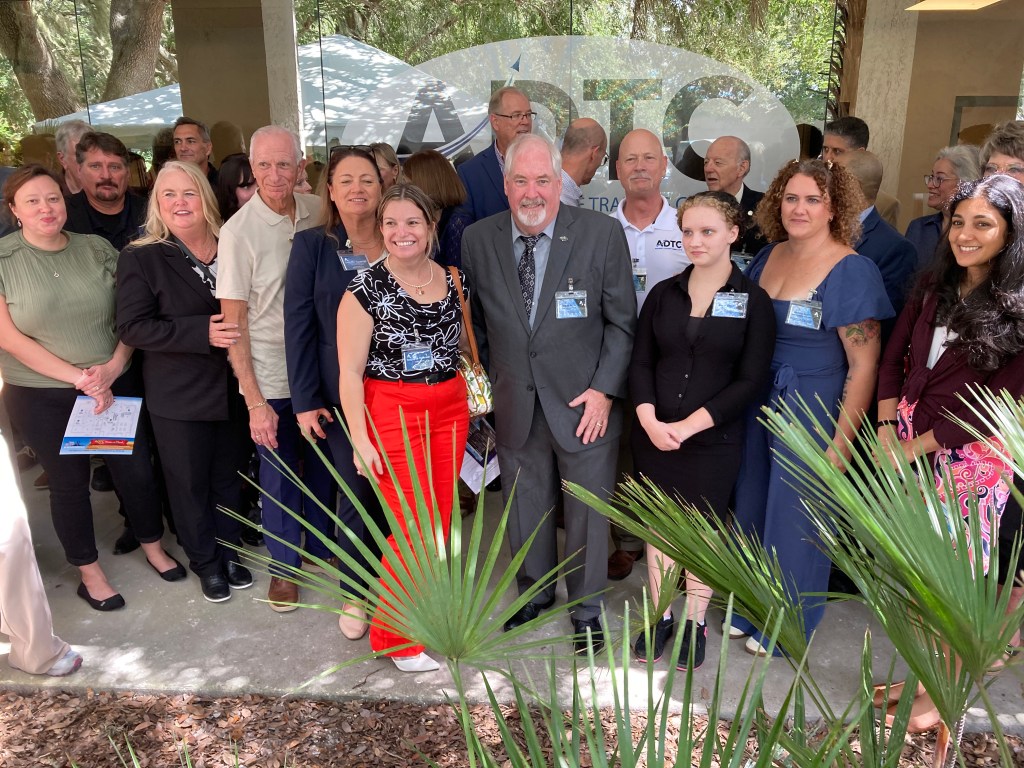
Aviation’s Blind Spot: Implicit Gender Bias

But this sentiment is not unique to the Middle East. During the Women in Aviation International conference several Latina women indicated that parents often do not support their daughters’ dreams of pursuing aviation careers because it is outside the cultural norm. In addition to urging girls who have reached the age of majority to pursue their dreams, they urged the industry to talk to the parents as well as the students when they were inspiring them to pursue aviation careers because otherwise parents could be a barrier to these populations joining our industry.

Moloney began the discussion saying we must pivot our thinking and link inclusion to a different design. At a time when some factions are falsely charging aviation safety standards are being lowered to accommodate women and people of color, it is especially gratifying she is pushing for “upping our standards” for safety in an industry that is slow to accept change.
To be successful, we must collaborate with all the groups trying to promote aviation and aerospace careers to Blacks, Latinos, LGBTQ, Asians and Arab Americans. They all have their own groups but we must emerge from our silos to forge a different design.

— 30 —

Coverage of Women’s Issues by Future Aviation/Aerospace Workforce News:

Rosie the Riveter Lives On

I Love the Smell of a Pregnant Woman in the Morning

Analysis: Building An Equitable Workplace with the Help of Male Allies