Future Aviation/Aerospace Workforce covers education, training and recruiting issues and delivers in-depth analysis of under-reported stories impacting the future of the global industry.Covering Aviation/Aerospace Workforce Education, Training and Recruiting.
Population declines increases urgency to create new pipelines including immigration
American competitiveness at risk
Job seekers exclude companies not meeting their diversity goals and will raise diversity issues in interviews
A quarter of global companies do not have diversity programs
30 top employers, including the highly regulated, make compelling business case for including those with criminal records
Diversity recruiting experts in high demand
New pipeline sources needed, affinity groups recommend partnerships
Retention of diverse workforce remains a challenge
Source: Hey Lagos Techie via Unsplash
Twenty five aviation and aerospace companies made the list of the Forbes America’s Best Employers for Diversity 2021 and top among them was Delta at 112 but besting the Atlanta-based carrier was Raytheon Technologies at 78.
The publication considered thousands of companies for inclusion on its fourth annual list and reported not only did these companies receive the most recommendations, but also had the most diverse boards and executive ranks as well as the most proactive diversity and inclusion initiatives.
Raytheon topping the list of aerospace companies is no surprise given its strong emphasis on education programs designed to increase those pursuing aviation careers including its recent funding of cybersecurity high school programs. In addition, its subsidiary, Collins Aerospace, is heavily involved in educating the next generation including a mobile STEM lab and generous grants to get computer science curriculum into elementary schools. (See FA/AW News’ Education and Workforce Development Resources for Aviation/Aerospace for details and other corporate programs.)
Population Declines Create New Urgency
Lost in the entire diversity debate is the impact on population declines on fulfilling workforce needs in the future. The Center for Disease Control reports US population fell for the sixth consecutive year in 2020.
“Without raising immigration levels now, the US will no longer be the world’s largest economy,” said a new report from George Mason University. “Expanded immigration will ensure the US workforce can continue to outperform global competitors. [Otherwise], the US will sacrifice its position as the world’s largest economy by 2030. In fact, if current US population trends continue, the US economy will fall behind China’s by 2030 and be only three-quarters of China’s economy by 2050.”
Global MRO employment down 3.5% to 385,000 employees working for more than 4,900 firms in the civil maintenance, repair, and overhaul (MRO) market at the start of 2021
Increased government spending on education needed
US competitiveness at risk
Schools need modern avionics, engines to deliver workforce industry needs
Numerous industry workforce development programs making a difference
This article is fourth in a series assessing workforce needs in different industry sectors. Parts One and Two dealt with manufacturing. Part III covered the impact of Covid on the MRO industry.
Credit: Tulsa Tech
By the Numbers
Globally, employment was at 385,000 employees working for more than 4,900 firms in the civil maintenance, repair, and overhaul (MRO) market at the start of 2021, down only 3.5% from the beginning of 2020, according to a recent Oliver Wyman study. In the US, there are more than 4,000 firms with nearly 185,000 employees in the civil MRO market, 5% fewer than at the start of 2020.
“While the impact of the crisis remains severe, recovery does now appear to be underway,” said the company in a newer report. “Two-thirds of respondents expect MRO demand to recover to 2019 levels in 2022 or 2023, in line with Oliver Wyman’s forecast of fleet recovery to pre-pandemic levels in 2022 with MRO following closely. Notably, airline respondents generally expect a slightly earlier recovery than MRO respondents. Regionally, Western European survey respondents were more pessimistic than respondents in North America and other parts of the world on how long recovery will take.”
On of the few projections for the technician workforce available is Boeing’s Pilot and Technician outlook, which last year, predicted a need for 739,000 by 2039.
Key Concerns
NAVEO Consultancy Managing Director Richard Brown worries about the people lost, especially those in who have experienced previous downturns.
The technician shortage is expected to re-emerge as early as this year, according to an Oliver Wyman study especially as some unemployed technicians leave the workforce permanently, similar to what has been experienced in the pilot corp covered in the last issue.
The good news, MRO workforces were not as devastated as other disciplines and are estimated to be down just about 3%. The recovery, which Oliver Wyman expects in 2022/23, makes MROs reluctant to lose employees given previous shortfalls.
JSFirm, the industry-leading placement company, reported hiring has already resumed. Its Hiring Trends Survey of hiring professionals, executives, and business owners indicated over 50% are projecting growth in 2021. Additionally, 66% of those surveyed did not cut any jobs in 2020, despite the pandemic. Furthermore, 33% expected to hire in the second quarter 2021 with pilots, maintenance and avionics techs in highest demand.
More than half of retirement eligible pilots are gone
By Kathryn B. Creedy
Study warns airlines to start training now to avert new pilot shortage.
More than half of pilots nearing retirement took early outs.
30,000 expected to abandon airline pilot career.
Booming flight schools provide important pipeline.
Career projection unlike anything we’ve seen.
Training funding still biggest barrier
For years, airlines, business aviation and even the military struggled with workforce shortages. Covid-19 led to furloughs and, of course, the accelerated retirement of thousands of airline pilots, technicians and manufacturing personnel. While providing a brief respite, retirements only mean a more acute pilot shortage that could start as early as this year. For the first time we have an estimate of how many pilots took early retirement.
Credit: Mike Phillips, WDEL
So it is not surprising to see airlines rejuvenating their pipelines such as United’s recent announcement it would hire 5,000 pilots by 2030, at least half of which would be women and people of color. It expects to enroll 100 students this year.
American, announced it would fly 90% of its 2019 schedule this summer, recall its pilot corp and resume hiring with a goal of 300 this year. It expects to double that next hear while Allied Pilots Association worries the carrier will be short of pilots as it takes time to return to the flight deck, according to Simple Flying. Spirit and JetBlue also said they will resume hiring this year.
A recently released study by Oliver Wyman notes the experience after 9/11 and the Great Recession when new pilot certifications fell 30% to 40% in the five years after the crises. Compounding this will be the departure of what the study estimates as 25,000 to 35,000 current and future pilots abandoning the cyclicality of the aviation industry in favor of more stable careers over the next decade.
But this time, at least for pilots, there is hope for operators in search of new hires. In addition to airline programs, the flight training business is booming which means at last, the pipeline is increasing not just for duffers but for those seeking careers. The question is whether the industry can build capacity fast enough to feed the 34,000 global pilot gap expected by 2025, according to the Oliver Wyman study.
With the first cohort of AOPA You Can Fly High School Aviation STEM Curriculum about to graduate in 2021, it is clear the program is making a difference in everything from school attendance to increasing the diversity of the industry.
Do you drone? Hereford High AOPA STEM program Credit: AOPA
But You Can Fly is only one of many resources available to teachers including the Civil Air Patrol (CAP), Experimental Aircraft Association (EAA), the Federal Aviation Administration (FAA) and an impressive Redbird Flight Simulations program. Combined, these resources offer an impressive array in moving the needle in workforce development programs. They can also be fielded in nearly every community since these organizations leverage their vast membership networks to market their programs either in the classroom or at their airport facilities.
What is needed is not the development of more programs but the coordination of those programs into a cohesive national effort to connect the dots between education, aviation and workforce development programs.
“We say the more the merrier,” said You Can Fly Executive Director Elizabeth Tennyson of all the emerging programs geared to aviation education. “I would love for us to be more coordinated, however. We already encourage people using our program to expand their horizons and explore other programs out there. But I think we need something more formal and, frankly, more effective, in place.”
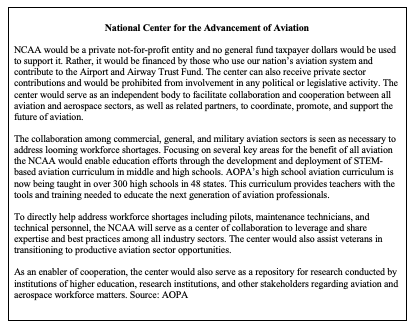
She sees this as the role for the National Center for the Advancement of Aviation (NCAA) proposed by senators Jim Inhofe (R-OK) and Tammy Duckworth (D-IL). Operated as a private entity and funded from the Airport & Airways Trust Fund, NCAA is intended to support the development of aviation STEM programs. More importantly, its role would be distribution of aviation/aerospace STEM programming as well as connecting the dots between education and workforce development. It would also disseminate economic and safety data as well as research and provide a forum for the cross-disciplinary collaboration needed to develop the interdisciplinary workforce of the future academicians and industry say is needed.
You Can Fly
“AOPA’s You Can Fly program is all about lowering barriers to entry,” Tennyson told Future Aviation/Aerospace Workforce News. “It is not just about the students, it’s also about the teachers. We want to make sure they are confident in teaching the material.”
You Can Fly Executive Director Elizabeth Tennyson. Credit: AOPA
The AOPA curriculum is in more than 200 schools with 255 teachers overseeing 540 classes in 38 states. Having reached 8,000 students to date, You Can Fly and other programs could not be more meaningful for priming the pipeline for the future aviation/aerospace workforce.
“We reach out to educators through events like our annual High School Symposium, as well as educational conferences and events,” Tennyson explained. “We target conferences that focus on career and technical education and STEM education. We also get a lot of calls from schools, districts, and even state aviation departments who have heard about the program and are interested in bringing it into schools in their area. We regularly meet with these different groups and help them learn more about what we offer, make presentations to decision makers and show them how the curriculum aligns to their own state and local education standards.”
The High School Curriculum is designed so graduates leave high school with either a private pilot or a drone license. Entirely funded by The AOPA Foundation, the program includes professional development programs, designed to help teachers teach the curriculum more effectively, and, last summer, had 300 teachers enrolled in its virtual event.
“We also provide 20 $10,000 scholarships each year to help teachers earn a private pilot license,” said Tennyson. “That gives them first-hand experience. When they have that they light up the classroom and become role models for their students. They come away feeling confident they are making a difference with the kids.”
She explained the value of the program. “Some schools have difficulty getting kids just to show up and this program has made a huge difference,” she said. “Teachers tell us they arrive and the kids are waiting outside the classroom anxious to begin. It can be a real turning point for a youngster to discover they like school. Teachers tell us that it sounds like a party every day as the kids develop competitions and cheer each other on.”
Demographics
The demographics of both schools and students are a testament to the difference You Can Fly can make. Eighty-four percent of schools are public with another 5% charter schools. Some 10% are private and another 1% from the home-schooling arena. Thirty-nine percent are in rural areas and 39% in suburban areas while 23% are in urban areas.
Key to the program is being free with The AOPA Foundation supplying everything needed along with support for teachers and the school to implement the program.
“Small districts are delighted they have access to this programming,” said Tennyson, adding a prime target audience is underserved communities. “They are able to do this without significant resources. That is important because 22% of the schools using this program are considered high-poverty schools. If you add schools that are considered mid-to-high poverty, that equals about 45%.”
Source: Unsplash
As for the kids, 56% have no previous experience with aviation. Saying only 10.6% of pilots and flight engineers were people of color, Tennyson noted nearly 50% of the students in You Can Fly are people of color. Twenty percent are female which may move the needle when it comes to the fact only 5.6% of commercial pilots are women.
This is critical since studies show that girls begin to drop out of STEM-related courses in middle school and children of color in high school. That makes AOPA’s program important as a bridge during these vulnerable years for kids who become involved at a younger age through such programs as CAP’s cadet program which starts at age 12 and EAA’s course work for younger kids.
“Teachers tell us that they capture kids in the 9th grade, and they are hooked and stay with the program,” said Tennyson. “It is opening a door and welcoming them in for the first time. We felt high school was the place to start because that is when students begin taking concrete steps for their future. If you open the door and make it accessible, a lot of students will follow because they realize aviation is fun. We can’t overlook that point when we are recruiting. It doesn’t have to be intimidating, it can be fun.”
Tennyson reported there were a lot of misconceptions about aviation. For instance, people think the only pathway is through the military or that you have to be great a math to be a pilot.
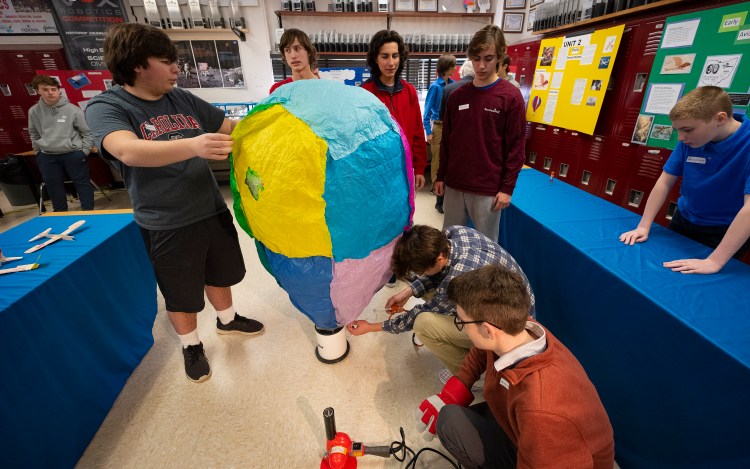
A lot of hot air. Hereford High’s AOPA You Can Fly Program. Credit: AOPA
“That is not true,” she said. “What we are offering here is a way for students to learn those misconceptions are not true. They end up building hot air balloons, wind tunnels and airfoils they then test in the wind tunnels.”
Identifying the Gap
For years, the industry has been worried about workforce shortages and in 2016, the AOPA Foundation examined the resources available to connect the dots between aviation and STEM education.
“When we started developing the program in 2016, we saw a big gap in this type of education,” said Tennyson. “There was nothing available that was comprehensive for high school age students that could be done during their school day and with which they can earn credits over four years. There were also no turnkey programs that were free. What was available, she said, were science classes using aviation-related programming or elective programs which were not for credit.
“We looked at this very carefully and discovered the majority of schools did not have the resources to prepare their students,” Tennyson continued. “They didn’t have the equipment or a qualified instructor or the lab space. So, we looked at what we could do to get aviation in the hands of the most students.”
The program also needed to ensure schools had the flexibility to fit it in whether as a four-year career & technical education program, a single course, an after-school program or as dual enrollment with partnering colleges. It is also paced to the student reflecting the need for curriculum tailored to how different students learn.
Student Pathway
Complete descriptions of each program semester are available on the You Can Fly website. The 9th grade starts with introduction to aviation, a broader brush stroke of history and careers available today including space, the military, piloting, general aviation, drones, advanced air mobility, maintenance and avionics.
“This allows students to see whatever they are interested in, there is a place for them in aviation,” she said, “In sophomore and junior years, they delve into aircraft systems, airport operations, air traffic control, communications, weather – all the things you need to be a pilot and how the system works. That is germane to any aviation career. Juniors get a deep dive into the FAA private pilot knowledge test or Part 107 for unmanned systems and in the senior year we dive into advanced topics which are a lot more career oriented. They also do a capstone project which could be a business plan, an internship or choosing a subject or a mission or designing and building a drone. One student did a business plan to create an FBO at a local airport. We provide a lot of materials and support so that projects are meaningful and to prepare them in a practical way to move ahead to college, certification or the workforce.”
Other Programs
Today, numerous programs exist. Future Aviation/Aerospace Workforce News recently updated its comprehensive list of education resources for aviation/aerospace and corporate workforce development programs in hopes industry and academia would connect the dots and amplify each other’s efforts.
For instance, in January, EAA launched AeroEducate, targeting age five to 18, complementing the AOPA Foundation program for older students. The idea of the free program is to connect the easy-to-use, aviation-themed activities for teachers and EAA chapters and can be used in classrooms or EAA chapter hangars. Similarly, AOPA leverages its chapters to connect the program to local schools.
AeroEducate also complements EAA’s own Young Eagles program that provides introductory flights for kids to attract them to aviation. The AeroEducate web-based resource provides age-appropriate pathways to aviation and aerospace engagement, as well as career paths.
Celebrating its 80th anniversary this year, CAP, the US Air Force auxiliary, has 60,000 volunteer members and 1,000 squadrons nationwide. Its cadet program, for ages 12 and up, goes beyond aerospace education to developing character and physical fitness.
It also has free resources for teachers, said CAP Outreach Coordinator Susan Mallett, who joined Tennyson in speaking recently before the Women in Aviation International (WAI) Conference Aviation Educators Workshop. CAP’s curriculum is free to educators but there is a $35 CAP membership fee.
Source: Unsplash
“Our K-6 is a special program designed to help kids make connections between aerospace and education,” she said. “These are grade-level specific programs to get young students interested in aviation and aerospace. We focus on character and physical fitness because if we don’t have good people of character and integrity we are lost. We have to develop the entire child before they get into middle school and high school where they can make mistakes that can diminish their chances of pursuing aviation careers.”
At no cost to CAP’s education members, it offers sophisticated STEM Kits providing additional materials such as flight simulators or drones that schools cannot otherwise afford.
The curriculum takes in every facet of aviation including drones, VTOL, weather stations, rocketry, remote control and robotics. It also offers teacher orientation flights from pre-flight briefing to actual flying so they can see how aviation applies to STEM concepts they are teaching.
The program, funded by USAF, has 76,000 students involved in its Aerospace Connections in Aviation (ACE) program every year. It also has an adopt-a-classroom connecting a particular squadron to a local classroom and mentoring kids move through aviation education.
“Sometimes these kids have a pretty negative experience with people in uniform,” Mallett said. “Our program helps to change that because it presents a positive role model of someone in uniform.”
Going Beyond the Sale
When Redbird Flight Simulations hired Joey Colleran nearly five years ago as its education specialist, it knew it could not just sell its low-cost, desk-top simulators and leave it at that. Without teacher orientation and hands-on guidance, it found many simulators were going unused.
“My job was to focus on the K-16 market – the high school market,” Colleran told WAI attendees. “What I quickly learned was a lot of customers had a grant and their solution was to buy our simulators. But they weren’t pilots and didn’t have a lot of knowledge and resources. I began to figure out free resources for them and ended up developing free curriculum to accompany the simulators. That included flight missions and other lessons related to their math and science curriculum.”
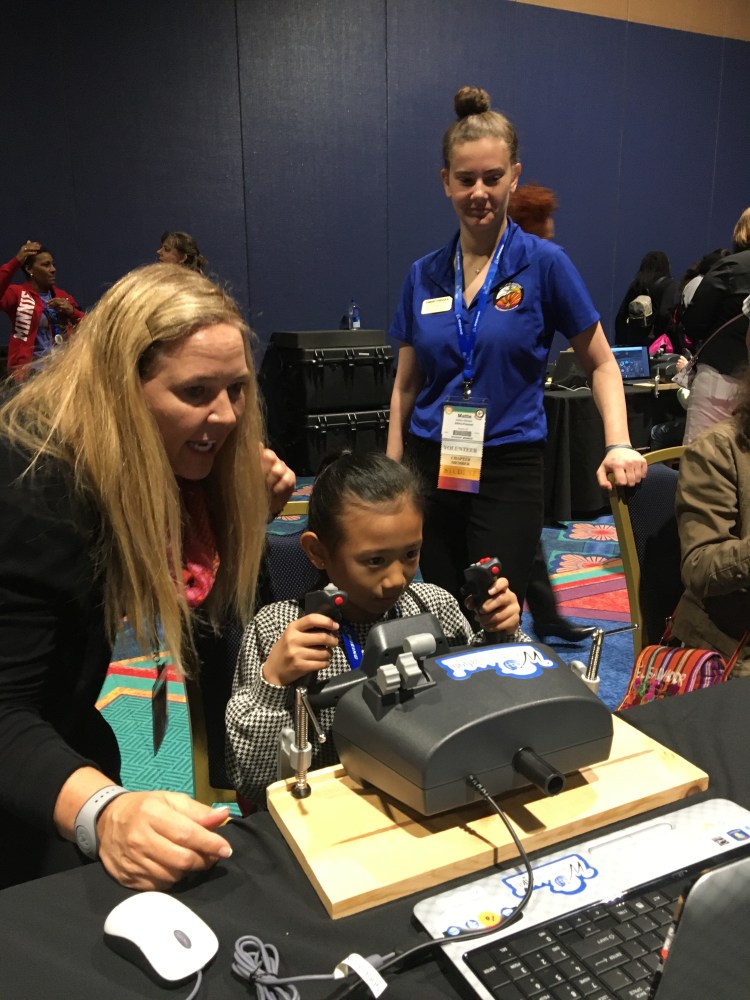
Women in Aviation Girls in Aviation Day. Credit: Kathryn B. Creedy
Colleran added the company also wanted to ensure they were exposing as many as possible to aviation opportunities and created a traveling STEM lab which it plans to relaunch once Covid is in the rear-view mirror. It is familiar to WAI attendees since it is a central part of its Girls in Aviation Day which wraps up its annual conference.
“We take it to schools and different organizations to recruit kids to take free classes taught by our director of STEM education,” she explained. “It helps parents and students become aware of aviation opportunities.”
Like AOPA, it identified a need for professional development for teachers and created an educating-the-educators program online or in person to illustrate how to incorporate aviation into STEM.
Government Resources
The FAA has its own offerings in its Aviation and Space Education (AvSed) program for teachers bolstered by 1,700 volunteer employees and, like EAA, AOPA and CAP, offering local resources nationwide and on the web.
Its Aviation Career Education (ACE) Academy provides unique summer aviation education programs for elementary, middle and high school students and reaches between 1,500 and 2,000 students each summer. The program, which includes lessons in flight planning, history and flight physics, provides students with a wide range of aviation career exploration experiences and also focuses on STEM. Other subjects cover aircraft design and maintenance, flight simulations and introductory flights on some occasions. It also offers field trips to aviation-related sites.
“Our volunteers cover all walks of aviation and space experience and they love to share that in the classroom and help with curriculum in flying or space,” Christina Drouet, manager of the FAA’s Aviation Workforce and Education Division told the WAI audience.
Like Redbird, Collins Aerospace and others, Indiana-based Republic Airways has its own traveling lab to bring aviation to those who would normally not even think about it. The airline, a pioneer in bringing aviation to the underserved, has been struggling for years with the pilot shortage and finally decided to set up Lift, its own flight academy, for ab initio training. More recently, the dearth of aviation maintenance technicians, prompted it begin work on adding that to the curriculum.
Why Aviation & STEM?
Credit: Airbus
“Aviation is really cool,” Tennyson added during the WAI Aviation Education session. “You cannot find a more engaging subject for students. Students who think they don’t like math and science do like airplanes and they make the connection. US News & World Report identified piloting as number 26 in the top 100 careers in the future. In addition, there are all kinds of emerging careers such as commercial space, unmanned systems and drones and we don’t even know the potential for those yet. You will see the reward in your classroom. An engaged student makes your job so much easier.”
Drouet agreed. “Emerging technologies are a big unknown,” she said. “To show the interest, today, the number of conventional aircraft in the US is about 300,000 but since we began registering drones a few years ago we have two million registered. To me, that is symbolic of how these emerging technologies will keep growing and why we need kids to think about these careers now. It’s exciting and there is so much opportunity.”
Because aviation and aerospace are awesome, Colleran added. “It’s important to have aviation in the curriculum because it’s the future,” she said. “The one important thing for educators to understand is how many free resources there are including the thousands of people in aviation and aerospace who want to help teachers in the classroom. When you bring aerospace in the classroom, you have so many resources at your fingertips.”
Credit: Joby Aviation
Next Steps
Tennyson wants more people involved. “That is why we support the NCAA,” she said. “All the stakeholders need to be at the same table to work together on these issues, identify the gaps that may still exist and fill them in a cohesive way. Ultimately, these are workforce issues as well as education and working together we will be creating the workforce of the future. Awareness is a huge part of it. You can’t create something successful if people are not aware of the opportunities and the needs in the industry.”
Creating an over-arching, industry-wide strategic plan is probably the biggest hurdle industry must overcome besides funding. You Can Fly is completely funded by The AOPA Foundation but to amplify it and get it into more schools, more funding is needed; likewise for all the other programs.
“Curriculum development is an intense and costly undertaking,” Tennyson explained. “We created a turnkey program of lesson plans, presentations, student activities, teacher notes and unit tests and we have been able to do that through the generosity of our donors. But we also must continuously update and maintain the curriculum and activities as rules and technology changes. We must stay on top of that and adjust and that requires a lot of support for schools. We must contend with high teacher turnover and need more professional development and support during the year. Schools may need help developing the data so there is a lot of hands-on support that goes into every school we work with. To expand, we’d have to provide that same level of support. This is one of our greatest challenges – making sure teachers have the right skills, material and support. For all those reasons, we need something that is formalized. We need support on a broad basis in order to support the great programs out there.”
Cue the Legislators
Having introduced the National Center for the Advancement of Aviation (NCAA), the industry now needs to leverage members to make it a reality just as Aviation Technical Education Council did with transforming Part 147 and Aeronautical Repair Station Association did with the creation of annual $10 million in education grants designed to promote pilot, engineering and aviation maintenance careers.
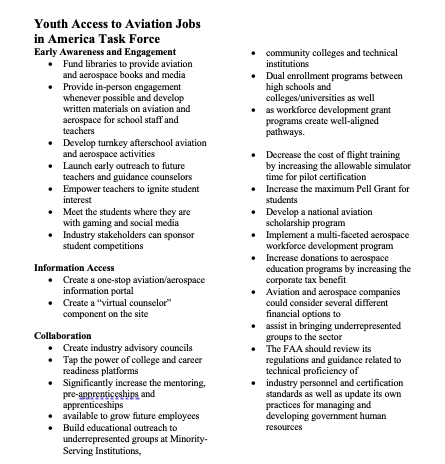
Then the only remaining hurdle is a formalized approach to alerting parents and students solid programming exists and can be implemented in their local community for free; programming that leads to high-pay, high-value careers. This is no small task but with the advent of the Youth Access to American Jobs in Aviation Task Force and the Women in Aviation Advisory Board it is clear the industry is now working together which makes the task that much easier.
Editor’s Note: I invite comments and challenges to my views. I also want to learn about concrete steps corporations are taking to create the work environment of the future. kcreedy@futureaviationaerospaceworkforce.com
Future Aviation/Aerospace Workforce News has been a catalyst for my personal understanding of the task before us if we are to create the future aviation/aerospace workforce.
Changes needed in the industry go far beyond just increasing numbers or the color of the faces on the line but calls for tectonic shift to how we do business and involves the most important issues facing society and business in history – social justice and diversity, equity and inclusion.
Source: This is Engineering via Unsplash
I’ve hinted of the challenges we face before but conversations recently prompted me to connect the dots on just how daunting it is. More importantly, I think few realize what it will take to change. In fact, it j is nothing less than a total transformation of both company culture and, by extension, society. You may argue solving social issues is not our mandate, but many argue otherwise especially if your mandate is more success and profits.
“It’s a really good business strategy and it’s growing today,” said Good Business Author Bill Novelli in the AARP Bulletin, one of many articles citing his work. “The idea is you can make money for your stockholders by creating social value for customers, employees and the communities where you work. It is not just altruism.”
“The title, ‘Good Business,’ comes from corporations that combine profit with purpose and track a tiple bottom line — people, planet, profit,” said Brookings Senior Fellow George Ingram.
Recently, during a discussion for an upcoming webinar, I stated it was my belief corporations had no idea how much they must change. They must not only develop their workforce but strive for a Just Culture. The person I was talking to was taken aback. “I’ve never heard anyone, anywhere say something like that before,” he said.
“I don’t think anyone has,” I said. Leastways, not in the aviation/aerospace industry. I am sure, however, those focusing on social injustice have. All the signs are out there hitting us in the face just looking at the Social Justice movement since 2014 when Michael Brown was killed.
Source: Alex Kotliarskyi via Unsplash
You may well question why corporate America needs to address social issues and you’d be right. I’ll make that case but the fact is, by addressing social justice and enlarging the middle class, we will create a new economic boom more powerful than what was achieved after World War II. It’s good business as Novelli argues.
The question is whether we will act on those signs. The question is whether this time, 60 years after the legislative successes of the civil rights movement, will be different. Or whether we will finally achieve pay parity 60 years after it was revealed that employee value is based on gender or race. Recent coverage in USA Today shows it is more important today given Covid’s impact on women’s progress.
The question is whether we see ourselves as part of the problem if we stand by and do nothing. The question is whether corporate America sees its role in what we are facing – a powerful movement toward a Just Culture, that, if it succeeds, will be good for all of us.
Aviation/Aerospace Very Familiar with Just Culture
Wikipedia defines a Just Culture as “a concept related to systems thinking which emphasizes that mistakes are generally a product of faulty organizational cultures, rather than solely brought about by the person or persons directly involved. In a just culture, after an incident, the question asked is, ‘What went wrong?’”
Sound familiar? It should. We call it the safety culture and it is the foundation of why our industry is as safe as it is. So, we know this Just Culture works because, collectively, we’ve made it work. Now we must apply it to the rest of what we do.
One may well ask whether overhauling industry workforce practices is really necessary. Since we’ve never had a Just Culture in the workplace, the answer is yes. Instead, we’ve had military-style, antiquated work rules and failures to address systemic race and gender problems.
We should start thinking about it now as part of the package the industry is already doing – promoting aviation and aerospace careers and drilling down to youngsters with STEM and other programming. You know you haven’t achieved what you need to when, in January 2021, Captain Jenny Beatty, who like, Captain Kimberly Perkins, connects the dots between workforce issues and safety, published Halt Harassment in Aviation.
Source: SpaceX via Unsplash
She is not alone. Since launching FA/AW News in November, I’ve heard from men, women and people of color from associations to companies to military who say their bosses tout new policies for gender and racial equity but it’s just PR. They talk about how they have been harrassed, bullied and punished and how their bullies and harrassers are rewarded. There are, frankly, just too many of them to believe this is anything but inherent workplace bias.
Indeed, we’ve seen many social media campaigns highlight women’s success stories during Women in History Month, just as we saw them highlight people of color during Black History Month. While some may reflect a genuine diversity commitment, the women who have contacted me say it is only so much lip service.
These companies, they say, are violating their own human resource policies, rewarding perpetrators and punishing those who are sexually or racially abused. The #MeToo movement proved they are right. The question is whether the companies realize the solution includes them too. From my conversations with people all over the country, they do not.
This is not an aviation/aerospace problem alone, it is a societal problem and until we recognize companies as well as individuals have roles to play in reform we will never get anywhere.
Speaking Truth to Power
And it is not solely a woman’s issue. Think about it in terms of whistle blowers, such as those at Boeing who expressed concerns about its MCAS system and were marginalized. The subject was nothing so serious, but I was marginalized when I was at the FAA and dozens of readers have also felt the marginalization and gaslighting that has always been standard corporate operating procedure for those who try to speak truth to power. Think about the women of Enron who warned the company was a house of cards.
Source: Science in HD via Unsplash
Consider Dr. Harvey Wiley, who was instrumental in overhauling the food industry when he identified toxins regularly added to food more than a century ago. Both food producers and his own Department of Agriculture attacked him, but his work led to the Food & Drug Administration and it was a losing battle until women got involved. It is depicted in American Experience’s Poison Squad.
Consider Jeffrey Wigand, who brought the tobacco industry down and revealed its fake “science” in fighting curbs on tobacco.
Or, Rachel Carson, who was attacked by the insecticide industry which used more fake “science” to combat her seminal work Silent Spring on the impact of those products on wildlife and humans. Recently, studies showed PFAS chemicals – used at airports – have leeched their way into humans proving it is very much a present-day problem. Remember Flint, MI?
For the past 40 years, the same tactic has been used on climate change led by the oil, coal and gas industries who, aided and abetted by politicians, put us on the precipice of disaster few are addressing with anything more than promises about carbon neutrality.
We know the tactics companies use to fight against what they don’t want or marginalize workers who fight for the right not to be harrassed or bullied . Isn’t it time we call BS on the status quo? Certainly, society is pushing these issues to the forefront. Shouldn’t companies get out in front of it? Studies say they will reap rewards if they do.
Aviation/Aerospace at Crossroads of Societal Change
I don’t mean to make corporate America the villain here, but its record is not good and aviation/aerospace is filled with work rules and violations against their own human resource practices just as other corporations are as we’ve seen from Hollywood to NBC. We should understand that it can do so much more to achieve a Just Culture than what it has or is doing, judging from both existing conscious and unconscious bias.
In fact, aviation/aerospace are at the crossroads of these issues. The task is nothing less than looking at every work rule and determining if providing workers with more flexibility – which studies indicate is a good thing – would be good for the company. Or whether examining the treatment of those who have been sexually harrassed or bullied should be revisited.
That includes work rules for pilots who have perhaps the most intractable issues since it involves hard bargaining between labor and management. Think about the mountain we have to climb there. One only has to observe the lack of progress for women pilots despite their activism and the publicity they’ve gained on these issues to know unions are not receptive.
Without Change We Will Never Meet Workforce Goals
Why does this matter in workforce issues? It matters because we know we cannot meet our workforce numbers if we do not include under-represented populations – women, people of color, LGBTQ, mature workers and differently abled.
Source: Clayton Cardinalli via Unsplash
It matters because we are selling aviation/aerospace careers to a generation that is vastly different than baby boomers who compliantly went along with restrictive work rules. We don’t want them to enter the workforce that fails to deliver on the promises they’ve been given as they earned their careers.
We are also dealing with a generation fully aware of itself and, like the Parkland survivors, are calling BS. And we continue to deal with attitudes that says women and people of color should just be grateful to have a job.
The next generation also has options because they have an entrepreneurial streak of historic proportions. In fact, it is already happening. What do you think is happening with all those women and people of color who have been “eased out,” of their companies by one tactic or another? They have become innovative competitors.
It matters because it is bad for business since it is far more costly to recruit than retain. While aerospace’s retention record is good, millennials are testing those work rules for a better work/life balance and, given the workplace changes wrought by Covid-19, we face a changed future. More importantly, they want their work to make a difference to the company and to society. Together with their companies, they can create the Just ecosystem required.
Good for Society
Equally important is the fact creating a Just Culture is good for society and we all have a role. Think about this. The US has failed miserably in transitioning the workforce as we digitized everything from manufacturing to news. We replaced workers with robots but failed to retrain and reskill those replaced. Forty years later the social implications, I think, lead straight to the attack on the Capitol on January 6. Hyperbole? Not when you look at the impact on the middle class during that time.
I’ve been reading Bernie Sanders’ missives since the 1980s when my parents moved to Vermont, where diversity is measured in income, not color, and my father sent me Sanders’ newsletters. Sanders first alerted me to the attack on the middle class that predated trickle-down economics. The massive wealth distribution from the middle class to the rich is proof that he is right and change is needed.
The biggest issues facing society today is restoring the middle class, making it bigger and creating a Just Culture and aviation/aerospace can make that happen. We saw the results of a bigger middle class in the post-war boom in the ‘50s and 60s and we can have that again if we understand we all have a role in this. Together, we can make it happen.
With the New River Gorge Regional Development Authority (NRGRDA), Cochran laid the groundwork for the development of an aerospace industry. New River Community Technical College is fielding career & technical education and West Virginia University Institute of Technology will introduce companion programs to train workers as Aircraft Maintenance Technician (AMTS) with an Airframe and Powerplant (A&P) rating to complement WVIT’s bachelors in aviation management.
That comes on the heels of a new aviation emphasis at Marshall University. Last August, Marshall broke ground on a new Marshall School of Aviation using grants to develop the Bill Noe Flight School at Yeager Airport. A Marshall grad, Noe is the president/COO of NetJets. Furthermore, Marshall, Mountwest Community and Technical College and the Robert C. Byrd Institute are in a joint venture to develop an aviation technology and maintenance program. Outer space? Not yet but it’s a start.
Think about the kids attending Vaughn College whose family incomes are in the high 30s. President Sharon DeVivo testified before Congress saying educating these kids into high-demand careers, is transforming the entire trajectory of their families.
Just Culture
So, how does corporate America create a Just Culture. We already know what we need to do because our safety culture provides the mindset. The most important thing it can do is listen. Listen to women, people of color, LGBTQ, mature workers and differently abled and make diversity, equity and inclusion a reality, not a PR campaign. Listen to millennials who want to forge a better work/life balance.
Source: National Geospatial-Intelligence Agency
Reach out to diversity organizations to learn the hard truths only they know. Ask the workforce how work rules can change.
The industry can also examine itself. I’ve spent my entire career guided by one philosophy. You learn more from those who criticize you than from all those who pat you on the back combined. Can the industry do that? It can if it has the will.
Most importantly, look into the past to determine how the company handled workforce issues such as sexual harassment and discrimination which drives so many women and people of color from the corporate ranks. This is not about unconscious bias it is very much about so-obvious-shout-it-from-the-rooftops bias.
Create an umbrella committee on diversity, equity and inclusion with subcommittees for each of the constituencies – Blacks, Latinos, LGBTQ, Women, mature workers and differently abled. Determine their unique issues and where they have common ground and proceed accordingly. And create the metrics that will show these changes are effective and pivot if they are not.
I’ve already made the business case for creating a Just Culture. Studies have long established diversity, equity and inclusion is good for business.
One would be right to think that total transformation of society and company culture is too big. It is, but it is also something companies should be doing anyway to ensure more profits and success.
So, lets define the entire task not just increasing numbers of black, brown and female faces in the office or on the line. While some may view this as Pollyanna, I do not, and have spelled out the hard work it will take to change. I also know we will reap high rewards if we do it – an economic boom like no other.
Editor’s Note: This article was originally written for LinkedIn in 2016.
As explained in Part I, entrenched work rules – including seniority and failure to establish better work/life balance policies – are key reasons why so few women are flying the line. Equally important is the fact it has been known for years changes are wanted by pilots of both genders indicating both industry and unions represent significant barriers to change. Indeed, airlines are behind other industries in promoting women into management.
Special Treatment Counterproductive
Credit: Shutterstock
Women pilots are not asking for special treatment and, in fact, say that is the worst thing that could happen. Rather, they are seeking sensible changes to outdated work rules that have remained in place for 70+ years. They are frustrated by work rules changes for other women in the airline workforce, but not for pilots.
They are fighting for policies that will help all pilots achieve better balance while benefiting the company bottom line.
In fact, their arguments reveal a business-based approach. “Allowing a pilot to have six months maternity/paternity leave is more cost effective than trying to replace that pilot with a new hire,” said Captain A. “The recruiting and training costs alone would cost the airline more than if they had a female pilot on maternity leave. If not, she either has to return to work or quit and some have quit.”
Tellingly, she noted that at her airline more male pilots are out on medical and military leaves than female pilots out on maternity leave. With the numbers, that is to be expected but it puts women’s accommodations into context with those required for men.
“With the shift in family dynamics, family issues are a concern for both male and female pilots,” said Captain A. “More male pilots are interested in being an active parent in their children’s lives. Dads have missed the birth of their child. We want a policy accommodating taking time off to be there.”
Captain H agrees. “Today’s generation expects to have a career and a family and expect companies to accommodate that.”
Corporate America is changing, however slowly. A reflection of how important such issues are, is the growing number of companies – 14%, according to National Partnership for Women & Families – are offering paid leave. Meanwhile, US HR policies are woefully behind their global competitors.
Biological Challenges
Restrictive maternity and return-to-work policies are cited as one of the major reasons the industry loses women pilots and why it is fighting a losing battle to attract more.
An alternative is Momavia, a private structure being deployed by airports to accommodate nursing passengers.
Accommodating Work/Life Balance
The most successful regional airline in the US has addressed these issues head on and found benefits.
SkyWest Pilots’ Women’s Assistance Committee was founded by Captain A and her colleague First Officer L and supported by both male and female pilots. The two pilots were joined by a host of volunteers to develop a handbook, since adopted by both the airline and the pilots association, to attract and retain women pilots.
Indeed, Captain A said retention was a huge part of the reason for their efforts. “We’ve had pilots quit because they couldn’t get an extension on their unpaid maternity leave and that is not good for anyone after an airline has invested in training that pilot,” she said. “By educating them we show young female pilots that being a mom and a pilot is possible and already a reality for many here.”
The committee speaks to each new-hire class which also raises the consciousness of male colleagues. It also created the first female mentoring committee in the US airline industry.
The handbook discusses all the issues surrounding starting a family, including planning a family, insurance, returning to work and tips on pumping on the road. It also covers scheduling techniques to be home more or nurse better along with sections on childcare. There are also articles on post-partum depression and exposure to radiation while pregnant.
“We wanted to address the issues women may face head on because they need to plan if they want a family,” said Captain A. “It was a shock when I went on maternity leave and lost my insurance. That never occurred to me. I was able to go on my husband’s but still you lose your paycheck and your insurance. So, planning has to start a year ahead to have disability insurance in place.”
The new policies forged by the handbook allow 12 months unpaid post-birth leave. But treating maternity as a disability is a problem. Losing insurance and unpaid leave are major issues.
“Male pilots are grateful for our committee,” said Captain A. “I had a captain call me for guidance after his co-pilot excused herself to express milk. He wanted to make sure he was doing the right thing and asked advice on how he could help her. That shows me our male pilots care.”
Captain C agreed. “Without an accommodation for breastfeeding, we have few choices and that’s bad for pilots and airlines. Some women quit, some take unpaid leave if available, and some make do by pumping in the lav. I see the only solution for airlines to accommodate breast-feeding is to provide alternatives to flying, such as paid/unpaid leave or job sharing.”
Retired Captain Kathryn McCullough took a ground job when she started a family. “I loved working in the simulator or office while I was pregnant,” she said. “The airline invests an exorbitant amount of money in every pilot. It can’t afford to lose any pilot mid-career. Pilots should also be able to take assignments on the ground.”
Systemic Whitewashing
Perkins, a pilot for more than 15 years, explained sympathetic men are part of the problem because of the large number of men who make the flight deck a tough place for women. Her realization of the problem came when she keyed the mike to communicate with ATC. In return, she heard a pilot on another aircraft say, “another empty kitchen.” It wasn’t the last time she heard it, either. Think about that. Perkins first piloting job was at Air Wisconsin starting in 2006, meaning such comments are part of the 21st Century mindset of male pilots. And it gets worse.
“Sixty four percent of male pilots say pushing for equity on the flight deck is not their responsibility,” said Perkins in a 2020 study, identifying the most significant problem women face. “Only 16% are actively doing something to make a positive change while 20% want to help but don’t know how. When I share stories of being called a ‘token’ or having someone say ‘empty kitchen,’ they are shocked and immediately attempt to discredit the occurrence.”
She called this systemic whitewashing. “One cannot be part of the solution without acknowledging the problem,” she said. “A chasm exists between our worlds. It is time we build a bridge. Ignorance is no longer tolerable. Rarely is a social injustice effectively addressed without assistance from the majority. We need men to stop justifying the behavior of their sexist colleagues and start defending the disenfranchised.”
Unions Part of the Problem
Normally pilots would turn to the union to make changes, but unions are part of the problem.
“The company is going to want something in return and unions don’t want to spend political or negotiating capital on this issue,” McCullough explained. “They see women pilots as a small minority. ALPA has been one of the worst offenders because the majority of dues come from men. I think management is using the union as a reason they can’t enact common sense policies.”
ALPA is fully aware of work/life issues since, until 2018, it rejected efforts of women pilots and even fired the captain pushing for change.
But a survey showing men wanted the same changes to work rules forced a change of heart. Sadly, the signal it sent was clear, women’s concerns are not worthy on their own and, by resisting change, ALPA was out of step with the majority of its membership.
According to ALPA’s survey, the issues women raise are much the same as their male counterparts. In a significant departure from previous generations, millennial employees now worry as much about quality of life as they do about pay, requiring a seismic shift in corporate and union policies.
Work/Life Balance Met with Intransigence, Not Solutions
“While discussing work/life balance with my manager in a previous position, I explained the importance of attending my daughter’s recital,” Perkins recalled. “In an exhausted huff and a twinge of annoyance, my manager said, ‘You chose to be a pilot, which means you’ll miss things.’ I pondered that response for weeks. I’m sure many pilots have heard similar rhetoric.”
The manager’s attitude was wrong. “The statement promotes the notion that pilots cannot have a good work/life balance,” she said. “It provides no solution and is apathetic in nature. Throwing one’s hands up and saying, ‘it is what it is’ is the equivalent of throwing in the towel on developing a solution. I refuse to accept that one must choose a career of flying or having a family life.”
It also fails to put such requests into context with the performance-based metrics emerging as part of efforts to gain both efficiency and improved safety. For any such request, managers should ask whether this pilot is a gold brick or a valued employee. The impact goes beyond gender and incorporates often ignored issues such as harassment or other discriminatory practices in the workplace. Evaluating the who of a complaint or a request is key to establishing equity.
“Flexibility is the key on leave policies – and listening – because every situation is different,” McCullough explained.
Talk Is Cheap
Credit: Shutterstock
Airlines and unions also need to be familiar with the impact of a lack of diversity to the bottom line. All these issues come into play no matter who is requesting time off.
Judging from its website, little has changed at ALPA despite its survey calling for better work/life balance. It seems as if ALPA is trolling for members by talking a good game but its actions speak louder than its words. For instance, it does not list Diversity, Equity and Inclusion (DE&I) among its top advocacy priorities. Nor is it mentioned in its Future of the Pilot Profession material.
Indeed, its presentation at the 2020 Women in Aviation International (WAI) conference, the first attended by the president of the union, called the issues raised by women pilots “misinformation.” Equally important, ALPA’s overall message was clear – no changes needed.
“Female pilots face unique challenges and often receive misinformation about how to strike a work-life balance,” the union said on its website on the session. “[Pilots] provided real-life examples of how they’re successfully balancing family obligations and enjoying a career they’re passionate about.”
On the panel, FedEx First Officer Kandy Bernskoetter said: “Women can have it all – a successful flying career and a family if that’s what they choose. While there are certainly some challenges that need to be addressed, the career offers many opportunities not available to those who work a regular 9–5, Monday–Friday job. Having the support of a partner, family and the community helps to create a positive synergy between a pilot’s personal life and their professional one.”
Even Bernskoetter acknowledged challenges need to be addressed. Her discussion of supportive partners is as problematic for pilots as it is for any other employee in society and ignores a major societal shift. The fact is today’s economy has working couples and women working outside the home is not a choice but a necessity. Beyond that, it completely ignores the needs of those who do not have these support systems.
“When compared to aviation dads, pilot moms overwhelmingly have working partners, which means no stay-at-home parent,” said Perkins. “Studies from MIT and a variety of think tanks show that diverse groups make better decisions and are more productive. It is not about lowering standards; it is about removing obstacles that hinder others from joining the process.”
Last summer’s social justice protests, caused ALPA to take stance.
“While the airline pilot profession today is not yet fully representative of the diverse population we proudly serve, ALPA is committed to change, and we are working to create a just and inclusive airline pilot culture,” said ALPA President Joe DePete. “We must make certain all individuals – regardless of race, gender, religion, or sexual orientation – find the piloting profession inspiring and accessible. I established the President’s Committee for Diversity and Inclusion, led by JetBlue First Officer Camila Turrieta to advance this work. Our committee strives to demonstrate inclusivity and educate under-represented communities about the career opportunities our profession offers. There is simply no place in our profession –or in our world – for discrimination of any kind.”
But that begs a serious question. If it were actually doing what DePete says, would the National Gay Pilots Association (NGPA) or the International Association of Women Airline Pilots (ISA+21) even exist? While these are not bargaining units, they do reflect a failure to address their needs by legacy unions.
Remember, as we learned in Part I, economists say organizations must make DE&I and social justice more than a marketing campaign.
Interestingly, A:PA cited safety on why fighting discrimination is important during the NGPA conference, an argument Perkins has made for several years in many industry publications.
“Any form of discrimination or prejudice can cause a communication breakdown that can trigger a degradation of operational safety,” said United First Officer Richard Swindell, chair of ALPA’s Professional Development Group in observing increasing diversity of airline pilots. “As an association, we must acknowledge and understand corporate and flight deck demographic changes, as well as our own membership cultural changes. It’s important to understand what these changes mean to our industry, our profession and our union. When you sit in the cockpit, we’re all wearing the same uniform as a professional pilot. If you have an issue, we’ll address it just like we would for anyone else.”
But does it? Actions speak louder than words and ALPA’s record is not good when it comes to diversity as reflected in its treatment of women’s issues.
Lutte’s Recommendations
The fact of the matter is airlines no longer have a choice if they are to remain competitive in the workforce. Rebecca Lutte outlined a pathway for change which applies equally to women and other minority constituencies, including people of color and LGBTQ. But, as she said, it starts at the top.
Start with organization CEOs, Chairs and Board members in individual discussions on their understanding of inclusion and the impact on representation.
Understand how this features in the bigger picture of organizational performance and facilitate alignment of passion and vision for future outcomes. Agree on a routine of conversation several times per year to reflect, observe, and revisit.
Investment not tokenism. Agree how inclusion and representation can be measured and incorporated into organizational performance measures. Introduce an immediate program, inviting colleagues throughout the organization to build inclusion into their role and focus to determine awareness and appetite.
Identify an organization champion who will build the community of inclusion leads throughout the organization and be supported, recognized, and rewarded as a longer-term plan is developed.
Plan an organization design review to understand how roles can be restructured to accommodate inclusion review and recommendations.
Launch a working group to understand a sustainable long-term approach to measurement within signatory organizations and how to resource the central collation and reporting of the information.
Don’t be a ‘one hit wonder.’ Build on the individual discussions to ensure commitment to long term change and what it will take as well as the longer-term vision.
Agree how best to start sending practical messages immediately about what can be done to drive inclusion and gender balance.
Adopt people practices including performance, talent, engagement and reward to identify gaps or available options to build a sustainable change platform.
Identify a passionate, accountable executives responsible for the success of the program to support and advise on the long-term change program who can influence stakeholders and dedicate time to galvanize support.
Women pilots have eloquently defined the problems encountered by the pilot corps and not restricted themselves to their own interest but accommodated the interests of their male counterparts and their companies. Consequently, we know, as we have long known, the remiediation required although the political will to make these change does not now exist. We also have solid recommendations from many quarters on how companies must change and it only remains for them — and unions — to start the hard work necessary.
The problem is companies and unions often respond to women and other minorities with how they have to change. That is dangerous and passes the buck. It is the system that has to change, period.
Editor’s Note: This article was originally written for LinkedIn in 2016. Some of the active-duty pilots interviewed for this article were reticent to be identified because they may face negative repercussions from their airlines or unions.
By Kathryn B. Creedy
The heroic save of Southwest 1380 by Captain Tammie Jo Shults after an uncontained engine failure brought women pilots into focus, prompting many to wonder why there are so few. Clearly, women have the right stuff.
Defining the problem is simple – societal attitudes toward women and industry failure to address these attitudes. Equally important, is the fact that the job itself is a deterrent given work rules forged 70 or more years ago despite work rule changes afforded other work groups. Industry and unions shoulder much of the blame having lacked the political will to accommodate changing workforce needs, not just for women but for the entire pilot corps.
Societal Attitudes
Most wouldn’t think societal attitudes a problem but a recent study reveals otherwise, showing pilots who do not meet the white male stereotype less trustworthy. This is very troubling and shocking.
Despite Schultz’s performance, around 51% of those questioned by Sunshine.co.uk, the online travel agent, said they were less likely to trust a female pilot, according to a 2021 Daily Telegraph article. Just 14% said they would feel safer with a woman at the controls, while a quarter said the pilot gender did not matter and 9% said they were unsure.
“Of those who said they would rather have a male pilot,” concluded the study. “32% said they believed ‘male pilots are more skilled,’ while 28% questioned the ability of female pilots to handle pressure.”
Tell that to Schultz and any number of combat pilots.
The fact is the industry is reaping the rewards of centuries of convincing the world women are inferior. They must now undo the damage and convince the world women are equal to the job, whatever job that is, because they have proven themselves to be.
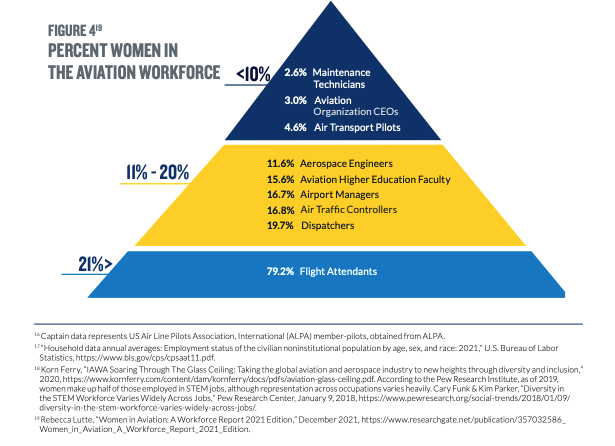
Comparisons between US airlines and those around the world paint a dismal picture. India leads the world with 12.4% of its pilot corps being women compared to about 5.6% in the US. Ireland and South Africa each have about 9%.
Everyone knows crew resource management (CRM) is a key ingredient in safety. But the current dynamic threatens safety, argues Captain Kimberly Perkins, putting an urgent spin on the entire issue. (Safety will be covered in Part II).
Having Schultz and others as role models is great but as industry continues to wring its hands about the dearth of women pilots, unions and airlines must look to themselves as the problem. Not having kept pace with the changing workforce, they failed to make improvements necessary to attract and retain pilots of either gender.
Since work rules were established more women have entered the workforce and labor demands for a better work/life balance became critical issues for society. Without wholesale reform, airline and union barriers remain a top challenge. (Unions will be discussed in Part II)
Seeing the progress made in other fields indicates something is really wrong that 33% of astronauts are women, according to the International Association of Airline Pilots (ISA+21) and women pilots make up only 5% of the global pilot corps. ISA+21 represents over 600 members representing 90 airlines in 35 countries.
“Sixty years ago, other fields including medicine, law, business and engineering were male industries,” said Captain C. “Today, they’ve had steady increases of women in leadership, while the airlines have been stagnant for decades. We can do the same in the aviation industry by improving family policies, increasing outreach to young women and encouraging leadership participation.”
In the US, according to studies by Captain Perkins, pre-Covid, women represented 46% of the total US labor force; but, a mere 5.6% in the pilot workforce with only 2% captains. The fact the needle moved so little since Bonnie Tiburzi Caputo became the first woman to fly for a US commercial airline in 1973, reflects the task ahead.
“Women are drastically underrepresented in aviation – a situation that has not improved over time like other STEM fields,” said Perkins. “The reason lies in small fragments of a much larger cultural issue [that prevents the airline industry from effectively recruiting more women pilots].”
What is interesting about what women pilots seek is the fact it is also good for the bottom line in that it increases retention and avoids the high cost of hiring and training. More importantly numerous studies show how diversity is important to the bottom line.
“Consumers and employees are now looking for more than Corporate Social Responsibility,” a recent Harvard Business Review (HBR) reported. “They’re looking for Corporate Social Justice. Consumers and other stakeholders want companies that see social good as a necessity, not just a marketing strategy. It’s up to companies to respond to this new challenge. Research shows companies with effective Corporate Social Responsibility (CSR) programs are more profitable than those that aren’t.”
The World Economic Forum agrees, saying diversity and sustainability are key parts of, not only consumer, but investor strategy. Consumers will pay a premium to companies echoing their values, according to recent studies showing sustainability, and now, social justice, drive premium results. The Carlysle Group found companies with higher diversity have nearly 12% more earnings growth per year than the average company that lacked diversity, according to Nasdaq.
Workplace Culture is the Problem
Perkins rejects the notion this is a pipeline problem. “While there certainly are fewer women training to be pilots, women also face gender-unique social pressures, double standards and systemic barriers that deter their entrance into aviation,” she said.
In a report released by Women in Aviation International, Associate Professor for the University of Nebraska Aviation Institute Dr. Rebecca Lutte, detailed how women viewed aviation/aerospace. The report Women in Aviation: A Workforce Report, is extremely important since these perceptions constitute a considerable barriers to diversifying the workforce.
Women perceived aviation to be an adventurous, fun career.
They saw it as a way to prove their personal abilities.
They saw it as a challenging career.
But they also perceived it as a good-ole-boy network.
What is remarkable in the 21st Century, their perceptions remain true although women aviation maintenance technicians report enthusiastic mentoring from male colleagues and cite the rise of women to maintenance operations management at United, which also leads US airlines in women pilots, and Alaska.
“The results indicate that workplace culture, described as good-ole-boy network, is still a deterrent to the ability to recruit and retain women in aviation,” said Lutte in her report.
“In a 2019 study, 24% of career female pilots said bias and discrimination was the number one reason the industry can’t recruit women,” Perkins added. “A second study shows a perceived negative culture was the second biggest deterrent for young girls considering a career in aviation (behind costs). Twenty seven percent of women pilots surveyed said ending bias and discrimination was the most important factor in retaining women in the industry (behind schedule predictability).”
While one could argue the numbers represent small minorities, they cannot be discounted since the industry needs to tap every under-represented group in order to populate its workforce. Listening to these women provides important clues to the significant barriers that sometimes force them to quit. They cite the lack of women in airline operations management. This is changing given the appointment of women to key operations posts in aviation maintenance, although women continue to be sorely lacking in pilot and flight operations management.
Interestingly, Air India leads the world in the number of women pilots. The question is what is it doing that more industrialized nations are not?
Women pilots cite the inexplicable resistance to changing work rules to reflect what flight attendants have had for years, saying it hampers recruitment. They also cite unsuccessful efforts to gain accommodations for biological differences which, if ignored, risk serious health complications.
“It’s hard because of the nature of the job,” Retired Delta Captain Kathryn McCullough said. “Young women who want families believe that being a pilot means too much time away from home but look at the thousands of flight attendants who are mothers. The difference is, their work rules have more flexibility like job sharing, better leave options and shorter schedules.”
The difference also show that for airlines and unions it is all about the numbers, not equity.
Perkins reported that ignoring soft issues is also to blame. “Soft issues are human issues,” she explained, noting they affect both men and women pilots. “They can include morale at the office, interpersonal relationships, the ability to approach management, a good work/life balance, sense of worth in the work product and the nebulous feeling of happiness at work. Soft issues are harder to measure quantitatively since they are subjective, yet they play a significantly important qualitative role in determining where people want to work. The answer to the why-are-there-so-few-female-pilots question lives in this piece of the pie. It is time we address the problems here in the hope of sweetening that slice.”
Perkins pointed to the implicit bias that women are meant to give up their careers in order to become the primary caregiver for children. “Implicit biases are more harmful to gender equality because they are insidious, more prevalent and seemingly socially acceptable,” she explained. “They perpetuate age-old stigmas and stereotypes that women have been fighting against for years.”
Covid put women’s issues front and center because so many have left the workforce because their caregiving burden is so much higher than for men.
Numerous press reports showed women accounted for half the 10 million jobs lost to Covid-19 while accounting for less than half the workforce, according to the US Department of Labor. More than 2.5 million women left the labor force between February 2020 and January of this year, compared to 1.8 million men, prompting Vice President Kamala Harris to call it a national emergency.
Seniority Seen as Barrier
Seniority which governs a pilot’s entire career is also seen as a barrier, making this an economic equity issue while revealing how deep the issues extend. Key to the flexible schedule needed by working parents, it means remaining in a lower paid position on smaller aircraft, holding women back from pursuing career goals such as larger aircraft which pay better. When a pilot moves up, they lose both seniority and the flexibility they need.
“It’s a huge trade-off between seniority and money,” Captain H said, “and a very difficult balancing act.”
It is certainly a barrier to equality, said Perkins who reported in 2020 women are three times more likely to bypass a captain upgrade because it would reduce schedule predictability.
Manufacturing needs 3.5M workers just for A&D by 2026
Global shortage tops 80M by 2030
Automation will not solve the problem
Many industry segments don’t tally future needs
Cost of taking no action in billions of dollars
It is difficult to pin down the actual number of workers needed for the different segments of the aviation/aerospace industry because some segments of the industry simply do not track future workforce requirements. Complicating this is the fact many reports are years old, compounding the confusion from different studies telling us different things.
For instance, Aerospace Industries Association (AIA) assesses the state of the workforce annually in partnership with the American Institute of Astronautics and Aeronautics (AIAA) and Aviation Week & Space Technology (AvWeek). However, it does its workforce projections only periodically, with the last published in 2017. On the other hand, General Aviation Manufacturers Association (GAMA) does not track future workforce needs and the AIA/AIAA projections do not include GAMA needs.
That leaves us without concrete goals since we don’t know how many people will be needed or how many we need to move from not knowing what they want to do to aviation/aerospace.
For that reason, Future Aviation/Aerospace Workforce News (FA/AW News) is launching a series examining each industry sector to tally both current employees and, if it is available, establish a baseline of industry workforce needs by sector – airlines, airports and government, etc – to reveal information gaps in workforce development.
The series will also be looking at the skills future aviation/aerospace workers. While some information may not be new, it is an important reminder of the urgency required for the task ahead.
One Playbook
One of the many information gaps is a unified source of all the information needed to develop a remediation plan. This series will get the industry working from the same information and hopefully in unison rather than in the current silos. What is needed are tools to give industry the wherewithal to compete with Silicon Valley and build the business case for dramatic reform.
Those studies and the economic impact statements from aviation/aerospace groups clearly chronicle what will happen if we don’t get our workforce act together not only in loss of global corporate and technological competitiveness, innovation, economic strength and untold billions in lost revenues, but in the loss of our strategic defense and security readiness. The conclusion is universal, failure to build the workforce needed is bad for business and increasing automation will not make a difference.
Manufacturing by the Numbers
FA/AW News’ series starts with manufacturing covering Aerospace Industries Association and General Aviation Manufacturers Association.
In a 2017 report (latest available), The Defining Workforce Challenge in US Aerospace & Defense STEM Education, Training, Recruitment & Retention, AIA reported members predicted 3.5 million jobs will need to be filled by 2026. Alarmingly, it said a skills gap is expected to prevent 2.0 million of those jobs from being filled. From top to bottom the industry tells educators it wants employees prepared to hit the ground running without costly training programs.
The United States alone could miss out on $1.748 trillion in revenue due to labor shortages, or roughly 6% of its entire economy.”
Korn Ferry: the global talent crunch
AIA’s report normally tallied the total workforce at 2.4 million but, with this report redefined workers, limiting them to those who design, build and sustain systems and platforms because it more closely mirrors the codes used by the Labor Department. In the 2017 report, the industry employed 849,000.
Add to that the numbers from General Aviation Manufacturers Association (GAMA), which reported in its 2019 Data Book, the industry employed 273,500 full- and part-time workers in 2018.
The study, done in coordination with the Aircraft Electronics Association (AEA), Aircraft Owners and Pilots Association (AOPA), Experimental Aircraft Association (EAA), Helicopter Association International (HAI), National Air Transportation Association (NATA) and National Business Aviation Association (NBAA), said general aviation also generated $77 billion in labor income (including wages and salaries and benefits as well as proprietors’ income) and contributed $128 billion to US gross domestic product (GDP).
What About Covid?
Source: Clayton Cardinalli via Unsplash
To be frank, Covid makes all these numbers a crapshoot. AvWeek’s 2020 Workforce Study study showed 75,000 new hires in 2019 but 115,000 employee losses by mid-2020. We can take little comfort in Covid’s mitigating some shortages. They are temporary and accelerated retirements will make them more acute once demand returns.
AIA members were hiring, according to its 2020 Facts & Figures US Aerospace & Defense covering 2019 which showed the workforce grew by 4.8% (1.4% of the US total workforce). It boasted average wages and benefits grew by a whopping 46% to $102,900, higher than the national average. It pointed out the high wages were supported by a 6.8% increase in industry sales revenue.
The consequences of workforce shortages are stark, according to the AIA’s report concluding shortages could cost the industry a staggering $49 billion just from positions remaining unfilled.
These foregone business opportunities tally with the Aeronautical Repair Station Association (ARSA) study showing, pre-Covid, workforce shortages cost the maintenance, repair and overhaul industry $1.4 billion annually.
AIA described the impact of shortages. “82% of U.S. manufacturers across all industries say talent shortages will have a moderate or extreme impact on production levels to meet growing customer demand,” said the 2017 report. “To compensate, forced overtime is often imposed, resulting in average annual working hours that are 17% more than in all other industries. The losses caused by this shortage are real – up to $3,000 per existing employee, and an average of $14,000 per open position, by some estimates. Thirty nine percent of companies predict an extreme impact on business growth, from labor shortages, not just of senior-level engineers but a shortage of skilled technical workers versed in technology fundamentals.”
This global skills shortage could result in $8.452 trillion in unrealized annual revenue by 2030—equivalent to the combined GDP of Germany and Japan. A global talent crisis could cost nations trillions of dollars in unrealized annual revenues.”
korn Ferry global Talent Cruch
The Global Problem
It is important to put AIA’s US numbers into context. According to a Korn Ferry Future of Work: The Global Talent Crunch report shortages will result in a talent deficit of 85.2 million workers worldwide by 2030 in three major areas –technology/communications/media, finance and manufacturing. It predicts a massive shift in industrial development overseas – specifically to India.
Source: Korn Ferry, The Global Talent Crunch.
“By 2030, all countries except India face deficits in highly skilled labor in the sector. By 2030, Brazil could suffer manufacturing worker deficits of 1.7 million, while Indonesia could see worker shortages reach 1.6 million. In the United States the deficit is expected to increase over the next decade, reaching a 2030 shortfall of 383,000 such workers, equivalent to more than 10% of the highly skilled workforce. Japan, the No. 3 manufacturing economy, could fail to realize $194.61 billion by 2030 due to severe labor shortages in this sector, the highest amount of any country analyzed, representing 3% of the country’s entire economy.
Source: Korn Ferry, The Global Talent Crunch.
But A&D can’t send its work offshore since defense-related contracts require US citizens with security clearance.
In manufacturing, Korn Ferry said, “The shortfall of Level A workers could equal 21% of the highly skilled workforce of the 20 countries in our study. India is the only country analyzed that can expect a talent surplus, driven by a burgeoning working-age population. This global skills shortage could result in $8.452 trillion in unrealized annual revenue by 2030—equivalent to the combined GDP of Germany and Japan. A global talent crisis could cost nations trillions of dollars in unrealized annual revenues.”
Source: Korn Ferry, The Global Talent Crunch.
“The talent crunch – an imminent skilled labor shortage affecting both developed and developing economies – could ultimately shift the global balance of economic power by 2030 if left unaddressed,” Korn Ferry said. “The United States alone could miss out on $1.748 trillion in revenue due to labor shortages, or roughly 6% of its entire economy.”
Source: Korn Ferry, The Global Talent Crunch.
Automation Will Not Solve Workforce Problems
Manufacturers hoping technology such as robotics will dig us out of the problem will be disappointed.
“Innovations in artificial intelligence and machine learning are driving automation, and the people-tech partnership promises enhanced productivity across every industry,” Korn Ferry reported. “But in a separate 2016 study, Korn Ferry found traditional firms already struggle to find the digital talent they need to keep up with customer demand and transform to more digital operating models.
“While 67% of CEOs believe technology will be their chief value generator in the future of work, they cannot discount the value of human capital. Even companies using more robotics foresee a growing need for human talent with advanced skills for example, redeploying people from the factory floor, where robots can perform repetitive work, to the research laboratory,” Korn Ferry’s Great Talent Crunch study continued. “The problem, however, is the mismatch between technological advances, including automation, artificial intelligence (AI), and machine learning, and the skills and experience workers need to leverage these advanced tools. Technology cannot deliver the promised productivity gains if there are not enough human workers with the right skills. What we found is that global growth, demographic trends, underskilled workforces, and tightening immigration mean that even significant productivity leaps enabled by technological advances will be insufficient to prevent the talent crunch.”
But AIA cited the erroneous but popular image of manufacturing as “dirty and dangerous.” It is equally about competition.
“Today more than ever, aerospace and defense recruiters compete for talent among candidates who also have skills highly-coveted in Silicon Valley,” said the organization, citing the Aviation Week 2015 Workforce Study.
But it is not just Silicon Valley, it is automotive, oil and gas and even financial industries that are looking for the high-tech talent so necessary in aviation/aerospace.
What is needed is a tool about the advanced technology that surpasses anything Silicon Valley is doing, something FA/AW News hopes to do. A tool that would discuss, as AIA pointed out, new technology that puts the industry on the leading edge of the future including virtual prototyping and 3D printing for jet and rocket parts on the International Space Station, and for advanced aircraft materials and design.
GE is already ahead of the game on creating those tools, with advertising campaigns and TV programming sponsorships that showcase STEM innovation.
Source: Carlos Aranda via Unsplash
Conclusion
Several trends are converging that could perhaps turn the tide in manufacturing’s favor including the cost of higher education. In addition, manufacturers have partnered with community college partnerships to meet their needs which attracts students from their local communities. There has also been growth of career & technical education (CT&E) which reaches down into high school to recruit new talent.
Perhaps, most importantly, is the interest of parents – especially in working class and middle-income populations – in creating alternate strategies for their children’s college education.
This is Part II of a series establishing future workforce needs in aviation/Aerospace manufacturing. Part I discussed the numbers – or lack thereof – and economic consequences for the inability to meet future workforce needs if drastic action is not taken.
By Kathryn B. Creedy
Source: NASA via Unsplash
The aviation/aerospace manufacturing industry is not only facing an acute workforce shortage during the next decade, it’s facing a skills gap that could prevent more than half of the 3.5 million jobs Aerospace Industries Association (AIA) members predict will be needed by 2026 from being filled.
The fact is, according to the Institute for the Future, employees must be turned into entrepreneurs with the creativity to develop work arounds to intractable problems.
Corporations, on the other hand, will need to significantly change the traditional employer-employee expectations and relationships in order to foster that creativity and ingenuity, a tall order.
Indeed, the gap between skills needed and those available in the population or in management is already here, according to a February 4 Gartner study. It concluded 58% of employees need new skills to address their duties because the number of skills required of a single job increased 10% annually since 2017.
Skills Needed
Source: This is Engineering via Unsplash
We know there is a growing skills gap for emerging technologies but such a gap exists with current technology as well and nowhere is it more acute than computer science and data analytics. And, we know serious reforms are needed in the education and industry sectors to build a constantly-pivoting, interdisciplinary workforce.
In demand skills, according a DOD analysis in the January 2021 Department of Defense study Industrial Capabilities Report said there are not enough software engineering resources in the education pipeline. DOD also identified skills related to machine learning, cyber, artificial intelligence, autonomous systems and hypersonics as in high demand.
Aviation Week & Space Technology’s 2020 Industry Workforce Report, done in partnership with AIA and American Institute of Aeronautics and Astronautics (AIAA), said the top 2019 reskilling areas were cybersecurity, data science, program management and manufacturing systems/computer skills. An increasingly connected industry means the industry will be competing against DOD – and everyone else, really – for those skilled in AI and machine learning.
Employers across all industries also see soft skills – problem solving, critical thinking, literacy, communication and collaboration – as increasing in importance and something they can’t find in the current workforce.
The Institute for the Future report, The Next Era of Human|Machine Partnerships, explored the impact that Robotics, Artificial Intelligence (AI) and Machine Learning, Virtual and Augmented Reality (VR/AR) and Cloud Computing, will have on society by 2030.
Source: Mimi Thian via Unsplash
“This outlook concludes, over the next decade, emerging technologies will underpin the formation of new human-machine partnerships that make the most of their respective complementary strengths. These partnerships will enhance daily activities around the coordination of resources and in-the-moment learning, which will reset expectations for work and require corporate structures to adapt to the expanding capabilities of human-machine teams.”
“If you pick up a device and learn how to do something that you couldn’t do before,” said Mullins. “You could fire up a passion in people and that is what’s going to make a change in our world. This is how the application of these technologies will solve even more interesting problems on a global scale.”
Tech Employees in Demand
Tech sits at the intersection of every corporate activity today so the inability to find computer scientists and data analysts is more ominous given findings by the AvWeek Study showing attrition is highest among young IT employees.
In a 2016 study, Korn Ferry found traditional firms already struggled to find the digital talent they needed for customer service and digital operating models. The study listed software and systems, electrical, mechanical and model-based engineers as critical occupations along with manufacturing automation specialists, all in high demand in other industries.
“The United States is so far failing to equip the next generation with the new skills that are needed to fill large numbers of high-tech roles,” says Werner Penk, president, Global Technology Market, Korn Ferry. “As with many economies, the onus falls on companies to train workers, and also to encourage governments to rethink education programs to generate the talent pipelines the industry will require.”
Source: Joshua Sortino via Unsplash
But these companies and academia cannot do it alone. It will take a massive effort that must also include government, airlines, operators, airports and other industry sectors to wrangle the hundreds of different efforts we have today into a single-minded approach to workforce development.
Whole New World
The report also prescribed what traits of the future worker.
“Individuals will need domain expertise, the combination of experience, context, and knowledge on how ‘things get done,'” said the report. “In addition, they will need attitudes often associated with entrepreneurs – vision, perseverance, creative problem-solving – will be a critical trait for all workers to employ. The ability to take a measured approach to balancing the big picture objectives of the organization with an entrepreneur’s drive to design workarounds and circumvent constraints will differentiate the humans from the machines.
“In other words, the skills traditionally employed by entrepreneurs will be fundamental for all workers,” the report continued. “As AI cloud services enable more applications and devices to incorporate AI capabilities without heavy investment in the technical infrastructure, access to information will be even more expansive than it is today. In 2030, skills in information qualification and judgment will remain critical, as will the new skill of interpreting an output produced by an algorithm. The ability to make sense of combined human-machine outputs will be key for success in the next era of human-machine partnerships.”
What the report describes is a signficant change to current employer-employee expectations and relationships. Consequently, organizations will also need new skills. Legacy corporations are not known for what is needed in tomorrow’s workforce, especially with respect to being open to disparate opinions and tolerance of employees pushing the envelope as they become more entrepreneurial. This, and failure to address harassment and other issues, is behind the wholesale loss of under-represented workers who sometimes leave to become competitors. That is a giant loss of talent that is all too frequent in aviation/aerospace.
“Organizations will need to ramp-up their internal competency to ensure that the growing number of algorithms running their business align with their brands and values,” cautioned the report. “In addition to ensuring the outputs from the machine-learned systems are accurate, organizations will need to be adept at reviewing the assumptions built into machine systems to prevent the systems from exhibiting implicit racial and gender bias.”
Source: Hey Lagos Techie via Unsplash
Implicit bias has already been identified as a major problem in workforce hiring.
The report also confirmed organizations need to readjust their view of the workforce – understanding how they value work and a work/life balance. Digital natives will view jobs as opportunities to learn and make a meaningful impact. Organizations that support those aspirations will attract the next decade’s top talent.”
Organizations must also manage the human-machine partnership. “As more automated machine-learned systems partner with workers, there needs to be a way of finding ways to create spontaneous and novel approaches to accomplishing tasks which will help inspire creativity in the workplace,” concluded the report. “Implementing structures and processes that incentivize workers to deviate from algorithmic systems will reduce the likelihood that systems are running on historical or outdated assumptions, and pose attractive challenges for the workforce to outsmart the machines.”
Industry Actions to Fill the Gap
“To deal with this skills mismatch, we’re seeing some companies building their own talent pipeline by hiring straight from school or college,” said Korn Ferry Institute President Jean-Marc Laouchez. “These younger workers can be recruited at a lower cost and trained in the company’s specific culture and ways of working. Constant learning – driven by both workers and organizations – will be central to the future of work, extending far beyond the traditional definition of learning and development.”
But corporate workforce reskilling and retraining programs amount to only 4% of revenues in 2019. The AvWeek 2020 workforce study reported:
50% of companies provide work-based reskilling
40% of respondents provide classroom-based reskilling courses
33% provide on-line based reskilling courses
In 2019, industries across the country signed up to increase the number of apprenticeships offered with 39% of respondents offering an apprenticeship program
The number of apprentices grew by 74% between 2018 and 2019
Respondents projected increasing apprenticeships by another 23% in 2020
Skill Adjacencies
Source: This is Engineering via Unsplash
“Many organizations have focused on talent acquisition to get the skills they need, however, our survey revealed that 74% of organizations froze hiring in response to COVID-19,” said Alison Smith, director in the Gartner HR practice of the company’s Leveraging Skills Adjacencies to Address Skills Gaps report. “In today’s environment, hiring is not possible for many organizations. Instead, companies can look at current employees who have skills closely matched to those in demand and use training to close any gaps. Some progressive HR leaders have partnered with their own internal data science teams to ground upskilling efforts in current knowledge of employee capabilities and prioritize immediate skills application.”
Conclusion
Gartner recommended companies do skills assessment of all employees to identify skill adjacencies, saying leading companies are already leveraging machine learning and Big Data in the effort.
AvWeek’s 2020 Workforce Study set three priorities: “Reskilling to meet the challenges in the coming years, understanding who the people are of aerospace and defense [through the lens of social change], and the identification of how industry is adapting to digitalization in a much-accelerated transformation.”
It is more complex than that, however. Despite the fact we have hundreds of aviation/aerospace development programs starting in Pre-K and $2B+ in federal spending on STEM, the industry still struggles.
What is needed are metrics to determine whether or not these initiatives are working. For instance, serious doubts have been raised by DOD about the erosion of STEM education. FA/AW News will examine this issue in the future.
Perhaps what is needed is to step back and take a scientific approach once we determine what works and what doesn’t.
Source: Science in HD via Unsplash
Each effort from manufacturers such as working with state education officials to create career & technical education and community college skill building programs to AOPA’s high school curriculum move the needle to be sure. But is it moving or just shaking? Are programs the most effective they can be?
When asked why different associations didn’t band together to enhance their efforts, FA/AW News was told they were focused on their own constituencies, but it begs the question as to whether that is the best strategy.
We should be thinking instead about creating an industry-wide pipeline ecosystem – a continuum taking in not only education reform and workforce development but the wholesale remake of an antiquated industry culture forged decades ago. Most studies show addressing culture is a must and transformation is no longer about diversity and inclusion but about creating a Just Culture. Corporations are already considering incorporating the grinding social justice issues into their social responsibility mandates because they know it’s good for the bottom line.
The industry does not have time to do more studies because so many have been done. We have enough data on numbers and skills needed to act while we study such issues as the effectiveness of current workforce development and education programs.
This will not be easy, but it is the only way to get to where we need to be. We sure won’t get there without wholesale industry change.