
By Kathryn B. Creedy
For decades minorities worked to hide who they were, but that is changing as illustrated by the recent Latino Professionals in Aerospace (LPA) conference when former United Airlines Oscar Munoz told attendees to embrace their heritage.
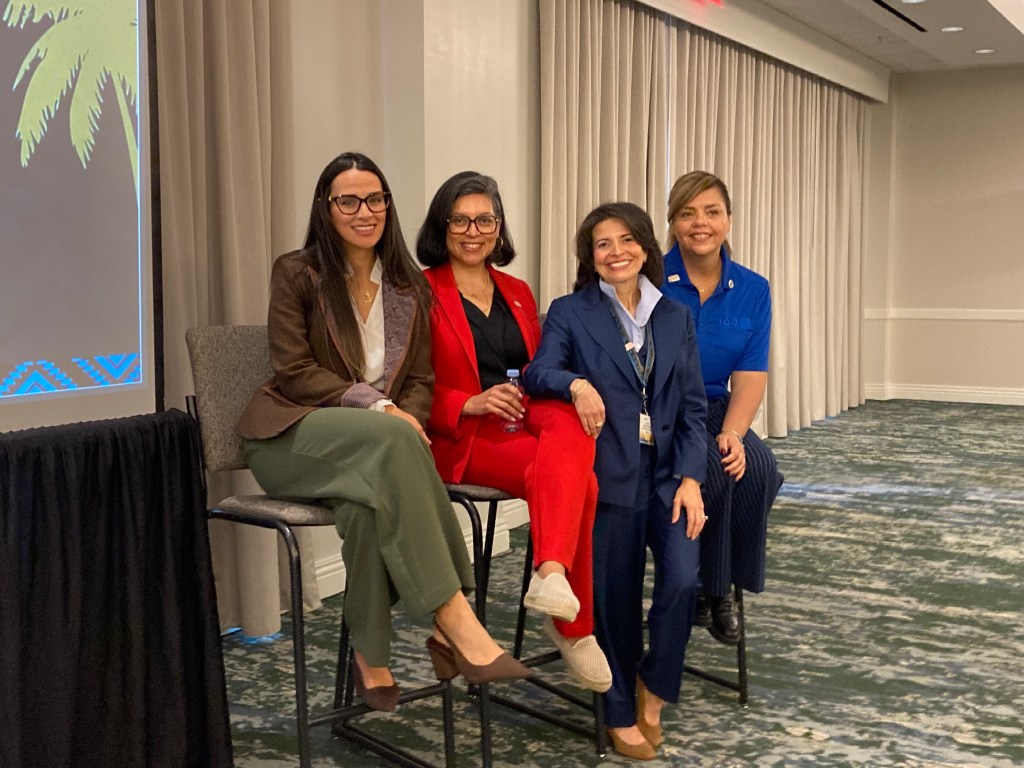
During the conference, women indicated they hid behind their Anglo names or straightened their hair to “pass” trying to fit into the White World.
Claudia Zapata-Cardone, LPA president, explained she made sure she didn’t have an accent and hid when she was eating her Arepa for breakfast. It was years before anyone knew she even spoke Spanish.
“African-Americans have it worse,” she noted, “I owe my career to the black women of the Organization for Black Aerospace Professionals (OBAP). They taught me about microaggressions which I didn’t even know about.”
Latina Super Powers
Panelist Laura Allen told the packed audience they should also embrace their language skills because “knowledge is power and when you have a second language you have a valuable skill,” she said. “While I want the rules to change to be more inclusive, my experience made me stronger.”
Juanita Valez builds her confidence by knowing the value of the Latino community.
“You have an economic impact and businesses need that,” she said. “Businesses need credibility and to understand how it works. They need to know Latinos – our contribution to the economy and what matters in our lives. Learn how we impact the economy because it positions you as a business expert. There’s no excuse not to know our numbers and know our impact on the economy.
“Today, I want people to know I’m Latina,” she concluded. “It’s like a superpower.”
The Economics of the Latino Community
Given the dramatic drop in birth rates for non-Hispanics, Latinos are now a major force is adding to the working population.
“The future is Latino,” said David Hayes-Bautista, distinguised professor of medicine at UCLA, of a 2026 report on the state of Latinos in America
An article on the study reported:
- The economic contribution of U.S. Latinos in 2024 surpassed Japan’s, generating the equivalent of the world’s fourth largest GDP.
- “Our data shows that the U.S. Latino GDP reached $4.4 trillion in 2024,” said Hayes-Bautista, co-author of the report. “It grew so much that it shattered records for economic vibrancy.”
- In total, between 2018 and 2024, Latinos added 4.6 million to their population while the non-Hispanic white population reduced by 3.3 million.
- In 2024, U.S. Latinos’ consumption hit $3 trillion, 25% larger than the entire economy of Italy and 32% larger than Canada.
- Finance and real estate is the top industry sector for the Latino GDP, amounting to $766 billion in economic activity by Latinos.
- The number of Latinos with a bachelor’s degree or higher more than doubled between 2010 and 2024, increasing by 144.5% while non-Latinos only rose by 44.8%. Latino educational attainment grew 3.2 times faster than non-Latinos.
- From 2007 to 2023, the number of Latino-owned businesses, including both employer and non-employer businesses, increased nearly seven times faster than non-Latino.
- Within that same period, Latino-owned businesses which employ one or more workers grew nearly 20 times faster than non-Latino employer businesses.
Latinos are now a force to be reckoned with, yet another superpower.
Opening Doors
Panelists also discussed how they were reaching back to help others.
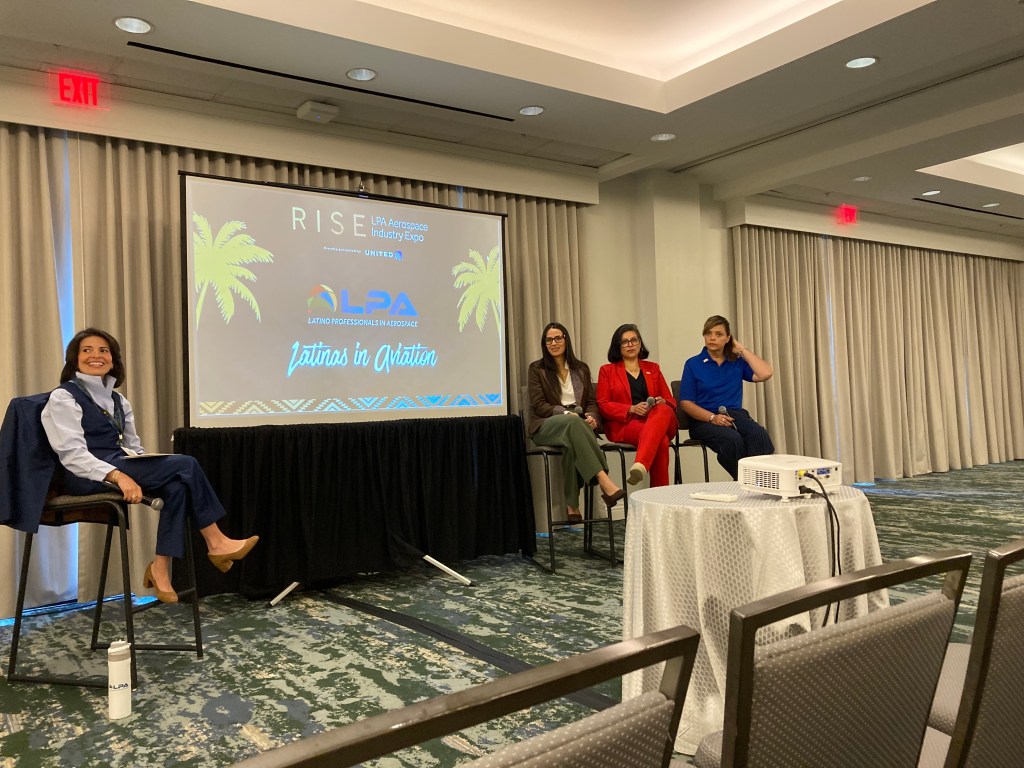
“Being the only woman, only Latina, only Hispanic, you feel like to don’t belong,” Valez explained. “Being in that room is powerful. But once you walk through that door, own that room, use that space and identify who else is missing in the room and advocate for them as well. You are not just holding the door for them you are widening the door for everyone. The barrier is there. You must acknowledge it, but it can’t stop you from overcoming that barrier.”
“How are you opening doors,” Anel Ruiz, managing director of people impact at United Airlines asked. “I put my name behind theirs to open the door. I want to take your name into that room. When I got a corporate job, I realized they rewarded vanilla. I didn’t even try to fit in because it felt so awful. But I created an identity. You have to build relationships and carve out a place to feel good about both identities.
“There’s a difference between being invited into the room and having influence once you are there so you can be heard and trusted,” Ruiz continued. “The best lesson I ever received was being prepared to sit at the table. You must show up prepared with knowledge of the subject and a point of view. Show up with questions and the ability to change your mind. A lot of influence happens before the meeting by having conversations with others to understand the topic, their point of view and having them understand yours. If we don’t do that, how are we going to move the needle?”
Allen advised seeking feedback.
“Sharing is important in getting to know each other,” she told the packed room. “What did they see in that meeting? What did I? What were the lessons we learned. What impression did I make, and can I improve? When we share that, leadership will treat you different because they know you now. Building those relationships builds your confidence. Sometimes seeking feedback will hurt but that is how you learn and grow.”
Out of the Mouths of Babes
Valez shared she stopped straightening her hair when her curly-topped, five-year-old daughter asked her why her hair didn’t look like her mother’s.
“I realized you can still look professional even if your hair is curly. The question is, as an immigrant, how do I adapt so I can move and open doors? I stopped trying to adapt. Adaptation is great to open doors but once through the door, what you bring into that room, no one else has. Teaching people about yourself helps them know the culture. Don’t dilute who you are.”
How Allies Can Help
During the question period an ally asked how he could do more to support women and minorities.
“It is a moment to be courageous,” said Ruiz. “You will be seen as an awesome human and a better leader as a result. I try to identify people and build strong relationships with them. The more they are exposed to you, the more they see what you are good at.”
The most important thing allies can do is witness for others by calling out awkward comments. Aviation writer Lane Wallace calls it building bridges with colleagues. That way they are more comfortable calling somone out and saying, “Hey, you are hurting the team.”
On the other hand, Former United CEO Oscar Munoz takes people who make such comments aside, asking them if they really mean what they said. More importantly, he wants to know how they came to have that opinion.

