
Sign up for a free subscription
An Analysis of the Aviation Culture and What to do About It
By Kathryn B. Creedy
In what I believe is a first for any women in aviation conference, veteran AMTs reported some of the most cringeworthy moments they’ve experienced on the aviation maintenance line. From customers who refuse to work with women to how inappropriate remarks should be handled, the lessons learned did not just come from the actors on stage but reflected very impressive audience experience and advice on how to navigate these occasions. The role playing taught us what should be done to counter the current culture but also instilled in us the courage to make it happen.
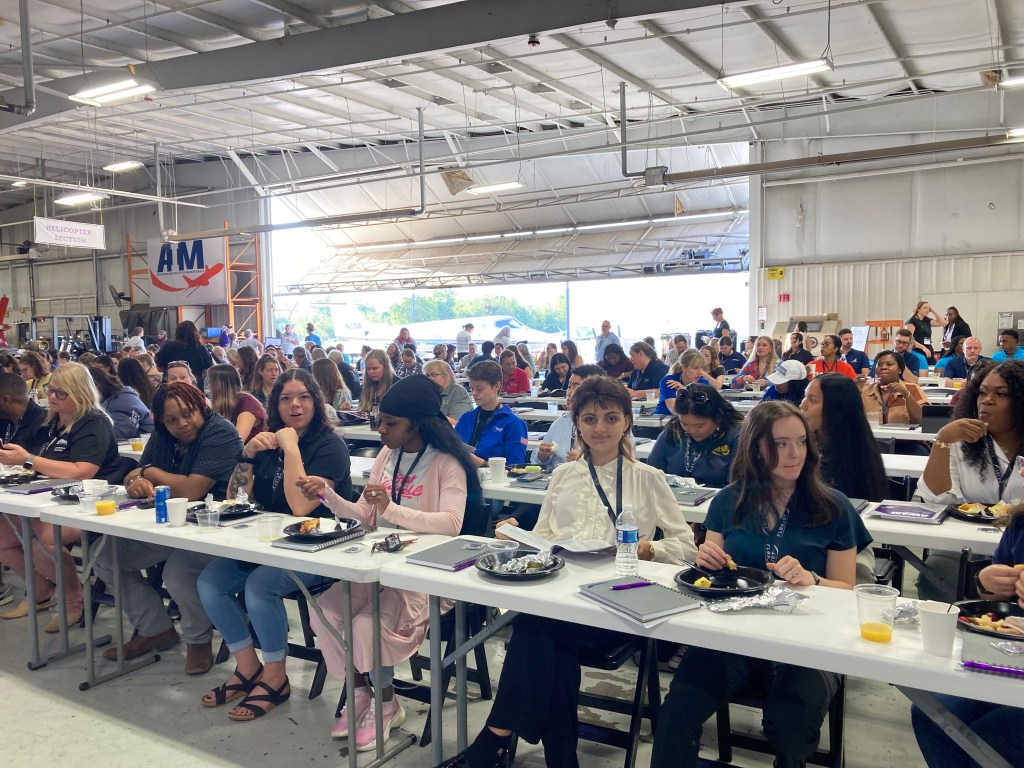
The message was clear. How companies support their workers is a serious litmus test, one companies cannot afford to fail given workforce shortages. For the women attending the Association for Women in Aviation Maintenance Conference last weekend, companies are now on notice. They may only be 2.8% of the AMT workforce but they are loaded for bear.
Taboo Topic
I’ve been interviewing women in aviation for decades for Aviation for Women magazine. However, these women played “good little girls” sliding past my questions on sexual harassment, assault and discrimination in the workforce. Instead, they rightfully spoke of their male mentors who pushed them into become more than a “wrench turner.”
From American Airlines Vice President for Maintenance Evie Garces to the veterans of the Chix Fix Team, they spoke with one voice.
“They saw in me what I did not see in myself,” said Garces of the managers that drove her forward. “There were a lot of men rooting for me.”
I’ve also been covering sexual harassment, assault and discrimination in the workforce for over a decade including a scathing editorial after this year’s Women in Aviation conference decrying the inclusion of Air Line Pilots Association President Captain Jason Ambrosi and the failure to link the male dominated workforce culture to safety. I have also written on how psychological safety is deeply tied to improving aviation safety, something WAI failed to grasp in its ally session earlier this year.
Opinion: Male Ally Discussion Very Disturbing with No Mention of Safety – Part One
Elevating Aviation Safety: The Critical Role of Bias Awareness and Psychological Safety
It is clear the latest generation of Rosies and their veteran counterparts are out to change the culture while older and more established organizations continue to shrink from the task for fear of alienating their sponsors. The audience at the Harassment – Real Stories session, were as savvy as the actors on stage. More importantly many showed they know how to handle themselves in awkward situations, peppering the session with actionable recommendations.
Are Members More Ready to Tackle the Culture Than the Associations Who Represent Them?
Many WAI members are pushing it to do more on culture but I also wrote a commentary about what we are risking if that backfires and sponsors abandon it. However, I don’t think it is risking much, by virtue of the fact sponsors need women and minorities to succeed – not just in staffing the workforce but in providing the diverse thinking that goes straight to the bottom line.
Just look at the numbers. Boeing’s 2025 Outlook report predicts a need for nearly 2.4 million new aviation professional over the next two decades including 710,000 maintenance technicians, to support the growing global commercial fleet and air travel demand. Boeing also cited the growing backorders and fleet demands as driving these workforce needs. Without us the industry cannot grow. Years ago, the Aeronautical Repair Station Association said the MRO industry was leaving $1.4 billion on the table for lack of workforce. Do you think the workforce shortage will be satisfied with just white men? That is laughable.
Memorize those numbers and use them. Remind supervisors that without us growth cannot happen.
Shouldn’t we be done with playing good little girls?
If this session revealed anything is that workers are ready for the cringeworthy and able to respond, which reflects a sophisticated, mature workforce with a confidence that even I didn’t know they had, especially given the changes wrought by the current administration.
I don’t think the organizations who represent women in aviation, aerospace and defense have fully internalized just how ready their members are. I don’t think they have the same courage reflected by the attendees and members at the AWAM conference.
Women’s organizations are not, as Board Member Angel Green said during the role playing, setting boundaries for the companies that serve our industry. Nor are they demanding the change called for at the AWAM conference which showed us that having these hard conversations can be done and should be an important part of any conference representing minorities and women because we are all dealing with the same culture.

WAI scheduled a sexual harassment session at the 2024 Orlando conference for one of the last sessions on the Saturday and I wondered at the time if that was purposeful. But, in reporting on it for Aviation for Women, I noted it was a packed house with a dozen women staying to discuss their experiences despite being one of the last sessions. Clearly, it was a popular, necessary conversation but it has not been repeated and it’s the first thing I look for when the program is released.
Harassment – The Real Stories
Board member Bill Russo, a specialist in tech ops training, played the bad guy in the scenarios but went out of his way to remind the audience he was just acting. In reality, he is well known as a long-time supporter of women in aviation maintenance and someone who helps them realize their potential. He was joined by board members Stacey Brown from FEAM and Angel Green from Tech Ops at UPS who reported that while she was pregnant, she walked by a coworker who said: “I love the smell of a pregnant woman in the morning.”
“We are using language that may offend people,” said Russo, cautioning attendees. “But it is important not to filter our language. These are real scenarios experienced by our board members and others.”
The Pilot Problem
Perhaps the biggest gripes AMTs have is when a pilot does not recognize them as mechanics and instead assumes they are from catering or a flight attendant and asks them to “send up maintenance.”
“Even female pilots do it,” one attendee said. “Usually, you get some type of attitude from the captain but just remind them they don’t move without the okay from maintenance.”
Green cautioned to be mindful of who is listening to the exchange especially if passengers are present. “You always want to stay professional and be respectful,” she said. “We are demanding respect, so you have to give it.”
Another reported a coworker always demanded a female mechanic make him a sandwich. “He was testing the waters to see what her boundaries were,” she said. “Set the boundaries with everyone within earshot.”
“Yeah, make him a dog food sandwich,” suggested Brown.
“I was even kicked out of the flightdeck because they didn’t believe I was a mechanic,” reported another attendee. “I just told him ‘fortunately you have the best mechanic on the team right here.’”
Another said she didn’t give people the opportunity to make that mistake. “I assert myself,” she said. “I introduce myself in a way that commands respect.”
Still a Man’s World
Brown indicated that aviation is still a man’s environment which doesn’t like women in the workforce.
“What we need to do is support our coworkers and friends and show we have their backs,” she said. “It is important to find a safe place at work. However, you respond, keep it professional. Ask why they said what they said. Tell them how it makes you feel uncomfortable and, if necessary, elevate the issue to the crew chief. Do not withdraw or avoid the person because that just signals there is no impact to what they have said and its breeds bad cultures with serious safety implications. It also affects your advancement and your opportunities to greater assignments that will provide new skills.”
For the customer who refuses to work with women calling them a distraction, Brown tries to reason and educate them. “You might want to consider her because she is a star mechanic who is loved by all the customers she works with,” she suggested, noting if supervisors and management don’t do that, they are signaling they don’t support their own team. “She’s also respected by her entire team which benefits from her experience.”
Or, in acquiescing, she continued, “you might say something like, ‘In the future you may want to consider her because there are now women in the workplace and they constitute some of our best mechanics,’” Brown added. “If that doesn’t work explain to the worker customer demands are not a reflection of their work or the team. But you also have to manage the customer relationships, and it may be that you want to tell them their attitude is unacceptable and the company doesn’t want to work with them.”
Russo added he often chooses team members strategically based on professional development. “I choose based on the opportunity an assignment would give them to gain new experience and round out their skills,” he said. “Leaders need to advocate for employees. The reason we are doing this role playing is because it is important to think about your response and to practice it because you get caught off guard and the tendency is to withdraw. Having a ready response is really powerful.”
Advice from Pilots
In fact, female pilots have made responding an art with Captain Jenny Beatty, one of the most powerful advocates against sexual harassment, assault and discrimination, offering up critical advice with her articles: Calm Comebacks to Rude Remarks, Halt Harassment in Aviation and 10 FAQs for the FAA Aeromedical Exam.
One of my favorite sessions during WAI is when Lane Wallace instructs us how to build bridges on the job. She explained my favorite nugget by describing an incident in which a team member says something insulting to a female coworker. Wallace indicated it is up to others present to call them on the behavior saying, “Hey, knock it off, you are hurting the team.” That takes the attack away from the women and puts it on the team and few want to go against the entire team.
We, too, had a speaker teaching us about building bridges in Dr. Linda Weiland from Embry Riddle Aeronautice University and that story can be found here.
Or, as another attendee suggested, “You may want to give them the silent death stare of a mother,” she said. “We all know the look our mothers have when we’ve disappointed them. That stare of disapproval goes a long way. The most effective response is to make someone really uncomfortable in a really pleasant way.”
Brown added: “The majority of guys have a mother, or sisters or daughters and responding to unacceptable comments by asking if they would speak to their mother or daughters that way makes them think,” she said. “It has an impact.”
Another attendee noted that culture plays a huge part in attracting talent and if a company is known for a bad culture which doesn’t support its workforce, that fact will spread faster than any recruiting campaign.
Terms of Endearment
The actors also covered dismissive nicknames – honey, sweetie or momma. Complaints are often met by the perpetrator telling them, “It’s a man’s world, get over it or you’re making a big deal out of nothing.” Standing back and saying it is a big deal and telling them you’ll report it to the supervisor is important, they said.
“Set your boundaries,” said Green. “Be forceful. Otherwise, you are letting them get away with saying your boundaries don’t matter. Be calm and direct. Repeat ‘What did I tell you over and over about calling me sweetie? Terms of endearment are reserved for my loved ones who are afforded the respect they deserve by such endearments. They are not for the workplace.’ Tell them that is a boundary you set.”

Another audience member noted they may think they are being subtle, but they are not. “They are trying to intimidate you,” she said. “This is a litmus test and that is why it is important to set the boundaries so every one of your colleagues knows what they are.”
“Everyone watching these events should know watching in silence is acceptance,” Brown added. “There’s always a third party listening so you may want to say, ‘we will talk about this later’ letting them know you are not done with what just happened.”
What about when a co-worker keeps making unwanted advancements despite all the refusals? “You don’t want to go with your boyfiend,” said Russo in his acting role. “Forget about him. I’m what you want.”
Report him was the advice of the group. “Just tell him you are done with talking to him,” said Brown. “Tell him you are going to the supervisor. And if the response is: ‘that’s just Bill, you’ll get over it,’ you’ll know this is not the culture for you and turn in your notice. Remember, supervisors have an obligation to deal with issues when someone escalates a problem. HR must deal with any violation that is documented.”
Proceed with Caution: Management Circles the Wagons Against You
The acting team also suggested bringing the issue to the legal team or a mentor, if HR or the supervisor does not respond appropriately or fails to launch a full investigation as required by the processes in place. But that can be dangerous since HR often retaliates against anyone who rocks the boat on harassment, discrimination or safety.
One of the members of the Delta HR team attending the the conference rose to urge participants to bring in HR before legal. “If HR doesn’t do full invetstigate, escalate to the legal team or to a mentor in the organization,” she said. “There is a clear process and way to report. Reporting can also be anonymous.”
“Make sure you document everything from the very beginning,” the team on stage advised. “Write down the date and time and what happened. That way you have a clear timeline of events, what was said, what you did about it and who was there. Connect with whoever is there to ask them to be a witness.”
All this is easier said than done. I have talked to many women who, with corporate policy against sexual harassment, assault and discrimination in hand, were not only rejected by HR but then retaliated against with marginalizing assignments and forcing employees into employee assistance programs they don’t need to intimidate them. This happens to both men and women. Retaliation is designed to make you leave. And the gaslighting they do starts with, ‘we’ve never had any complaint against this person so it must be you.’
Don’t believe it. Ask others who have dealt with the employee in question and build a case.
Similarly, if you are looking for support from your union, you may be surprised as they join management in the retaliation. Numerous pilots have reported that unions not only deny you support they are required to give but they use your dues to fight you.
Resources: Delta’s Debacle, a primer on how to protect your career, Calm Comebacks to Rude Remarks, 10 FAQs for the FAA Aeromedical Exam and Core Strengths by Lane Wallace.
One audience member noted she reported an incident of sexual harassment – “he locked me in the cargo compartment” – only to be suspended for complaining, and, at the end of her suspension, she handed in her notice. “They’ll ask why you are leaving and tell them you can’t work for a company that won’t stand up for you.”
Your AWAM Tribe
Several members noted that AWAM constitutes a considerable resource. “If the company is not looking out for you then turn to your colleagues at AWAM,” they said.
Russo seconded that suggestion saying, “Our mission statement is building a community of support around women and mentoring.”
Another attendee said her instructor always interrupted her to tell dumb blond jokes. “I elevated it to the president who said I was lying,” she said. “Social media is a real thing, and a bad review makes an impact. You don’t want anyone else to go through what you did.”
But be careful in using social media. Confer with your colleagues before pulling the trigger on a post. They’ll deliver strategic advice.
The audience was enthusiastic in their recommendations with one suggesting using SBI – Situation, Behavior and Impact. “You say either to the offender or the supervisor, ‘here’s the situation, this is the behavior I observed, and this is the impact it had on me.’ It’s just a very effective tool you may want to use.
Final Lessons
“We will never change the culture if you stay silent,” Russo concluded. “I’ve been a leader a long time and am proud to have built a reputation as an empathetic leader so my team trusts and respects me. The higher you go in leadership, the more important it is to temper what you say so as not to offend. What we say to people at work matters. Having this frame of mind makes us stronger as a team.”
Complete coverage of the Inaugural AWAM Conference is here:
A&P Value Goes Well Beyond Turning Wrenches
Analysis: Building An Equitable Workplace with the Help of Male Allies
 futureaviationaerospaceworkforce.com