
By Kathryn B. Creedy
The aviation and aerospace industries love to tout the billions of dollars they contribute to local economies, but few talk about the personal impact those contributions have on the community. Pittsburgh International Airport (PIT), however, is showing how airports contribute beyond the economic impact to elevating the personal lives of those in the community and the region.
“PIT is pioneering what an airport’s role can (and should) be within the community it serves,” said Director of Workforce Development Alicia Booker. “It is doing this in a way that encourages opportunity not only for those participating in PIT2Work but for their friends and families as well. Quite simply, PIT is generating a legacy.”
Recasting the Role of the Airport
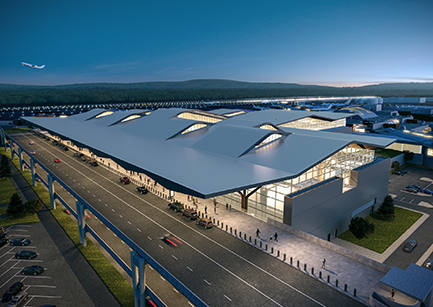
When it began planning its terminal transformation which is scheduled for completion in the fall, it wanted to bring the community along and created the PIT2Work program to hire and train locals in construction and airport jobs they may not have even known existed.

“Pit2Work is a workforce development program using the terminal modernization construction program as a really big advertisement for why you want to work in construction or aviation,” said PIT CEO Christina Cassotis, in a promotional video on the program. “We created PIT2Work because we believe in equal access to opportunity, and we wanted to make sure more and more people in the region can access jobs here at the airport. We want to ensure they are aware of what they can be. We took care of some of the barriers to entry like transportation and childcare and now training.”
Pittsburgh International Airport is a perfect example of how airports are transforming the community while transforming itself. Through its partnerships it is introducing locals not only to the inspiration of travel but to aviation careers, something sorely missing on an industry-wide scale. And, with the workforce development, PIT is changing the trajectory of individuals, entire families and the community the airport serves.
Airports are large, complex, noisy and foreboding infrastructures, often more likely to attract a community’s ire than support. Separated from the surrounding community, aviation advocates have long complained security procedures are detrimental to sharing their avocation. So, PIT broke down this barrier separating the airport from the community – the high fences and security that tell locals they are not allowed unless they are flying — by using workforce development to invite them it. It is about making the airport more accessible as a living part of that community. That model will attract more supporters than detractors.
And, according to Booker, it was all part of Cassotis’s vision. “At the very beginning, Christina sent me a slide about turning the airport project into a vision for creating the pipelines needed in this region and how they can be used to address the workforce shortages we and our community are facing. It was about how can this develop the workforce sustainability we need.”
An innovative five-week training program, the PIT2Work program is hosted by PIT in partnership with local trades unions, Partner4Work and Pittsburgh Gateways Corporation. It uses Partner4Work’s Pittsburgh Gateways Introduction to the Construction Trades program and is funded under grants from Partner4Work, the Arconic Foundation and the Allegheny County Airport Authority Charitable Foundation.
Doing Well by Doing Good
PIT2Work and its affiliated programs immerses students into high-demand trades and provides them the skills needed to take careers to new heights. By the conclusion of the five-week program, graduates have completed hours of construction-related coursework and received an OSHA 10-Hour safety certification, PennDOT Flagger certification, Pennsylvania Registered Pre-Apprenticeship certification and an environmental health and safety certification.
PIT2Work was recognized as a Fast Company Most Innovative Companies in Transportation winner. Additionally, the National Association of Workforce Boards awarded PIT with the W.O. Lawton Business Leadership Award for its support of the Pittsburgh region’s workforce through PIT2Work. In 2024, PIT was recognized by the World Changing Ideas Awards in recognition of “innovative ways organizations are addressing modern challenges.” It has also garnered accolades in the Enterprise, Corporate Social Responsibility and Education categories.

Booker, the driving force behind the airport’s PIT2Work program, said PIT just launched its seventh PIT2Work cohort and recently celebrated the program’s one-year anniversary. For Booker, it’s all about leveraging the assets of the airport for the betterment of the region.
The development of transportation and childcare to support these new workers addresses the social barriers of upward mobility now being adopted at more and more businesses in need of a stable workforce. By addressing these barriers to employment, the airport was also addressing the economic barriers of working. Much of the discussion around diversity, equity and inclusion ignores the fact that diversity is also economic.
Airport Workforce Shortages
We all know that if there is a job discipline in aviation, we have a shortage. But few speak of airport needs beyond how the pilot shortage prompts a loss of air service. This is, of course, serious since it has resulted in the loss of scheduled air service to more than 400 communities in the last decade. But equally important are the on-airport jobs – baggage handlers, ramp agents, gate workers, operations managers and management.
What few realize is starting as a ramper often leads to a rapid rise through the ranks into upper management. That’s why, when I see a young ramper, I make sure to tell them they are at the cusp of a great career where, if they stick to it, they will rise through the ranks. The same is true of airports.
More Than a Hub
Another part of the vision was using the transformation project to signal airports are more than transit points as Pittsburgh quickly moves past its steel origins to become another the tech hub recently featured in The Wall Street Journal.

A once powerful US Airways hub, decision making was all about what was good for the airline. Airline consolidation prompted the loss of several once-powerful hubs, including PIT which underwent changes at US Airways – its merger with America West and US Airways merger with American. Even so, the airline retains a substantial footprint and is one of its PIT2Work partners.
As it approached its transformation plan, Booker, who overseas workforce development for the Allegheny County Airport Authority told Future Aviation Aerospace Workforce News PIT wanted to reinvent itself by leveraging aviation and construction careers as part of its effort to do what is right for the region.
“Redesigning and reinventing PIT was about what an airport can be to the region and the world,” she said. “We wanted an airport built for Pittsburgh by Pittsburgh. We wanted an airport that would support regional growth. As we transformed the airport, we wanted to transform the industry and the local economy.”
Booker stressed the vision was never about the length of a single construction project but to show locals there is a future beyond that project.
“We saw what this could be,” she said. “The airport worked with local trades unions who were already focusing on how to address the skill shortage in their industries. But we wanted to go beyond that to include what we are seeking in terms of careers that support aviation. This was the project that could do it for us. It’s not just about the economic impact we have in the region. It’s about the disparity in communities not benefiting from that impact. That was the impetus behind PIT2Work. The terminal was a catalyst for helping locals in the community learn the tools of the trade and how to find a career and how to grow in that career. How they can advance.

“We were seeking training around careers that support aviation,” Booker continued, “and we knew this project could do it for us. Bringing in the community to support the airport has dividends. It was never just about business development but about creating that opportunity for people to build their future, build their families and build their careers. We had to include the community in our transformation. In fact, from a business perspective, it is important that we pay attention to the community we live in, and we need the community to be part of that. And from our initial efforts people have gone into careers such as aviation, banking and construction. They have taken our investment in them and turning around to invest in the region.”
It has worked. Approximately 100 participants have gone through the PIT2Work program in its first year, and many are now working members of local Pittsburgh trades unions. Participants ranged in age from 18 to 57 of both genders. Some 86% of trainees completed Pit2Work and 80% were employed because of the PIT2Work experience. The airport also established a PIT2Apprenticeship program to address coming retirements, said Booker. “We want to develop a sustainable pipeline to fill those posts,” she said. “We have partner initiatives to support all the employment you see at the airport. We may be small at 486 employees, but we are strong because of those partners, and they are strong because we support their workforce development as well.”
PIT’s Former Chief Human Capital Officer Lisa Naylor agreed. “It exceeded what we thought the benefits would be,” she said. “The fact we were able to make a difference in someone’s life is amazing. It is not just ‘well let’s have some training program and everyone shows up.’ It’s about being very specific to ensure we are breaking down barriers to those who have not had the opportunity to have training for employment at our airport.”
Reflecting the Community
“PIT2Work introduced two things,” she said. “It introduces them to our careers and aviation. It was about creating pipelines for the region and how we addressed workforce shortages we are facing and ensuring we have the workforce sustainability we need. It was all about looking at the community and making it a part of our project, getting them involved and helping them grow. On the new terminal, our goal was about how we address our talent pipeline needs to support the region and other building projects here. It was about engaging the community and making them a part of the project and how we create a development opportunity that will have lasting impacts throughout the region.”
PIT is leading a trend in airports looking at their surrounding environment and identifying interests that could benefit from partnering with the airport. It created a dedicated program to recruit small businesses to meet the business opportunities available. Indeed, Denver International Airport offers classes in connecting local businesses with airport opportunities as explained in this article which includes an explanation of its new workforce development learning facilities that is also used for youth programs and airport employee professional development.
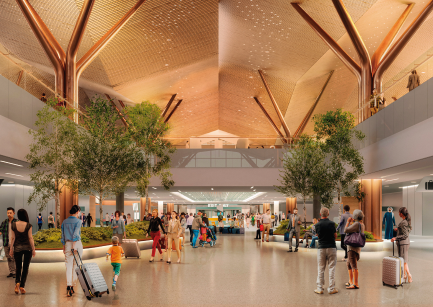
Booker explained the reasons behind bringing the entire regional ecosystem into the airport. “The artwork mimics the 90 neighborhoods around PIT,” she explained, adding designers wanted the community to see themselves as part of the airport ecosystem. “Once we accomplished creating a down-home community feel of the region that is Pittsburgh, we looked around for something else we could do and coming out of Covid that was about getting the community back into the workforce and that is not just about jobs. It’s about how we need to support those workers with transportation and childcare. We looked at the disparity within communities and identified who was not benefiting from our work. That was the impetus behind our transformation. It’s not the length of the project but the future of the project and the region.”
It also recast the economic contributions and started with the construction jobs needed for the new terminal which promised an additional 14,300 direct and indirect jobs from construction alone. The project created 7,800 direct temporary design and construction jobs including 563 jobs in the pre-construction phase and 6500 temporary spin-off jobs in the region. PIT’s transformation also delivered long-term economic benefits, generating about $2.5 billion in economic activity; $1 billion in direct labor income in 2021; and $700 million in gross regional product/value for the region and $27 million in state and local income tax.
“That’s a lasting economic impact,” explained Booker. “The future of PIT2Work is about expanding the program. We did so well with the construction program around the airport, we want this to be more than a moment. We want to be a movement to encompass different workforce activities we have.”
The airport is also rolling out youth activities, expanding into different schools to create career awareness with PIT2Aviation initiatives. American Airlines is supporting its work for maintenance technicians, and PIT has incorporated Fly Like a Girl which introduces young girls to drones and aviation. It also partners with a summer camp in collaboration with the Smithsonian and the Tuskegee Airmen.
Booker also explained PIT2Apprenticeships to ensure it has the workforce it needs. “It’s not just about now but a future in which we see a lot of retirements,” said said. “We are building our own sustainable pipeline to fill those posts. “We are developing partner initiatives to support all the employment we see at the airport, and we help support our partners effort to develop their workforce.
Conclusion
Airports tout they are gateways to their regions but at PIT the airport is fast becoming a gateway for the community as well. In discussing PIT’s workforce development program Booker made the point that aviation/aerospace and airports were not just gateways to the world but offer a ticket to the middle class with high-value, high-paying jobs resulting in careers like construction, airport operations and aviation maintenance.
Incorporating the community into major projects by providing jobs really is the definition of a rising tide lifts all boats. It may be Pollyanna in a dog-eat-dog business world, but more and more organizations are leveraging aviation careers to elevate those who are often forgotten.
 futureaviationaerospaceworkforce.com