
By Kathryn B. Creedy
While many corporate workforce development programs focus on universities or poaching employees from each other. Others target high schools but it has long been acknowledged the industry needs to target very young kids.
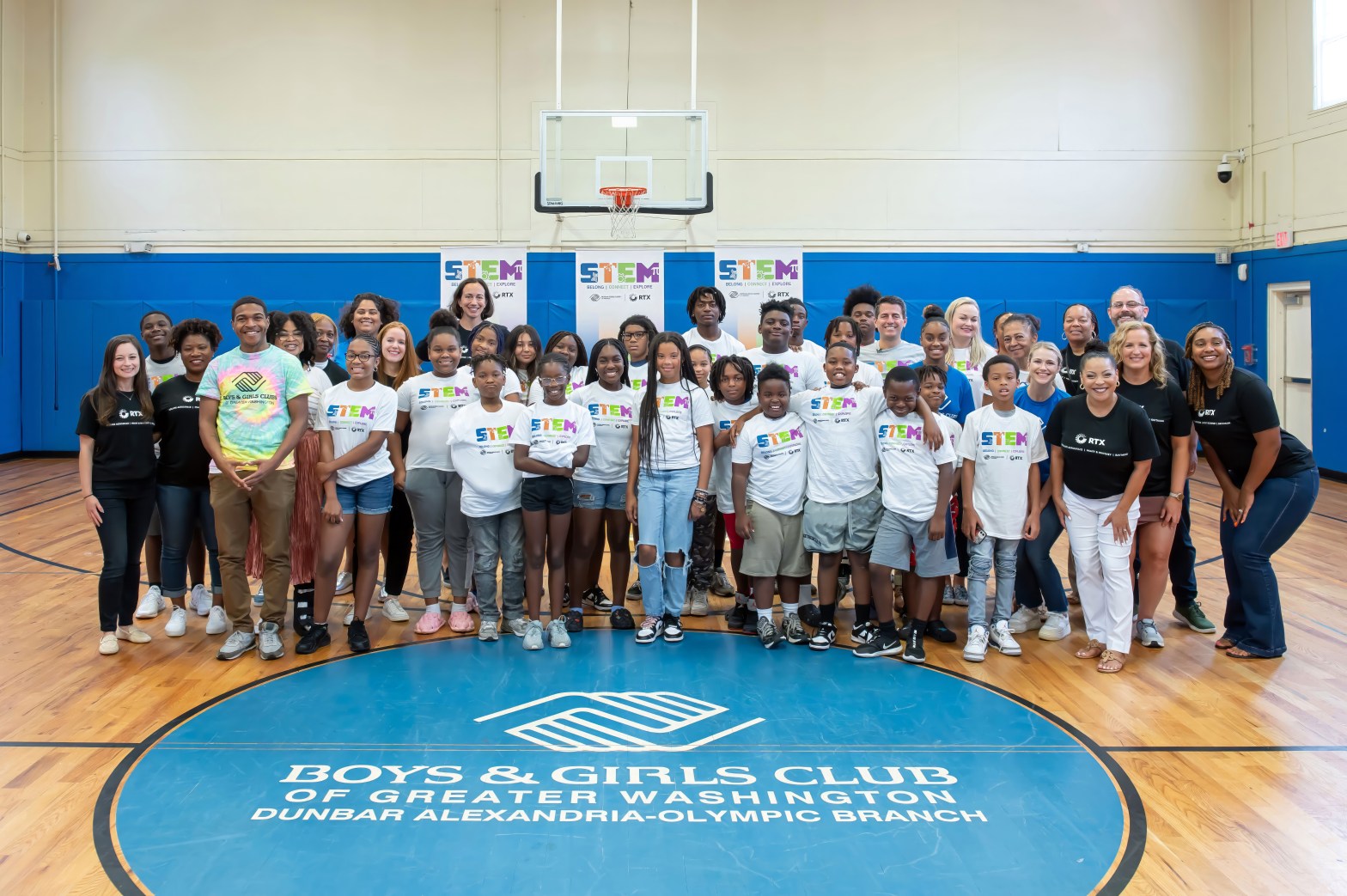
That is exactly what RTX – parent company to Collins Aerospace, Raytheon and Pratt & Whitney – is doing with the Boys & Girls Clubs of America (BGCA) by investing in the first-of-its-kind STEM curriculum at clubs nationwide.
Its reach is massive – over 5400 clubs and over three million youth.

The curriculum is a game changer, according to Dr. Michael Kennedy, research professor and director of Science in Society at Northwestern University. Kennedy’s team developed the new curriculum and staff training model to reflect best practices in STEM teaching and learning. He explained it brings a new style of instruction which is being tested over the next three years to establish the efficacy of a holistic STEM Club Model for youth.
“Research tells us that students learn best when they are deeply engaged in the practices of science and engineering,” he told FAAW News noting his team developed the new curriculum and staff training model.
“Rather than having an instructor tell students what to do, they need to be challenged to figure it out themselves,” he explained. “The instructor’s role shifts from being a sage on the stage to a guide on the side. Boys & Girls Club staff don’t need deep STEM content knowledge to effectively facilitate student learning. The students’ own experimental results and collaborative sense-making will lead them to the ‘facts.’ For staff members, it’s learning this new pedagogical approach and building their identities as science educators.”
Indeed, part of the goal of expanding the pipeline, as RTX is doing, is to increase the accessibility and the curriculum by addressing real-world problems kids encounter every day. The model is being tested over the next three years to establish the efficacy of a holistic STEM Club Model for youth.
Workforce of the Future

Kristy Becerra, senior director of Corporate Social Responsibility at RTX, defined the skills under development with its new program with BGCA, skills needed in the workforce of the future.
“We need technical skills and an understanding of basic engineering principles,” she said. “But, as important, is having critical thinking, collaboration and problem-solving skills to complement the technical knowledge. To solve the important problems of the future. You need collaboration and a passion for problem solving. It also takes leadership skills and a strong sense of empathy to really understand the experience around you and be motivated to find solutions. The curriculum gives participants all these skills.

“This is how we at RTX are considering future talent,” Becerra continued. “We know that late elementary school and middle school are critical periods especially for kids who are starting to feel excited and have confidence they can do STEM. We also strongly believe in making high quality STEM programs accessible to students from all backgrounds. And beyond programs and curriculum, we want our employees out there mentoring students and showing them career pathways and opportunities. We show them that, with persistence, they can build a career in technology or engineering. The only way to close the STEM gap in the future is widening the pipeline with those who would otherwise not have access to these careers.”
Becerra outlined the rising demand for STEM expertise. “You’ve probably seen the statistics from the labor bureau showing STEM jobs will rise by 11% by 2031 which is five times that of non-STEM careers,” she continued. “Some careers, like computer science and engineering, have a faster rate of growth and we’re reaching an inflection point. RTX realized that if it didn’t look ahead, fielding STEM talent will be an increasing challenge. It feels like a crisis. Our goal was the make technology and engineering exciting and accessible and get employees involved. It just takes one spark to make a difference in a young person’s life. We are finding students who don’t have access and who are in under-resourced communities need to develop a passion for STEM much earlier in their education. The question then becomes how we bring scale to bear for high quality STEM education and working with BGCA was our answer.”
By widening the aperture, the industry naturally becomes more diverse because it taps those who otherwise wouldn’t be exposed to STEM careers. The aperture also includes diversity no one really thinks about – economic diversity.
“Even BGCA clubs that don’t have the cash flow for STEM kits, are enabled to do DIY STEM,” said Becerra, who indicated getting employees involved was a force multiplier. “Our employees want to do more in their communities. Any employee can take what we offer and go to their local club and meet with students. It is a way for us to increase employee volunteerism because we always need more legs to get it to other clubs. We have 180,000 employees and that’s a big network to bring this curriculum to Boys & Girls Clubs.”
Long History with BGCA
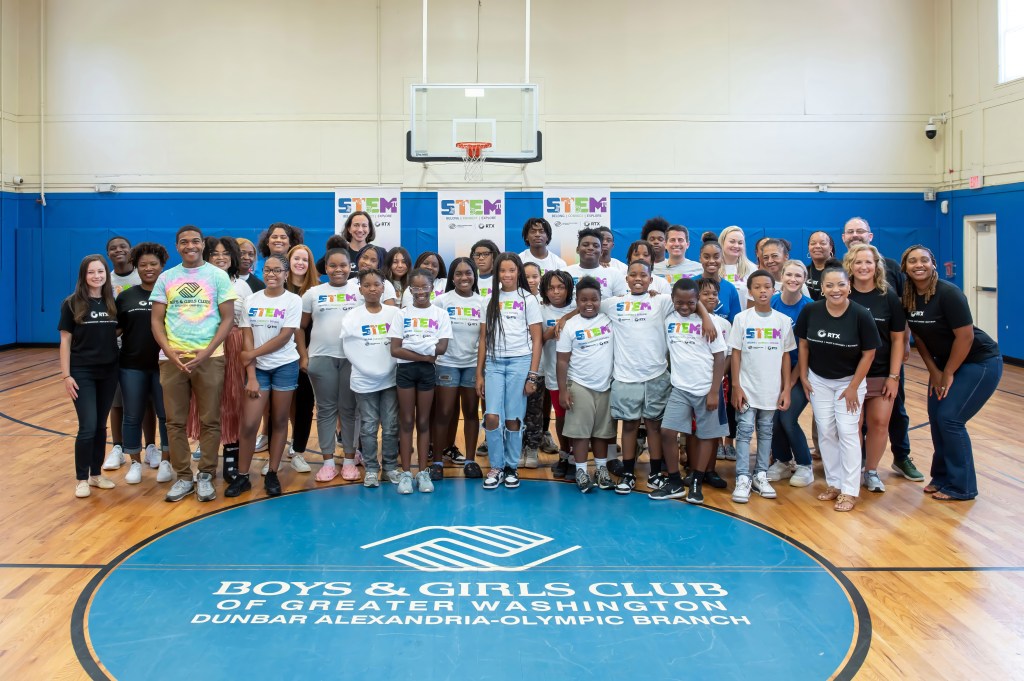
RTX has been a longstanding supporter of Boys & Girls Clubs of America, including funding Centers of Innovation for Clubs across 22 sites globally. RTX also supports about 35 BGCA clubs in its communities. In addition, it is the title sponsor for the RTX Invention Convention U.S. Nationals, in partnership with The Henry Ford Museum in which participants must identify a problem that doesn’t have a solution and invent something to solve it. In addition, it supports Girls Who Code to get girls from elementary to high school into coding and robotics, all much needed skills for now and into the future.
“We want to know what is working, where the gaps are,” Becerra said of its efforts to establish efficacy for its programming. “We know there won’t be a silver bullet, and we will undergo an evolution over time, but I think the results will be exciting and enable us to plug in other elements to the BGCA model. It is not just another STEM kit. We are taking everyday problems the kids experience in their own lives and teaching them the critical thinking and problem solving and collaboration to build solutions.
Important Strategic STEM Partner
“The idea is building the resources and developing the teaching models and expecting certain outcomes and this program is testing that,” explained Susan Ciavolino, director of programs and innovation for BGCA. “It encompasses the sum total of all their experiences – field trips, curriculum and reinforcing relationships with each other and industry partners. We expect to show how outcomes are affected by the quality, the staff and the support along with how it impacts a child’s academic performance and career interest. We want to ensure young people find their place in the community and emphasize career development and exploration. We ensure we have role models who look like them who can explain what they can be doing in the future.”

The curriculum is all about real-world science, added Northwestern’s Kennedy. “When they work collaboratively to explain a scientific phenomemon, they learn how science happens,” he said. “New discoveries most often result from scientists in several disciplines working together. It’s not just one person. It’s the team growing with one another that ultimately makes those breakthroughs.”
Interdisciplinary education and work is a key concept for future workforce as it evolves. Employers are wanting super employees trained across disciplines to enable faster communication and understanding across team members. The military has already started this cross-disciplinary collaboration as critical for success and the Utah Valley University cited a demand for super maintenance employees able to work throughout the aircraft four years ago.
Ciavolino agreed with Kennedy when she said: “This is a hands-on, minds-on program,” she explained. “It puts kids in charge of learning. They are put into teams, and each is assigned a role giving them responsibility for both the project and the team. That makes them feel differently which is an important part of learning and helps them define their own experience. It also gives them the skills they can take to pursue aviation and aerospace careers. Today, STEM can be intimidating but this program makes them feel welcome and makes science and math more accessible. If we are going to change the mindset to be open to STEM careers, it will take a concerted effort.”
Kennedy also explained it upends traditional science teaching. “What is exciting is how Boys & Girls Clubs are rethinking how science and math is done,” he told FAAW News. “Science is normally taught as a set of disconnected facts and recipe experiments. But that is not how scientists work. Scientists seek to explain our natural world through experiments they design. They collaborate and share their knowledge with each other. Boys & Girls Clubs of America’s student-centered approach is authentic to how science is done. Students ask the questions, develop the experiments and collaboratively figure it out. When you see it in action, club kids’ experiments and creativity are really impressive.”
Program Success is Measured in Pursuit of Careers

While this RTX program is new, what the national youth organization has been doing since 2012 is clearly working. “Providing an open, inviting environment shows the progress we are making,” said Ciavolino (right). “According to Boys & Girls Clubs of America’s 2024 Youth Right Now Survey, nearly half (48%) of young people say they would like to have a STEM-related job in the future. The survey also found 82% of youth say they like to participate in science projects and 79% say they are curious to learn more about science, computers or technology.”
The BGCA initiative, in partnership with RTX, includes staff training on the curriculum, according to Kennedy.
“This is significant because STEM can be as intimidating to adults as it is for kids,” Kennedy told FAAW News. “Importantly, the program reinforces the idea that STEM is a career option for everyone, a key to widening the pipeline. The series of four modules, each with three or four sessions, reinforces lessons by returning to various concepts three or four times.”
One unit is aligned with principles or lift, materials and trajectories while other units emphasized principles very core to aviation, said Kennedy.
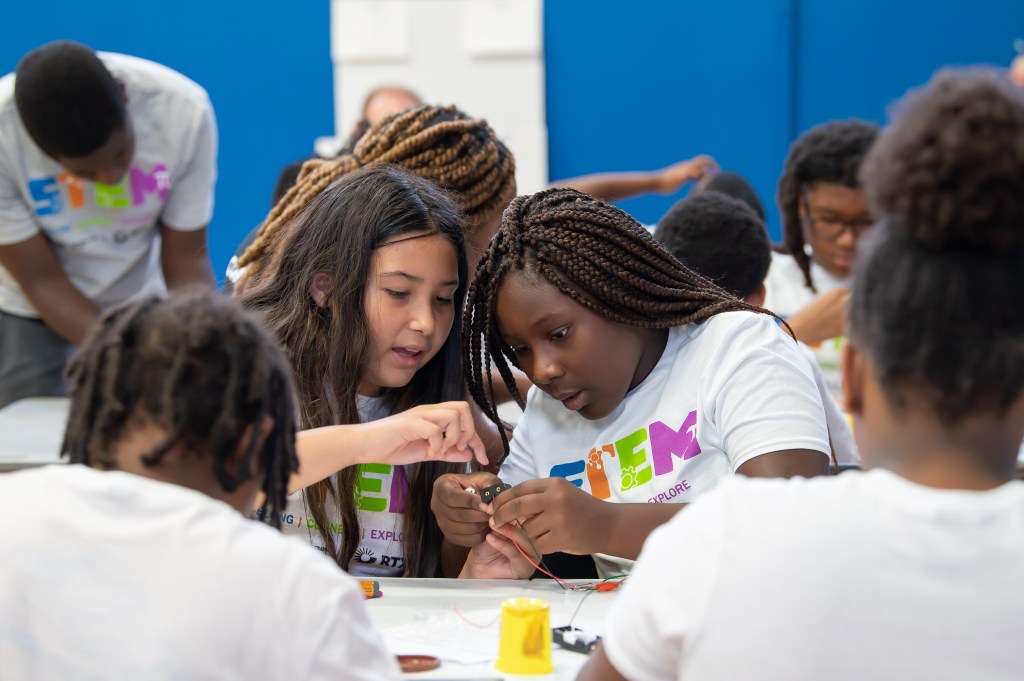
“This program is all about empowerment,” said Kennedy. “It is interdisciplinary, student-centered learning. In one unit, students learn concepts of air pressure and forces – that air has mass. It takes force to push an object up or make an object fall. In a second unit, centered on the engineering design process, students design and test paper airplanes comprised of different materials and wing structures. Additional units explore circuitry and electricity, including application of these concepts to build a novel electronic game.
“These are not recipe-based curricula,” Kennedy continued. “All of the questions, experiments, and engineering challenges are student-led. This approach builds kids’ STEM identity – a core self-perception that directly leads to STEM careers. The middle school years are a critical period. If kids enter high school with the idea that STEM is for them, they are two-to-three-times more likely to end up in a STEM career.”
Nor is STEM new for BGCA, according to Ciavolino, who said the national office has been developing culturally responsive programming including all things space, aeronautics and aviation since 2012. RTX previously had a STEM competition on paper airplanes which prompted employees to want to be part of the company’s next-generation workforce efforts.
RTX is a Model to Copy
Today, companies are taking many approaches to the workforce with a handful of curricula from CorePlus in the Pacific Northwest and Choose Aerospace from the Aviation Technical Education Council which is teaming with the AOPA Foundation’s High School STEM curriculum to connect kids to STEM using aviation.
By focusing on younger kids, RTX is building a long-tail pipeline and creating an aviation/aerospace education ecosystem to bring together industry and educators to solve workforce shortages once and for all.
Despite millions in workforce development investment by industry over the last 30 years, industry remains on the sidelines of this trend and its participation is necessary to highlight the gaps to achieving a career-ready workforce, and help educators and government develop programs needed to provide it.
One of industry’s greatest failures is working in silos which is a huge barrier to creating the K-Career pipeline. There is now a nationwide trend toward the creation of regional networks that include all stakeholders — government economic and workforce development officials teaming with K-Collegiate and nonprofit STEAM educators to increase the visibility of technical careers. Industry is largely AWOL or working within corporate confines.
There are remarkable programs that have already reached maturity such as the National Business Aviation Association student initiative which opens up its annual block-buster convention to high school and collegiate students, another model to be copied.
RTX is not alone in connecting the dots between local educators and industry. Airlines are fielding cadet programs and partnering with training professionals to address the pilot and aviation maintenance technician shortages. Maintenance Repair and Overhaul companies such as Duncan Aviation and West Star Aviation have developed their own AMT training programs designed to deliver a ready-to-work employee right out of high school. Regional networks are forming to collaborate on meeting industry needs.
But most of the focus is on older kids. What is needed is the programming and support to not only spark an interest in aviation/aerospace in young kids but the supports to ensure we don’t lose them if they don’t know what the next step is as they transition throughout their education.
In fact there are hundreds of aviation/aerospace non-profit programs throughout the nation. But we must connect the dots with industry workforce development efforts to create the K-Career Aviation/Aerospace Education Ecosystem needed.
Clearly, RTX is ahead of the power curve on early youth education and its partnership with Boys & Girls Clubs of America is a game changer in more ways than just creating a new curriculum and teaching method. It is connecting the dots for the future workforce.
 futureaviationaerospaceworkforce.com