
By Kathryn B. Creedy
In the 1960s movie The Graduate, Dustin Hoffman was told the most lucrative career was plastic. In the 1980s, it was computers. Today, in the 2020s, it is trade skills because many expect these careers to be bullet-proof against Artificial Intelligence (AI).
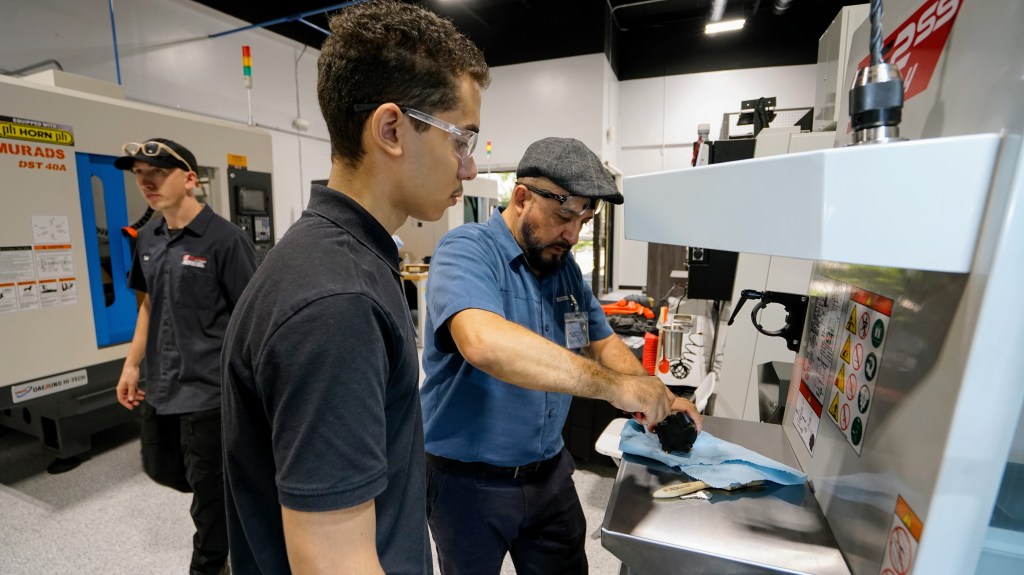
In Florida, a new training center developed a new training model for the aerospace community — one focused on short-term training to meet a specific employer’s needs that ensures the machines keep running. And it addresses one area that is little discussed in workforce development — small- and medium-sized companies who invest in training only to watch that investment walk out the door in answer to a solicitation from a larger company. The key is retention rather than recruitment.
Focus on Trade Skills
The overwhelming shift to trade skills in the past decades is a reaction to college costs and the Great Recession but it also provides a lifeline for the unskilled, the unemployed, the underemployed and those threatened with job loss owing to AI. We first saw it with teens in high school more than a decade ago as a hedge against college costs and it is now attracting displaced workers and those seeking second careers.
That shift has paid off as employers, too, have shifted from degree credentials to skills hiring. To illustrate the demand, the entire graduating class of Eau Gallie High School’s Aerospace/Aviation Assembly Program was already employed before graduation, snapped up by commercial space companies. In addition, the Brevard School District’s Career & Tech Ed programs added aerospace, drone and manufacturing curricula around the county. Just down I-95, in Vero Beach, Piper Aircraft worked with the state’s workforce development program – CareerSource – to develop a training program for its manufacturing of general aviation aircraft and trainers.
All this innovation also illustrates a great strategy to mitigate college costs as these teens enter the workforce and leverage employer education benefits for higher education or certificate training. In the future, employees will be in a continuous education mode as technology changes and pursuing stackable credentials will keep them relevant, according to this article in Future Aviation/Aerospace Workforce News.
Today, that shift is focusing on aviation, aerospace and defense and states across America have identified aviation and aerospace as key economic drivers so what is happening in Florida is happening in every aerospace, aviation and tech arena around the country. As a result, they are not only funding trades training – including aviation maintenance and manufacturing – but they are building training centers to meet the demand for skilled professionals and developing a pipeline that attracts kids as young as middle school. Massive workforce shortages from pilots to aviation maintenance, dispatchers, manufacturing and engineers is so severe, it is now threatening the unprecedented growth expected in these industries.
Time for Training Compressed
The problem is training takes time and feels daunting to those entering the industry for the first time. But with a new training center on the Space Coast of Florida, the focus is now on short-term programming specifically addressing local employer needs using a combination of online and hands-on learning.
Speaking before the Space Coast Alliance for Tech & Innovation (SCATI) event, Tom McCullough, program and operations manager at the Aerospace and Defense Training Center (ADTC) near the Kennedy Space Center. “ADTC’s mission is to provide short-term training not provided by the state’s community colleges. It is also tasked with developing the entry-level skills to take someone with no manufacturing experience to the production line.
“The goal here is to enable our manufacturers, especially small businesses, to retain a competitive edge when it comes to the workforce and to maximize the return on investment in training,” he reported. “The current pattern in business is to grow, level out and then shrink. Our job is to identify the skills gaps, reskill, upskill and backfill. Instead of shrinking, promoting and reskilling costs far less than recruiting. Recruitment costs, the costs of having a vacancy, paying a premium wage owing to scarcity, onboarding, productivity ramp up, risk of early turnover and security clearance all come at a high price. But if you have a staff, you save in recruiting and onboarding because it is quicker to reskill and get them up to speed once they hit the production line. You not only build loyalty but by adopting these strategies companies become the employer of choice.
“Manufacturing needs a workforce of about 1.9 million,” McCullough continued. “About half of these jobs could go unfilled without major workforce changes. The biggest challenge, say 65% of manufacturers is attracting and keeping talent. But the biggest pressure is on the small companies, who invest in training only to see their workforce go to the bigger companies. That leaves them, once again with staff shortages and production delays. They can least afford this pipeline cost, yet they are the ones tasked with preparing the workforce. Promoting and reskilling develops the loyalty they need.”
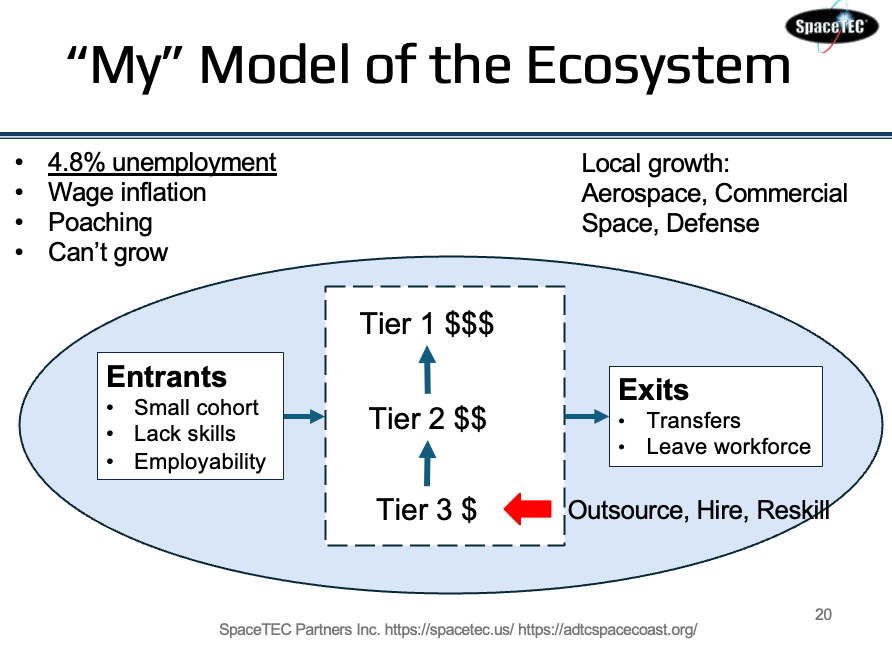
Indeed, a recent Aerospace Industries Association (AIA) report cited concerns about the shortage of parts and the decline of parts manufacturers, its two top findings after surveying the industry, according to a report on how workforce shortages are stunting industry growth in Leeham News and Analysis.
McCullough argued the advantages of the training delivered by ADTC go far beyond saving recruiting and onboard costs, but builds capacity and resilience, retains institutional knowledge, becomes a pipeline for future leaders.
“It signals the company will invest in the talent it already has,” he explained. “It improves employee morale and it reduces attrition. Our goal is to maximize the value of the workforce development strategy. Reskilling from within is best overall value for the employer looking for lower-cost alternatives without sacrificing quality and performance. Promoting from within ensures that open roles are filled by people who already understand the company’s mission, values and operating environment. The goal is to keep the machines running.”
ADTC not only develops the skills training needed but a new training model for the aerospace community, that not only saves recruiting and onboarding costs but is a faster route from training to the production line. Funded by a grant from Florida Commerce, ADTC is just one arrow in the state’s quiver to address the needs of its employers. Indeed, the Florida Atlantic Workforce Alliance surveyed companies on the east coast of the state and identified four key areas in need of workforce training and delivery – aerospace, defense, aviation, manufacturing and cybersecurity. Turns out it’s no different across the state nor, indeed, the rest of America.
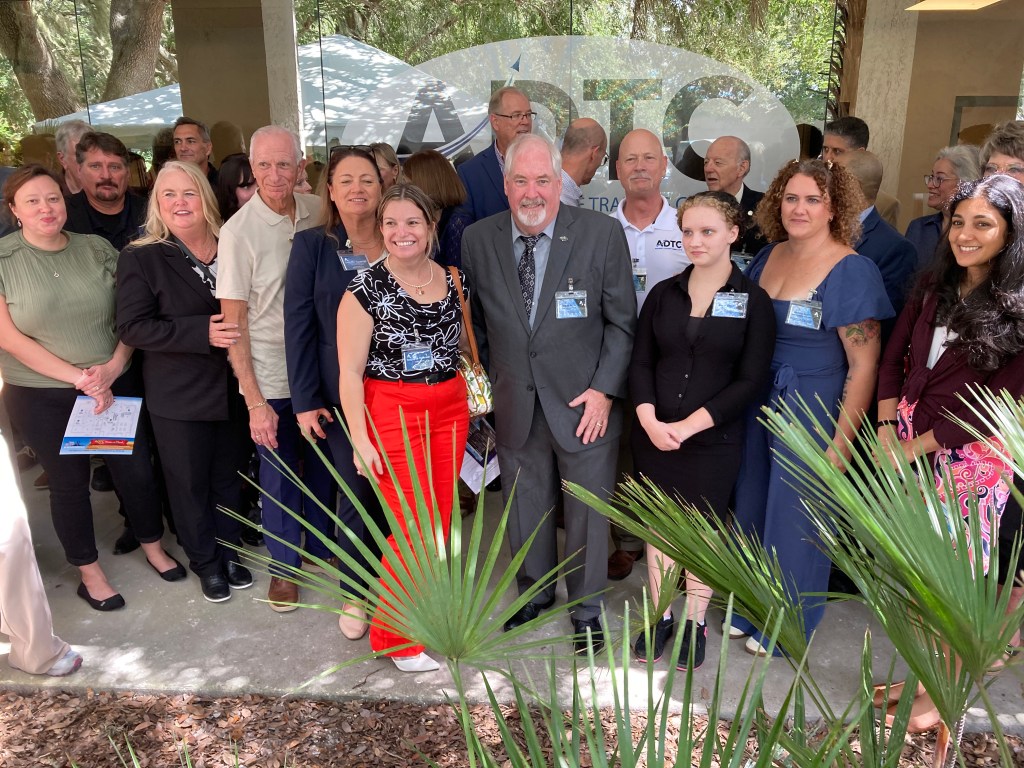
A tour of the ADTC facility in Titusville, FL, which opened earlier this year, meant weaving through manufacturing processes that can produce a trained employee in a few weeks. The specialty training includes certified aerospace technician, aerospace coatings specialist, aviation structures, basic composites, basic and advanced electricity and electronics all to the specification of such professional organizations as the Precision Metalworking Association for metal forming technicians. It also follows the American Society for Testing and Materials guidelines for nanotechnology including fabrication, as well as aircraft electronics technician, aerospace aircraft assembly, unmanned aircraft system maintenance and aircraft electrician training in the electrical wiring interconnection system.
The program is part of the Space Coast Consortium Apprenticeship Program (SCCAP) which includes 20 Space Coast employers and combines paid, on-the-job training and classroom instruction through Eastern Florida State College.
The training is short term, accelerated and targeted and blends online instruction with hands-on experience leading to industry-recognized certifications. The employer then provides on-the-job mentoring. Special emphasis is placed on manufacturing essentials including machining, blueprint and GD&T as well as composites and cybersecurity.
As the world worries about AI, a new industrial revolution is at hand…one based on skills.
ADTC is part of a broader initiative called SpaceTEC, a National Resource center for Aerospace Technical Education, providing skill-based, nationally recognized professional certifications for the U.S. Aerospace Industry. It includes a Schools to Space Program.

