
By Kathryn B. Creedy

Those are the words of Katherine Moloney, CEO, Ellevate (her) Aviation as she was speaking to Shaesta Waiz on her powerful Aviate Podcast. The discussion was a game changer for me because it raised so many issues being discussed on LinkedIn and in the halls of the recent Women in Aviation International conference. The podcast link is below is here: Aviate with Shaesta and Katherine Moloney
While Ellevate (her) is European focused, it is expanding into Africa and just opened a Middle East office, spreading the support for women in aviation far afield from its British roots.
The discussion was about aviation design of uniforms and of aircraft, something I learned about during Jessica Rutterber’s presentation at WAI. While I’ve long complained about uniforms along with pilots and aviation maintenance technicians, I never thought of aircraft design, unless I was hitting the head on a commercial aircraft. Yeah, you know what I mean.
“Research we’ve done indicates 40% of flight schools do not provide a woman’s uniform, constituting another barrier for women,” Moloney told Waiz in the interview. “In addition, 16% of flight or engineering companies do not have women’s facilities. Those may not seem to be big things in the grand scheme of things, but they say you don’t belong here. When you look at manuals, books and exams they all refer to a pilot as ‘he’ and that contributes to the culture as well. That says you don’t belong. That is your baseline that shows you won’t be equal.”
Why Gender Neutral Terminology is Important
These are just some of the unseen barriers for women, she said, adding the cost of pursuing a career in aviation affects women more because they have half the savings as men.
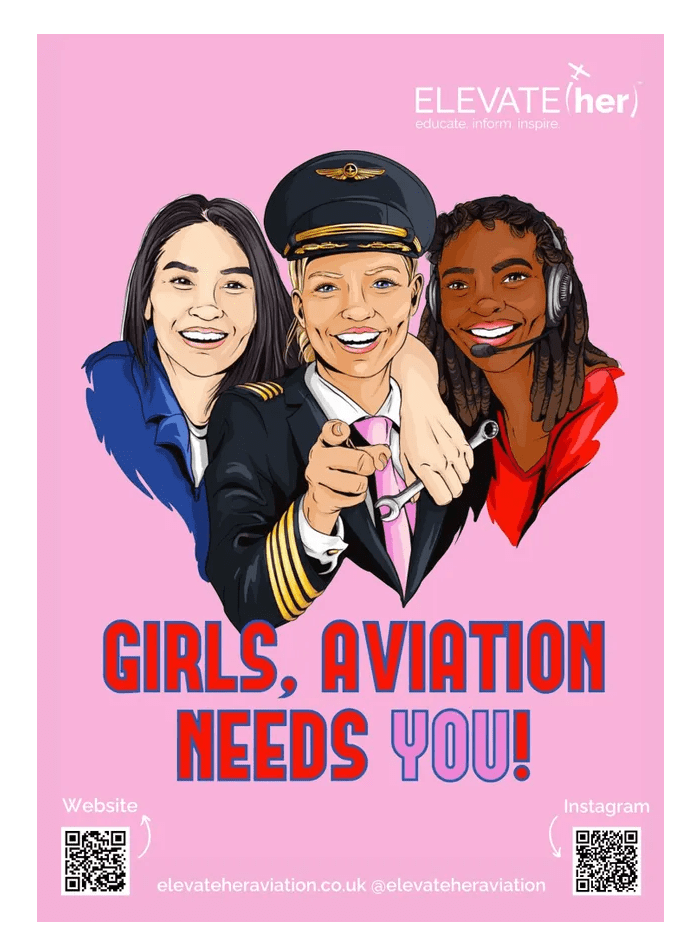
“The gender gap in pay is still 7%, so women start at a disadvantage,” she said. “That’s why they don’t come into the industry, or they leave. All these things add up to you don’t belong here and that’s what we at Elevate (her) Aviation are fundamentally trying to change and it starts with those small things.”
Waiz chimed in saying women start behind the starting line and are always having to catch up. She described her experience with the flight suit saying it was designed for a man. The only time she wore it as she circumnavigated the world in a Beechcraft Bonanza promoting aviation careers to girls, was at press events because it was so uncomfortable and impractical. But Moloney added that ill-fitting clothes are major safety issue which is a familiar refrain to women in the building trades and aviation maintenance.
“Inclusion is not about special treatment it is about different design,” Moloney explained. “Some of the things weren’t built with women in mind. Flight suits, helmets and flight jackets. We should start with the uniform both designing them and providing them for women. We just had a story on our website by Madison Dooley who spoke of how aircraft were not designed for women. Only 6% of women in the RAF fit the physical specifications to even be considered for the role.
How Design in Aviation Affects Women
Rutterber, a former military pilot revealed how few women fit the dimensions to be able to take advantage of more combat roles.
“Currently, the United States Air Force’s aircrew height standards are based on a 1967 anthropometric survey that accounts for only males,” Rutterber reported during her WAI session. “The required standing height of 64 inches to 77 inches and sitting height of 34 to 40 inches is documented in the Air Force Instruction 48-123 and the Medical Standards Directory (MSD). The MSD is used for a flying class physical upon entry into service. Without a waiver, the standing height requirements eliminate 44% of the U.S. female population between the ages of 20 and 29, compared to only 3.7% of males. For minorities, the sitting height requirements eliminate 74% of black females, 72% of Hispanic females, and 61% of Asian females.”
Like Rutterber, Moloney doesn’t think the mismatch between women and safety is willful misunderstanding.
“It really is a lack of information and with more women coming into the industry than ever before, these issues will take on a larger role,” Moloney said.
Elevate (her) highlights Dragonfly Skywear for women.
“In an industry that says it prioritizes safety so much,” said Moloney, “why are so willing to pass up on women being safe? This is crazy and unsafe. There are so many areas that we just need to up our standards. As women we must come together and ask for more. We need to ask for the bare minimum for safety. We need to ask for these things to be designed for us so we are comfortable and so we can do our hobby, our passion or work more safely and effectively.”
And therein lies a huge problem. Culture is a problem for anyone who does not fit the White-male mold. Thus, if we are to change the culture we cannot make the argument just about women. We must consider the safety impact of any non-traditional aviation employee.
Indeed, the problem today is the fact the industry does not recognize this as a safety issue despite leaders and researchers making the case that changing the culture is not a nice thing to have but a pathway to improving aviation safety. Even WAI, last year didn’t link its allyship discussions on the main stage to safety.
Opinion: Male Ally Discussion Very Disturbing with No Mention of Safety – Part One
Opinion: Concrete Steps for WAI and Members to Change the Culture — Part Two
Research an Important Part of the Mission
Women in Aviation International has long been researching the impact of recruiting and retention on women as has Elevate (her) Aviation. Years ago, WAI reached out to the academic researchers including Rebecca Lutte, associate professor/chair in the Embry-Riddle Aeronautical University’s Boeing Center for Aviation and Aerospace Safety, to find out if what men were saying — that women weren’t interested in aviation and aerospace careers — was correct. The WAI study found women were very interested in the challenges represented by our careers but were afraid of the male-dominated culture and rightly so.
Culture was also the top concern in the findings of the Congressionally mandated Women in Aviation Advisory board. But if culture is bad for one consituency within aviation and aerospace, it is bad for them all.
WIAAB Cites Culture as Driving Women from Aviation
Elevate (her) has conducted a number of surveys reporting its findings on its website. Moloney indicated the latest survey is on maternity, one of the biggest causes for lack of retention in the industry, she said. WAI is also interested in work/life balance and each conference has sessions on how pilots and aviation maintenance engineers navigate this rocky road. One of the most important points on how seniority affects women is the fact that, in search of a stable schedule, they opt to remain as captain on a lesser paying aircraft reducing earnings over their entire career.
How Airlines, Unions Hurt Women Pilot Recruitment & Retention – Part I
How Airlines, Unions Hurt Women Pilot Recruitment & Retention – Part II
“If women don’t stay in the industry, there are no role models to show younger women what can be accomplished,” said Moloney. “It’s also very expensive to train a pilot or engineer so it is important to retain everyone.”

Societal Culture Also a Problem
Waiz, whose is Afghani-American discussed how wider societal cultures hold women back.
“The culture in the Middle East puts everything into the oldest boy who gets all the resources for education,” she said. “I’m one of six girls and if my parents had had a boy, I would not have been able to achieve what I have. It breaks my heart see women in the Middle East when they don’t have the backing of family to pursue their dreams.”
Aviation’s Blind Spot: Implicit Gender Bias
But this sentiment is not unique to the Middle East. During the Women in Aviation International conference several Latina women indicated that parents often do not support their daughters’ dreams of pursuing aviation careers because it is outside the cultural norm. In addition to urging girls who have reached the age of majority to pursue their dreams, they urged the industry to talk to the parents as well as the students when they were inspiring them to pursue aviation careers because otherwise parents could be a barrier to these populations joining our industry.
Moloney began the discussion saying we must pivot our thinking and link inclusion to a different design. At a time when some factions are falsely charging aviation safety standards are being lowered to accommodate women and people of color, it is especially gratifying she is pushing for “upping our standards” for safety in an industry that is slow to accept change.
To be successful, we must collaborate with all the groups trying to promote aviation and aerospace careers to Blacks, Latinos, LGBTQ, Asians and Arab Americans. They all have their own groups but we must emerge from our silos to forge a different design.
— 30 —
Coverage of Women’s Issues by Future Aviation/Aerospace Workforce News:
I Love the Smell of a Pregnant Woman in the Morning
Analysis: Building An Equitable Workplace with the Help of Male Allies
 futureaviationaerospaceworkforce.com