
In the first-of-its-kind program, developed in partnership with Denver International Airport, University of Colorado Denver, draws on world-class faculty to deliver experiential courses tailored for aviation executives.
Designed for mid-career aviation professionals. No undergraduate degree required but must have 15- to 20-years’ experience. Scholarships are available.
By Kathryn B. Creedy

Aviation career professionals are facing two key challenges in their quest to rise through the ranks. First is the need to have an edge, to stand out from the crowd. The second is to have an ecosystem-wide approach to management. Both are being delivered by the University of Colorado Denver in a unique learning space at the Denver International Airport’s Center for Equity and Excellence in Aviation (CEEA).
Kicking off in January 2026, the Executive MBA in Aviation is the world’s first degree for leaders and aspiring executives that spans the entire aviation ecosystem; an ecosystem at the cutting edge that will include commercial space and advanced air mobility along with significant changes in how airports, airlines and air traffic control are run.
For the Executive MBA in Aviation the partners are targeting mid-career aviation professionals offering them the opportunity to learn from a curriculum shaped by such aviation leaders as Oscar Munoz, former CEO of United Airlines, Matt Cornelius, EVP at Airports Council International, Rhonda Hamm-Niebruegge, who runs St. Louis Airport, among many other aviation experts.
What is interesting is the industry’s reaction to the development of such an academic program, striking a nerve in what might be missing in aviation leaders today.
“We have veteran professionals approaching us asking how they can help,” Program Director David Chandler told Future Aviation/Aerospace Workforce News. “That positive enthusiasm and talent illustrates the value of what we are building. The people in our first cohort will also be instrumental in building the program, illustrating what we are doing and providing the foundation on which we will build.”
DEN is a good choice given it is the largest single largest economic driver in the Rocky Mountain region and the fact it is the 6th busiest airport in the world. It is also a central location for the students the partners hope to attract from throughout the nation.
Training Industry Leaders
Chandler was careful to define what the new MBA is not. “The Executive MBA in Aviation is designed to replace the way the MBA is taught,” he said. “Fifty years ago, the MBA was for mid-career professionals who wanted to excel in their careers. Today, it is often geared toward people in their twenties who have hardly begun their careers, while corporate training programs are focused on producing better corporate employees. In contrast, this Executive MBA in Aviation is designed to train industry leaders – mid-career professionals who have logged a lot of experience and who want to stretch beyond their function and organizational silos to gain a picture of the entire aviation ecosystem and how it fits together. That is the difference. A well rounded executive needs to embrace as many of these opportunities as they can to advance. The Executive MBA in Aviation takes you outside of the corporate culture and introduces you to people all over the ecosystem. We then weave in a heavy dose of leadership and strategy which is what you need at the senior level of organizations.

“We are trying to produce leaders of the future,” Chandler continued, “with the skills necessary to lead under conditions of ambiguity. We need to address those intangible leadership skills companies are telling us they want employees to have, including the ability to function across disciplines. With our faculty we are focusing on what is needed but not often taught. Skills like the ability to motivate others, comfort with ambiguity and counterintuitive thinking. That is what will build the leadership of tomorrow.
Chandler explained the interdisciplinary approach. “The key ingredient to this coursework is students wanting to learn across disciplines, a more challenging learning experience. However, it increases empathy and respect for other’s opinion and experiences. Students will see the aviation world from multiple perspectives that involve different skills.”
Executive MBA in Aviation
The new program comes as education itself is changing. Given the technological advances driving workforce upheavals, employers can no longer rely on degrees alone. Future careers will be peppered with continuing education requirements to become certificated or credentialed or to upskill, reskill and adapt to new technologies. Many educators see a future made up of stackable credentials for the future workforce. The generational workforce shortages are driving future employees to seek companies who will offer them to upward mobility and education they will require over decades. And, companies must compete for these employees because our workforce shortages are tied more to the birth rate than demographics.

It also comes at a time when many companies from tech giants like Google and Apple to airlines like Delta are no longer requiring degrees at all, leveraging the technological expertise many young people have mastered just as they have grown up with gaming and other advances. A profound change has occurred as parents and students question the value of a college degree given the six-figure costs and the student debt that inevitably follows. Instead, they are opting for skills training, which, in aviation is designed to prepare them for jobs in manufacturing, piloting, aviation maintenance for flight dispatch.
But for executives looking for the next step, this new Executive MBA in Aviation provides an interdisciplinary approach now favored for rising leaders.
Offering a one-of-a-kind learning environment, the university said it puts “students behind the scenes as aviation’s future unfolds through real-time operations and decisions at scale.” The CU Denver Business School will deliver an 18-month hybrid cohort program to enable students to pursue their degree, without career interruption. The Executive MBA in Aviation delivers all the foundational knowledge of a traditional MBA, while immersing students in the interconnected elements that drive aviation: from stakeholder partnerships and strategic communications to regulatory compliance and revenue management.

“In business, you want to be early, smart, and lucky,” said Munoz, who is a member of the program’s advisory board and is also teaching a course in the capstone term entitled Future of Aviation. “To be a part of the very first aviation MBA of its kind in the world – just as we are witnessing a revolution in the aviation industry, much of which is taking place right here in Denver – is the best way to be the earliest, smartest, and therefore luckiest professionals in this exciting frontier moment.”
The Faculty
“These are not ivory tower academics,” Chandler explained, “they are industry professionals, experts in aviation who have come on board saying we need this program. We purposely focused on identifying faculty who understand exactly what the industry needs. CU Denver then provides the administrative support a well-run academic program needs.
“Students will be learning from the top leaders in the field, and they will be exposed to other perspectives besides their own because the future workforce must work across disciplines to be innovative and successful,” he continued. “When you reach the top of your function, you tend to be siloed focusing only on your own area of expertise whether it is finance, operations, economics or marketing. Each role has its own perspective, but the value of the program is learning about the perspectives of all the other functional areas in an organization. To this all-discipline approach, students bring their expertise and their insights within a cohort that draws from the entire aviation ecosystem. That produces a much more valuable classroom conversation. In fact, the more variety of experience we have across the cohort, the better, because students will gain insights into other aspects of aviation and airport disciplines and offer the insights gained from their own experience to group projects.”
Chandler described the experience as enabling mid-career professionals to take the next career step in leadership, no matter what their discipline. This is especially important in breaking the current corporate practices of focusing only on revenue-producing executives to elevate to leadership roles.
“The more unique your pathway in aviation, the more value you add to program,” said Chandler. “It also fosters a culture of learning and respect. We want to source students domestically and internationally, all of whom can gain value from studying for this degree. Initially, we anticipate the most interest from domestic professionals but the goal of the program is to attract students from airports and airlines around the world.
Chandler noted the program was not designed just to meet airport needs. “It is a program that serves the aviation workforce ecosystem as a whole,” he said. “We want students from airports, logistics, insurance, airlines – really the entire supply chain in aviation. We are holding it at an airport for the convenience for those attending nationally and beyond.”
Unique Learning Environment
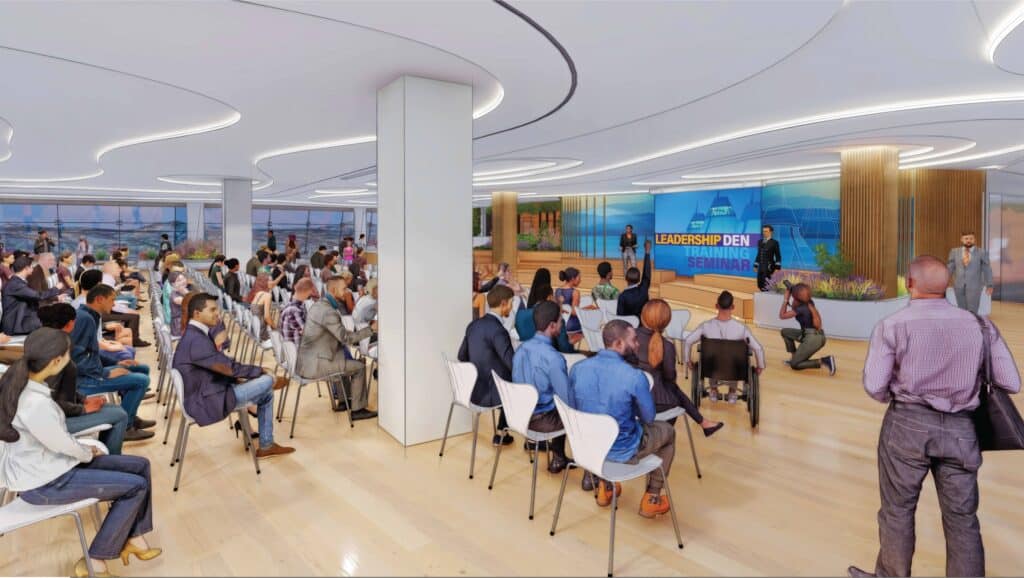
The use of the airport’s CEEA complements the mission of the facility which is designed to address three things needed in aviation workforce strategies including a Business & Development Training Academy, A Career Pathways Program and a Research and Innovation Program.
The vision behind CEEA is making education and research a key airport mission. Airports are like cities and having such programs enhances the experience for students and airport employees.
The Training Academy gives small businesses the information and skills needed to submit proposals and win contracts with DEN in the areas of construction, professional services, goods and services and concessions. The three primary goals of the Training Academy are to create, educate and cultivate an environment where small businesses can grow and connect with other businesses, DEN staff, and industry groups.
Meanwhile, The Career Pathways program offers graduates points of entry, creating an aviation talent pipeline. Career Pathways is a key component of the Center of Equity and Excellence in Aviation mission from engaging, educating and providing opportunities for youth as well as through training and leadership development to all employees. In addition to exposing youth to aviation and aerospace careers, it is also targeted at airport employee career advancement.

The Research and Innovation Lab is designed to be a safe place for learning and trying new things for participants of all ages. The vision of the Research and Innovation program is to be a leading hub of innovation and excellence, driving transformative solutions that shape the future of aviation and airport operations. The lab will provide programming and a network of innovation. In building this lab, DEN was intentional about how it builds equity into the infrastructure of the programming whether it is working with underrepresented students and or growing small businesses test concepts in a real-world airport environment.
Program Components
Generous scholarships are available for eligible candidates, designed to encourage early applications. The degree lasts 18 months, and is divided into eight terms, each containing two courses and lasting for seven weeks. The hybrid approach includes both in-person, online classes, and asynchronous content delivery, to accommodate the schedules of busy managers and executives.
Students will have four, week-long residencies in Washington, D.C. and at major airports around the globe to experience firsthand how different hubs operate, innovate, and drive regional economic growth. The five-day experience will be at major international airports including a partnership with Munich Airport Academy with the other two domestic airports currently being finalized. Given general aviation’s importance to the aviation ecosystem, program orientation will feature a visit to the general aviation airport in Centennial, CO. The fourth residency will be hosted by Georgetown University focusing on the regulatory, ethics, laws and rules in aviation.
Today, aviation and aerospace are struggling with workforce shortages and talent development while universities are struggling to maintain relevance and employees struggle to stand above the fray. This is, perhaps, one unique way to address those issues and could be a model for future professional development in the industries.

 futureaviationaerospaceworkforce.com